A Drone Above the Grand Mosque
Saudi Arabia's red lines—religious, dynastic, diplomatic—converge on one institutional claim: the Custodian of the Two Holy Mosques holds ground that no external pressure can formally concede.
In 1981, a mortar shell fired by Sikh militants struck the perimeter of the Golden Temple in Amritsar - a provocation calibrated precisely because its target was irreplaceable. The logic was not military. It was theological: to demonstrate that no sanctuary is truly safe, and to force the guardian of that sanctuary to respond on terms not of its choosing.
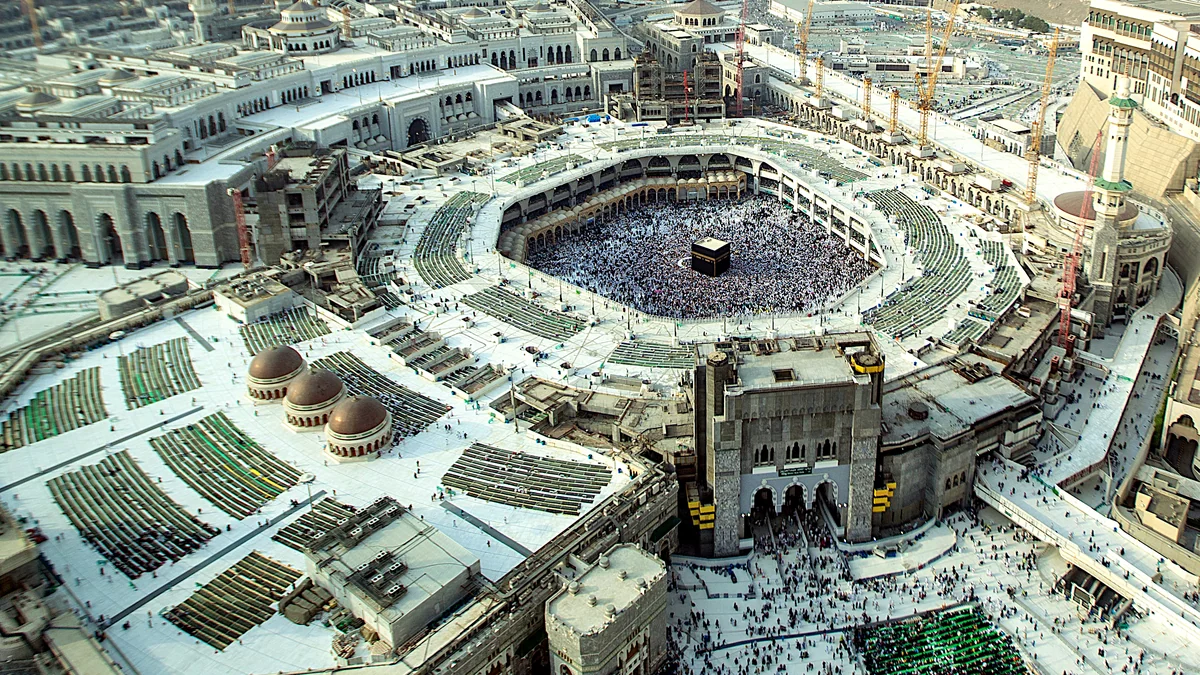
On September 16, 2026, a Houthi drone headed for Mecca was intercepted and destroyed by the Saudi-led coalition, and the logic was the same.
The Saudi Ministry of Defense had issued formal warnings the preceding day, September 15, that an attack on the holy cities was imminent. That the warning came first matters. It transforms the interception from a military reflex into a political statement, staged for an audience that extends well beyond Riyadh or Sanaa.
Coalition spokesperson Brigadier General Turki al-Maliki left no room for interpretive latitude: the security of the two holy mosques and pilgrims is a red line.
The phrase is not rhetorical decoration. For a state whose monarch carries the title Custodian of the Two Holy Mosques, the physical inviolability of Mecca is load-bearing - remove it and the entire structure of Saudi regional authority begins to shift. The coalition has accused the Houthi militia of systematic terrorist activity across a decade of cross-border strikes, but this event belongs to a different category.
Hitting a drone is one thing. Hitting a drone above the Grand Mosque is a signal that the kingdom's inviolable lines have acquired coordinates - altitude, trajectory, a specific date in September. Somewhere in Riyadh, a map was quietly updated.
The Title That Carries the Throne
The official title of the Saudi monarch is not King of Saudi Arabia. It is Custodian of the Two Holy Mosques. That sequencing is not decorative: the title predates the modern state's institutional architecture and carries a claim that no rival can match.
The keeper of Mecca and Medina speaks for the umma, not merely for a country. Every red line the kingdom draws - military, diplomatic, dynastic - runs back to that sentence and derives its force from it.
The physical fact of the kingdom reinforces the institutional claim. Saudi Arabia covers approximately 2,149,690 square kilometres of the Arabian Peninsula, the fifth-largest country in Asia. Scale alone does not confer primacy; plenty of large states are peripheral.
But scale combined with the holy cities and the oil beneath the sand produces a weight that smaller neighbours cannot offset by alignment or rhetoric alone.
Beneath the state runs a social structure that no constitution names. The kinship principle and the extended family remain the bedrock of Saudi organisation - loyalty flows through lineage before it flows through bureaucracy, and the Al Saud's political control has always rested on managing that network rather than overriding it. The Organisation of Islamic Cooperation, headquartered in Jeddah and substantially Saudi-funded, converts this domestic logic into multilateral reach: what the kingdom decides about Islam's governance, it can amplify through fifty-seven member states.
The legal architecture is equally deliberate in its apparent incompleteness. Sharia in Saudi Arabia is uncodified. Judges retain independent reasoning authority - a design that looks like ambiguity but functions as flexibility, allowing the religious establishment to adapt rulings without the monarchy ever having to formally rewrite a statute.
That is the load-bearing wall. Everything else is moulding - pull it and nothing falls.
Three Spheres of Saudi Arabia's Red Lines
The phrase "red line" does a great deal of work in Riyadh. Saudi officials reach for it across three distinct domains - religious, dynastic, and diplomatic - and the word carries a different load in each. Understanding the architecture requires keeping those loads separate.
The religious application is the oldest and the most legible. Turki al-Maliki's declaration after the September 16 intercept - "the security of the two holy mosques and pilgrims is a red line" - draws on a century of Hashemite rivalry, Wahhabi compact, and custodial theology. The diplomatic extension follows a recognisable logic: Saudi Arabia has stated that the Al-Aqsa Mosque's status quo in Jerusalem constitutes a religious red line beyond the Yemen file, linking the defence of sacred geography in the Hejaz to sacred geography in Palestine.
Both claims rest on the same institutional foundation - the Custodian's title carries obligations that reach Mecca, Medina, and, by assertion, Jerusalem.
The dynastic application is newer and worth examining closely. Adel al-Jubeir, Minister of State for Foreign Affairs, has stated flatly: "Our leadership is a red line." The referent is the King and the Crown Prince - persons, not offices.
The shift from protecting pilgrims to protecting the person of Mohammed bin Salman is a rhetorical escalation. Whether it is a load-bearing wall or decorative moulding is the practical question: states have absorbed attacks on sitting leaders before, and the world did not end. What it tells the reader is that the vocabulary of sacred obligation has migrated from geography to biography - and that migration has a direction worth tracking.
For a state whose monarch carries the title Custodian of the Two Holy Mosques, the physical inviolability of Mecca is load-bearing - remove it and the entire structure of Saudi regional authority begins to shift.
The Palestinian Condition
Faisal bin Farhan Al Saud has said it plainly: the creation of a Palestinian state is the only path to regional stability. It is not a talking point. It is the price list.
Saudi Arabia will establish no diplomatic relations with Israel until a Palestinian state exists within the 1967 borders, with East Jerusalem as its capital and Israeli forces fully withdrawn from the Gaza Strip.
The 1967 line is not chosen arbitrarily. It is the last internationally recognised territorial demarcation before the Six-Day War rewrote the map, and Riyadh treats it as the floor below which no negotiation begins. East Jerusalem carries its own specific weight: Al-Aqsa Mosque, the third holiest site in Islam, sits there, and the Custodian of the Two Holy Mosques cannot publicly concede its status without fracturing the Islamic legitimacy the title is designed to project.
Gaza is the current pressure point. Washington has pressed Riyadh to separate normalisation from the Palestinian question, to sequence concessions, to find interim arrangements. The Saudis have declined.
Total Israeli military withdrawal from Gaza is listed as a prerequisite, not a subsequent step. A deal signed before that withdrawal is a deal Riyadh calculates it cannot sell inside its own sphere.
The framing itself is instructive. Bin Farhan does not speak of Palestinian rights as a humanitarian obligation. He speaks of regional stability as a structural requirement - a deliberate register that addresses the American argument on American terms, converting a moral claim into a strategic one.
Watch the language in any joint communiqué between Riyadh and Washington. If the text says Israel shall withdraw, someone has conceded something real. If it says should, the Palestinian condition remains exactly where it is.
Oil as Sovereign Doctrine
Riyadh applies the same vocabulary to barrels that it applies to pilgrims. Energy policy, and the specific right to regulate production through OPEC+, is declared a sovereign red line: no outside interference, no negotiation, no concession to Washington's periodic requests to pump more in order to cool inflation or punish Moscow.
The language is not accidental.
What Mecca is to religious legitimacy, the oil price floor is to fiscal sovereignty. One underwrites the monarchy's claim to spiritual authority across the Islamic world; the other underwrites the state budget, the social contract, and consequently the throne itself. Strip either and the architecture shifts.
The contrast with smaller producers is the instructive one. Nations that surrendered pricing autonomy to external pressure - whether through IMF conditionality or bilateral arm-twisting - found that the concession was never singular. Saudi Arabia has watched that pattern and drawn its conclusion.
The word "non-negotiable" travels across all three spheres of the red-line doctrine with identical weight, which is either a coherent strategic posture or a considerable bet that coherence alone deters.
The Marker to Watch
Three red lines, then. Religious. Dynastic. Diplomatic. The structural question is which of the three can bear actual weight if Washington decides to test it seriously, and which is painted on.
The first two are close to irreversible. No Saudi ruler survives a credible accusation of having bargained away Mecca's sanctity, and Adel al-Jubeir's declaration that the leadership is itself a red line reflects a dynasty that has made personal security a matter of state doctrine. These are load-bearing.
Pressure them and something structural collapses, not the regime's reputation but its architecture of legitimacy.
The Palestinian condition is the exposed line. Faisal bin Farhan has stated it in plain language: a Palestinian state on 1967 borders, with East Jerusalem as its capital, as the price of normalisation. Under sustained American and Israeli pressure, conditions have a way of softening without formally disappearing - the verb changes and the position is technically maintained.
That is where the repricing happens, if it happens at all.
The marker to watch is specific and readable. When the next Saudi-US joint communiqué on Gaza is issued, locate the sentence about Palestinian statehood and read the operative verb. If it says the parties shall work toward Palestinian statehood, the condition survives.
If it says should, Saudi Arabia's red line on Palestinian statehood will be back on your screen before the year is out - under a different headline.