
Before the Pipeline: The Escalation Sequence That Made September 11 Predictable
The Gulf shadow war's new front opened not with a declaration but with a ledger entry that keeps getting passed over: a school near Bandar Abbas. The strike in late February 2026 killed approximately 170 people, most of them children. The communiqué kept that line small.
The ground had been prepared the previous summer. In June 2025, Iran fired more than 550 ballistic missiles and a thousand drones in what analysts would call the Twelve-Day War — a name that itself requires interrogation, since wars that last twelve days have a way of resuming. The scale was the signal. Tehran was demonstrating not capability alone but willingness to spend it. That distinction matters when you are trying to calculate what comes next.
What came next was Operation Epic Fury on February 28, 2026. Approximately 900 strikes in the first twelve hours, launched by U.S. and Israeli forces following the collapse of nuclear negotiations. The immediate trigger was diplomatic; the structural cause was the arithmetic of the previous summer. One of those strikes killed Ali Khamenei.
A leaderless IRGC is not, as some commentary suggested, a weakened one. It is a decentralised one. When the apex authority disappears, the constituent commands do not wait for a successor to form a doctrine; they execute the retaliatory architecture already in place, each node authorising itself.
Ali Larijani moved into the vacancy at the political level, but the IRGC does not take its operational orders from the political level. That is the load-bearing wall. Everything else is moulding — pull it and nothing falls.
The Bandar Abbas school belongs on the same ledger as Epic Fury's 900 strikes — not as equivalence, but as record. Both entries were made in February 2026. The September 11 pipeline shutdown is a downstream consequence of that ledger, not a new chapter.
Larijani's Inheritance: The Hormuz Closure as Opening Doctrine
Ali Larijani assumed de facto control of a state already at war, which is a different thing from inheriting a state and choosing a war. The distinction matters because it forecloses the transitional-strongman theory — the comfortable Western read that a new leadership might seek an off-ramp. What an interim authority in Tehran could offer, in the spring of 2026, was not moderation. It was continuity of action while the question of permanent succession remained unanswered.
The IRGC Navy's formal closure of the Strait of Hormuz on March 27, 2026, to vessels linked to the United States or Israel carried its own legal fiction: selective closure, port by port, flag by flag, administered by gunboat. The law of the sea does not permit it. The IRGC enforced it anyway, and 2,000 merchant ships and 20,000 seafarers stranded in the Persian Gulf are the empirical footnote. Whether a court later rules the closure illegal is a question for peacetime; the cargo does not move while the case is pending.
What the evidence does not yet settle is whether the retaliatory architecture under Larijani is more decentralised than Khamenei's proxy management or simply its continuation under a lighter hand. The Hormuz closure is a formal state act, which argues for central coordination. The drone strikes from Iraqi territory are a proxy act, which argues for distributed reach. Both things happened. That they coexist is either a doctrine or a contradiction, and the March 27 order is too early to read as proof of either.
Twenty Thousand Seafarers and One Hundred Dollar a Barrel
Count the ships first. As of September 2026, approximately 2,000 merchant vessels sit idle in the Persian Gulf, carrying roughly 20,000 seafarers the IMO monitors but cannot move. The Hormuz closure, formalised by the IRGC Navy on March 27, is not a blockade in the classical sense — it is institutional paralysis dressed in naval uniform, and the distinction matters because paralysis has no clear surrender condition.
The sequence that pushed Brent crude above $100 a barrel had its own tit-for-tanker logic. On September 8, Iran captured a U.S. uncrewed underwater drone near the Strait of Hormuz — a provocation calibrated for deniability, the kind of move that produces an incident without requiring a signature. CENTCOM's answer, delivered the following day, was five Iranian oil tankers destroyed in the Gulf of Oman, following missile attacks on a U.S. warship. Each exchange is proportionate enough to avoid the headline "war" and consequential enough to keep the price above the round number that signals market panic.
One hundred dollars per barrel is not a price signal. It is the market's valuation of institutional paralysis — the spread between a world where Hormuz functions and the world that has existed since March.
One hundred dollars per barrel is not a price signal. It is the market's valuation of institutional paralysis — the spread between a world where Hormuz functions and the world that has existed since March.
Shipping companies are repricing war-risk premiums, cargo insurers are building in Gulf surcharges, and the vessels that do move carry the cost of every vessel that does not. The twenty confirmed seafarer deaths since the blockade began do not appear in the commodity index. The IMO monitors their welfare; the futures market monitors the barrel. These are not the same ledger, and the gap between them is where the practical cost of this conflict actually lives.
Bosaso to Bab al-Mandab: The Gulf Shadow War's Western Jaw
In July 2026, the Houthis announced a Saudi naval blockade and began striking Saudi-flagged tankers in the Red Sea. The eastern jaw of the pincer was the IRGC Navy holding Hormuz. This was the western jaw closing.
The geometry had been prepared quietly, well before anyone in Riyadh named it a blockade. In mid-2025, UAE-linked proxy activities were traced to Bosaso airport in Puntland, Somalia — the Horn of Africa functioning not as a theater but as a rear logistics node, the kind of detail that appears in one regional outlet and then disappears into the wire's silence.
Bosaso is a small port town on a thin coast. What moves through its airfield does not announce itself.
That rear logistics architecture connects to a broader evasion economy. The EU has blacklisted over 630 shadow fleet vessels used by Iran and Russia to circumvent price caps — tankers with flags of convenience, ownership chains routed through four jurisdictions, insurance documents that technically exist. The list is real. Enforcement is a separate question, and the gap between those two things is where the oil moves.
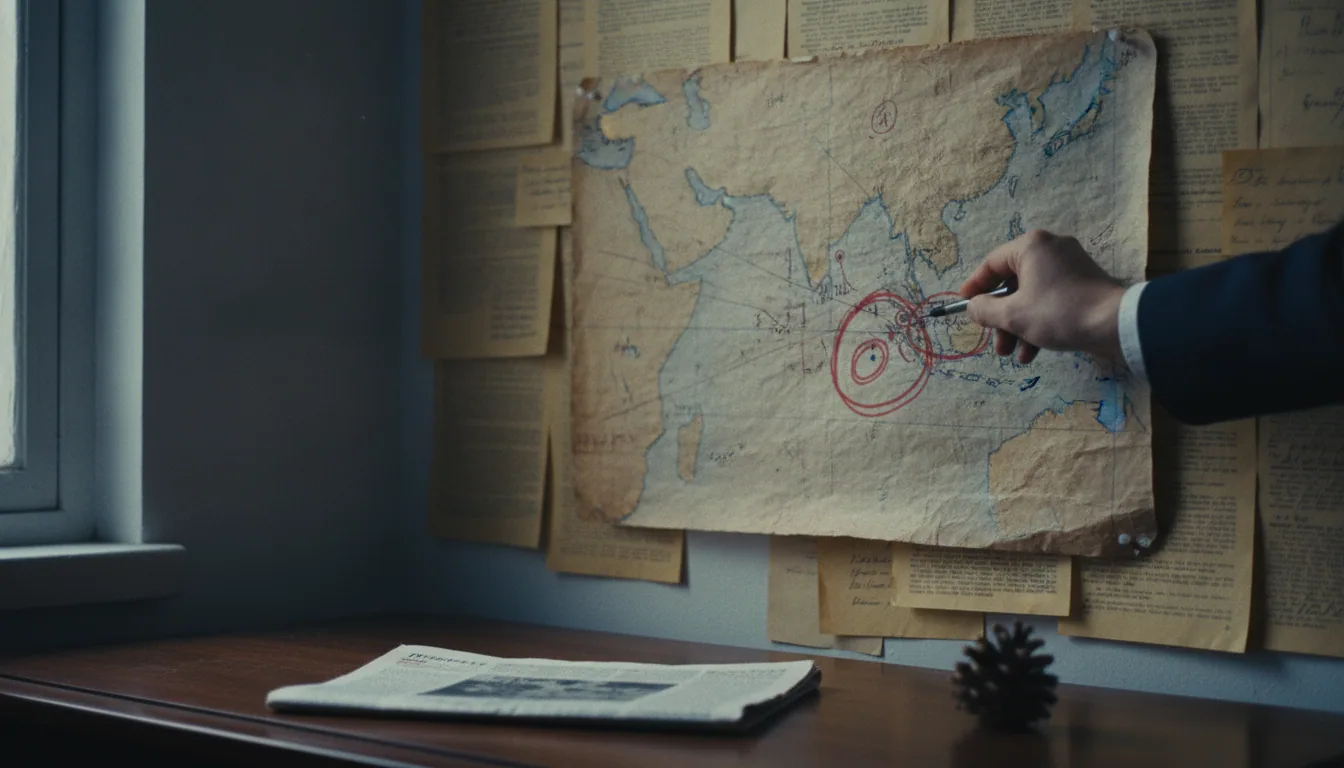
The Red Sea blockade is not a surprise, read against this sequence. It is the activation of a capability that was being assembled in plain sight — through Bosaso, through the shadow fleet, through years of Houthi maritime operations that Western coverage treated as a Yemeni civil-war subplot rather than a forward component of Iranian strategic depth. The Arabian Peninsula now faces pressure from two maritime directions simultaneously. The corridor between them — overland, through Saudi Arabia — is exactly where the pipeline runs.
The Bypass That Was Not: Iraq, the East-West Pipeline, and the Limits of Redundancy
The East-West pipeline was built on a specific argument: that Saudi Arabia need not run every barrel through the Strait of Hormuz. The logic held for decades. Route the crude from the eastern fields westward overland, load it at Red Sea terminals, and the chokepoint loses its leverage. It was the geopolitical equivalent of a second staircase.
On September 11, 2026, Saudi Arabia shut the pipeline down as a precaution after drone strikes targeted the Riyadh and Madinah regions. The drones came from Iraqi territory. This is the point worth holding: not the Persian Gulf, not the Strait, not any theater where the IRGC Navy operates with declared intent. The bypass was struck from behind.
The 1979 comparison — the one about infrastructure as a strategic liability in revolutionary war — is tempting and largely wrong. What happened here was not ideological seizure but geometric encirclement. The pipeline's design assumed the threat remained maritime and eastern. Proxy reach from Iraqi soil invalidates that assumption entirely.
What Riyadh has not said matters as much as what it has. The Saudi Ministry of Foreign Affairs confirmed injuries and unspecified damage "currently being addressed." The exact toll on internal pumping stations, the precise casualty count, the operational timeline for restoration: none of this is public. A shutdown described as precautionary may conceal something structural, or it may not. The silence is the gap in the ledger.
The second staircase is closed. Whether it is burned or merely locked remains, for now, Riyadh's answer to keep.
The One Number to Watch
Not the price. Brent at one hundred dollars a barrel is a symptom, legible enough, but symptoms do not tell you whether the body recovers or reorganises permanently. The number that matters is simpler: whether Riyadh restores flow through the East-West pipeline before or after it secures credible air-defence coverage of the overland route.
If the pipeline restarts without that coverage, the shutdown of September 11 was a pause. If Riyadh waits for the defence architecture first, the market should read it as a structural admission — that the bypass designed to outlast Hormuz has itself become a front.
The second variable is Iraqi government silence. Baghdad has not formally attributed the drones. That silence is not diplomatic ambiguity; it is the load-bearing function of the proxy-deniability structure. The moment Baghdad speaks, Washington's threshold question becomes answerable, and the architecture Tehran has spent six months building begins to collapse or to harden. Watch for a statement, and watch its verbs.
The third is winter. If the Hormuz closure holds through December, this Gulf shadow war is not a crisis. It is a reorganisation. The evidence, as of now, forces that conclusion to remain open — which is the most uncomfortable thing the evidence can do.