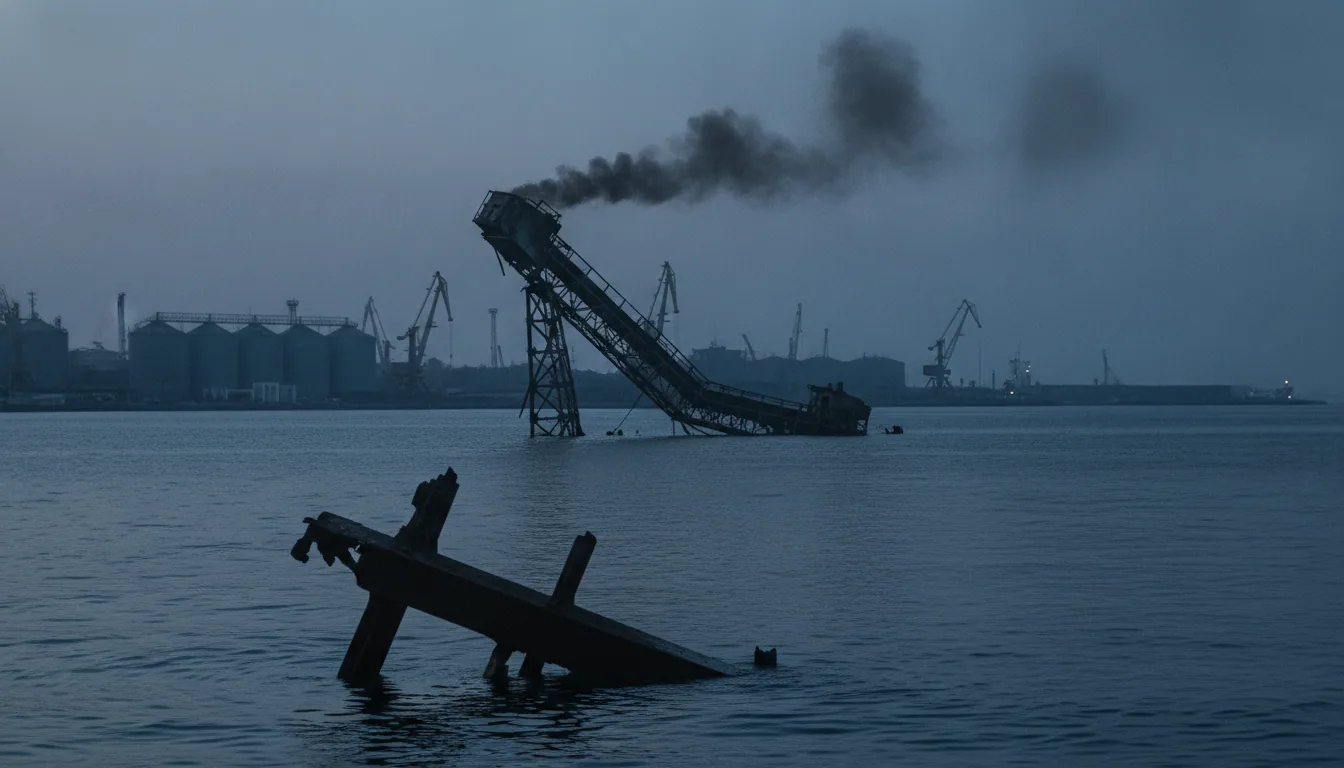
The Strait That Was Always the Load-Bearing Wall
Bab el-Mandeb — the Gate of Grief — is 29 kilometres wide at its narrowest point. Before the escalations of 2024 began compounding into the crisis of September 2026, the Red Sea corridor it anchors carried 12 to 15 percent of global trade. That is not a statistic about shipping; it is a statistic about the load-bearing structure of the world economy. Pull the linchpin and you do not slow the system. You redesign it, expensively and under pressure.
In 1973, the oil embargo taught a generation of planners that the path between a barrel and its buyer was a political fact, not a logistical convenience. The lesson was absorbed, set aside, and absorbed again. The geography, however, did not change.
Saudi Arabia's East-West pipeline — the Petroline, 1,200 kilometres of buried infrastructure — was built precisely to ensure that if the Strait of Hormuz closed, crude could still reach the Red Sea. It was an answer to one chokepoint, running straight into the throat of another. By September 2026 the answer had become part of the question. The Suez Canal, the northern exit of the same corridor, had already recorded a 57.5 percent collapse in transit volume against late 2023 levels. Two chokepoints on a single supply chain do not compound arithmetically — they compound the way vulnerabilities always do: faster than the spreadsheet predicted, and all at once.
Two Closures, One Morning: Mokha, Mayun, and the Pipeline
The sequence mattered as much as the events themselves. By September 11, 2026, Houthi forces had seized both the Port of Mokha and Mayun Island, the small volcanic outcrop that sits in the Bab el-Mandeb's narrowest channel like a cork in a bottleneck. Control of Mayun is control of what passes beneath it. The announcement came with a precision the earlier years of Red Sea attacks lacked.
That precision was the point. The Houthis declared a Saudi-only blockade, asserting that international trade remained safe while any vessel affiliated with Riyadh was a legitimate target. The legal and commercial logic of this distinction is interesting — and largely irrelevant, because maritime insurers do not price geopolitical claims; they price risk corridors. A strait declared hostile in any direction is a strait that costs more to transit.
The same morning, the Saudi Energy Ministry shut down the East-West pipeline as a precautionary measure. The Petroline runs 1,200 kilometres from the Eastern Province to Yanbu on the Red Sea coast, and its original purpose was to ensure Saudi crude could reach export terminals if the Strait of Hormuz were ever closed. The irony writes itself in a Ministry communiqué: the redundancy route, built against one chokepoint, now suspended because of pressure on another.
This did not arrive without warning. Houthi strikes on the Jazan refinery and Abha International Airport in July and August 2026 were not indiscriminate harassment. They were range-finding, establishing that Saudi fixed infrastructure inside the kingdom's own borders was reachable. The September seizures were the conclusion of a campaign, not an escalation of one. Somewhere in Riyadh, a map was quietly redrawn.
A Saudi-Only Blockade and the Coherence of Maritime Law
The Houthi declaration was precise in its legal ambition. Vessels affiliated with Saudi Arabia are targets; all other international trade, the announcement said, passes freely. The distinction sounds surgical until a shipping firm's legal department tries to define "affiliated" against a war-risk clause.
That is the practical problem. Global carriers now face a binary they did not choose: maintain Saudi commercial partnerships and absorb elevated war-risk premiums, or quietly shed those relationships and hope the passage stays clear. Neither choice is neutral. Maritime insurance rates have climbed on all routes, not only Saudi ones, because the market prices uncertainty rather than declarations.
The deeper question is whether a selective national blockade — one that exempts most flags while targeting a single state's commercial network — can survive contact with the law of the sea. International maritime law does not easily accommodate the concept. A lawful blockade must be declared, effective, and non-discriminatory toward neutral shipping. The Houthi formulation fails the last test by design. That legal incoherence does not make the physical threat less real. Ask the underwriter covering a Jeddah-bound container vessel what theory of maritime law governs his premium: he will quote you a number, not a convention.
Somewhere in the gap between the legal argument and the freight rate, the practical calculation settles. Carriers are already re-routing. Suez Canal transit volume fell 57.5 percent from late 2023 levels before September's events added fresh weight to that number. The blockade need not be legally coherent to be commercially effective. That asymmetry is the point.
Washington Offers Intelligence, Not Strikes
The phone call between Riyadh and Washington in the days after September 11 did not go the way Mohammed bin Salman had wanted. Trump refused the Crown Prince's request for military strikes against Houthi positions. What the White House offered instead was intelligence support — sharper eyes, not armed hands. The outer limit of the American commitment had been drawn, quietly, in a single exchange.
This was the fracture beneath the fracture. For decades the arrangement had been understood by both parties without needing to be written down: oil flows, and the flag follows. The kingdom exports hydrocarbons; Washington provides the security architecture that keeps the lanes open. September 11 did not break that sentence — it changed the verb. The guarantee had become conditional, and the condition was someone else's war.
Saudi Arabia moved fast to fill the gap it now knew existed. On July 30, 2026, the kingdom convened 43 nations in Riyadh to build a defensive maritime coalition, a gathering that was itself a kind of message — a formal acknowledgment that Riyadh could no longer assume the cavalry would come. Forty-three nations in a conference room is an impressive photograph. It is not a carrier strike group.
The security-for-oil arrangement that anchored Gulf order for two generations rested on the assumption that an attack on Saudi energy infrastructure was an attack on American interests. That assumption now requires evidence. Somewhere in the margin of the diplomatic record, a clause that everyone once treated as automatic has been quietly downgraded to discretionary.
The blockade need not be legally coherent to be commercially effective. That asymmetry is the point.
The $7 Billion Rail Line and Saudi Infrastructure Built to Bypass a Sea
The honest comparison is this: the Saudi Landbridge is not an innovation. Every continental power that has ever found a sea lane threatened has reached for the same answer. The Habsburgs built roads over the Alps when Venice controlled the Adriatic. The Soviets laid rail east of the Urals when the western ports became untenable. The question is never whether the overland corridor works in principle. The question is whether it works before the crisis bankrupts you.
Riyadh is betting $7 billion that it will. The Saudi Landbridge, 1,500 kilometres of rail connecting Jeddah on the Red Sea coast to Dammam on the Gulf, has been under construction since 2025. Spanish engineering firm Sener received the design contract in April 2026 — a detail that is less about Spanish expertise than about the pace Riyadh now needs to maintain. The targeted transit time across the peninsula is ten hours. That is the number to hold in mind: not as a promise, but as the load-bearing assumption behind every other calculation in Saudi Vision 2030.
The rail line does not stand alone. In July 2026, Mawani announced a SR 641 million investment to expand cargo capacity at Jeddah Islamic Port — the western terminus that the Landbridge must feed. King Abdullah Port, on the eastern coast, is targeting 25 million TEU. And Terminal 1 of the Port of NEOM is scheduled to open in late 2026, positioned explicitly as a bridge port toward Europe.
The architecture has a coherence to it. That coherence is also its vulnerability. Each project assumes the others will be finished on time, and each assumes that the threat justifying the whole undertaking will remain legible enough to sustain the political will. The Habsburgs' Alpine roads outlasted the Venetian republic. Whether Riyadh's rail line outlasts the current Houthi command structure is a different order of question entirely — and no spreadsheet resolves it.
Amaala at the Edge of a Conflict Zone
Al Wajh Airport reopened on May 24, 2026, following a modernisation programme managed by Red Sea Global. The runway serves a coastline where Phase 1 of the Amaala luxury tourism project is on track for a Q3 2026 opening. Both facts belong in a brochure. Neither belongs in a geopolitical assessment without a hard annotation.
The arithmetic is worth stating plainly. Billion-dollar resort construction is proceeding on the same Red Sea littoral where an active naval blockade has reduced Suez Canal transit volume by 57.5 percent since late 2023. War-risk insurance premiums are rising. Houthi forces struck Jazan and Abha in July and August 2026. Amaala is not Jazan, but the Red Sea does not carry separate risk registers for luxury and logistics.
The single contradiction Vision 2030 must resolve is structural, not cosmetic. A tourism economy requires a stable security environment — one that Saudi Arabia cannot, at this moment, guarantee without Washington's kinetic commitment, and Washington has declined. Watch the first Amaala booking numbers released after Q3 opening: if they are withheld, the brochure has already answered the question. The Red Sea chokepoint is not a shipping problem Saudi infrastructure can simply build around. It is a sovereignty problem, and the $7 billion rail line, the expanded port capacity, and the luxury coastline all sit in its shadow together.