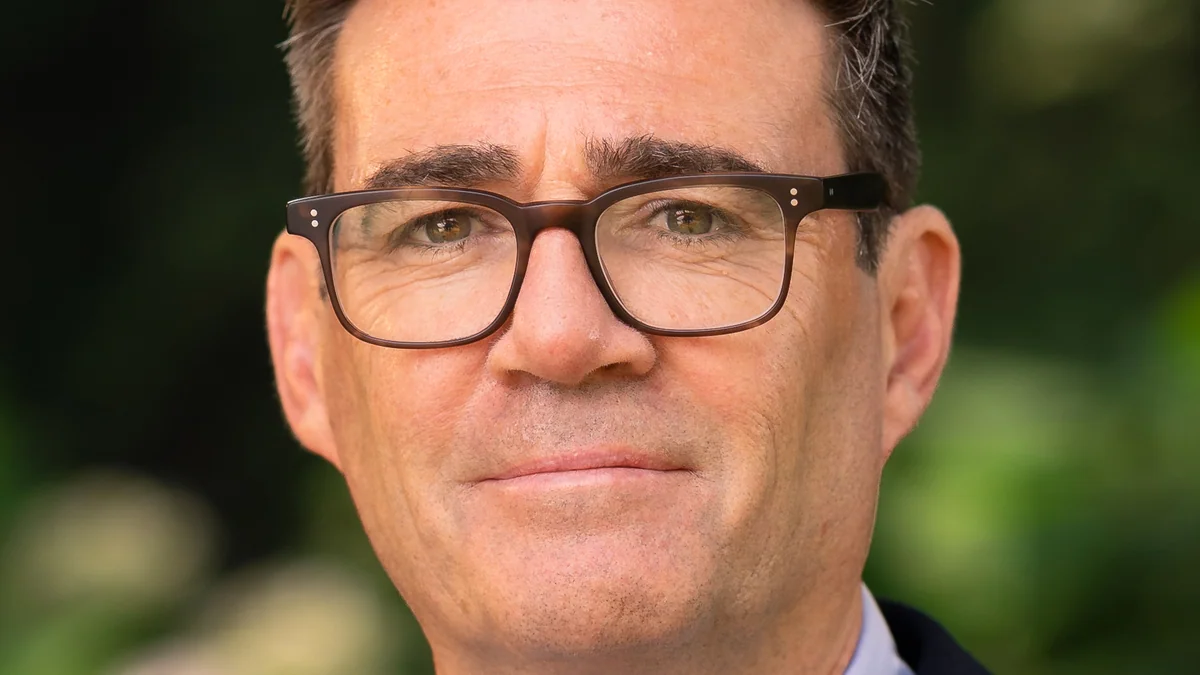
Andy Burnham's October 2026 declaration of openness to a formal British slavery apology — announced forty-eight hours before CHOGM opened in Antigua — is a structural response to accumulated diplomatic pressure, not a moral conversion. The reparatory debt stands at £18.6 trillion. The word "open" is doing considerable work.
The Sum Before the Summit
The Maastricht Treaty was signed in February 1992. Three days before the ceremony, the Dutch foreign ministry quietly updated the agenda for the forty-first time. No one called it a concession. The word used was "clarification." That habit — of timing announcements to diplomatic calendars and labelling the result a principled evolution — has not grown old.
On October 30, 2026, Andy Burnham stated he is "open" to a formal state apology for Britain's role in the transatlantic slave trade. The announcement came forty-eight hours before the Commonwealth Heads of Government Meeting opened in St. John's, Antigua and Barbuda, on November 1. The proximity is the argument.
The baseline from which Burnham is departing belongs to Keir Starmer, who in 2024 refused to place reparations on the Samoa summit agenda at all. That refusal held for roughly two years. What moved it was not a moral conversion inside the Cabinet; it was a diplomatic calendar, a host city in the Caribbean, and the legal ground shifting underfoot. In March 2026, the UN General Assembly classified the transatlantic slave trade as the gravest crime against humanity — a classification that upgrades every subsequent evasion from a political choice to a documented one.
Burnham's signal is best read as a structural response to accumulated pressure, not its resolution. Britain enslaved approximately 3.2 million Africans. The Brattle Group's estimate of the resulting reparatory debt stands at £18.6 trillion. Against those numbers, the word "open" is doing considerable load-bearing work for a very small word. The summit has not yet begun, and already the communiqué is being drafted around what will not be said.
What the Ledger Actually Records
Britain transported approximately 3.2 million Africans into chattel slavery. That number is the load-bearing fact beneath every diplomatic formulation in Antigua this week — strip away the communiqués and the structured dialogues and it is what remains. Everything else is moulding.
The Brattle Group's estimate follows from that figure with the cold logic of compound accounting: £18.6 trillion in reparatory debt, roughly $24 trillion, a sum larger than the entire United Kingdom's GDP by a factor that should end the conversation about whether the arithmetic is serious. London has not disputed the methodology with any published counter-calculation. It has simply declined to engage the number, which is a different thing entirely.
The gap between the moral record and the diplomatic vocabulary is not accidental. A government that acknowledges 3.2 million people as a historical fact while refusing to attach a financial consequence to that fact is making a precise choice about which ledger it will open. The word "apology" has been avoided for decades in Whitehall not from squeamishness but from legal geometry — an admission of state wrongdoing, properly worded, could constitute the predicate for a liability claim that the Treasury has no intention of honouring.
This is what makes the arithmetic matter to Barbados and Antigua regardless of enforceability. The 15 CARICOM nations are not primarily pursuing a courtroom. They are establishing, in the public record, the distance between what Britain owes and what it offers. That distance is now measured. It is £18.6 trillion wide.
The Architecture of Britain's Slavery Apology
Read the sentence Burnham actually used. Not will apologise. Not intends to apologise. "Open to" an apology — a posture, not a commitment, and almost certainly not by accident. A lawyer reading that construction in a brief would mark it as non-binding in the first pass. No obligation attaches. No deadline runs. The phrase is a door left ajar, which is precisely the point: a door ajar generates no cognisable legal claim.
The load-bearing wall was stated plainly alongside it. Direct financial reparations are ruled out. That ruling-out is not a negotiating position to be softened in dialogue; it is the structural element the UK Treasury will not move, because moving it would open the £18.6 trillion question the Brattle Group has already put on paper. Everything else Burnham offered — the "structured dialogue," the "drive on debt-servicing" — is the decorative moulding. Pull it and nothing falls. The architecture remains intact.
This is how a sovereign apology gets engineered. The moral pressure is real, the public polling gives Burnham domestic cover, and the word "apology" will appear in headline after headline. What will not appear is a mechanism. Structured dialogue produces communiqués. A drive on debt-servicing routes through the IMF, where Gordon Brown's initiative will set eligibility criteria on terms the UK helps write. That is not reparation; it is development finance with a change of name. The moral demand is acknowledged, the legal exposure is sealed, and somewhere a spreadsheet was quietly updated to reflect no new liability.
Burnham's openness is a large empire offering to discuss the terms on which it will describe what it did.
The Crown's Separate Account
While Burnham worked the corridor at Marlborough House, a second operation was running on a different track. King Charles III had arrived in the Bahamas on a nine-day tour of the Bahamas, Guyana, and Antigua — three countries where the republican question is no longer theoretical. The timing was not coincidental.
Buckingham Palace's position is precise and, once you read it carefully, quite deliberate. Charles would "reflect" on the slave trade. He would not apologise. The distinction is not semantic refinement; it is a legal firebreak, drawn to separate the monarchy's exposure from whatever the Burnham government eventually commits to in the communiqué.
The Crown carries a liability the elected government does not. An apology from the monarch would implicate the institution in a way that a parliamentary statement, hedged in procedural language and committee timelines, would not. The Palace has watched Caribbean republics accumulate: Barbados in 2021, a referendum pending elsewhere. The tour is designed to slow that arithmetic, not to settle it.
Commonwealth Secretary-General Shirley Ayorkor Botchwey understood this geometry. Her statement that "the time has come" for financial discussions on reparatory justice was addressed, in form, to all parties. In substance, it landed on the Palace steps. She added, with careful understatement, that a formal apology from the British monarch "wouldn't hurt." The Palace's response, issued before Charles had completed the first leg of his tour, was the word "reflect" — chosen with the same care one selects a load-bearing wall over decorative moulding. One holds the structure up. The other simply covers it.
The Borderland's Demands
CARICOM's updated 10-Point Plan for Reparatory Justice is not a wish list. It is a minimum threshold: debt cancellation, return of cultural artefacts, and a formal reckoning with the structural poverty that slavery built into Caribbean economies and then locked in through a century of imperial administration. Measured against that threshold, Burnham's offer of structured dialogue and a drive on debt-servicing is not a response to the plan. It is a rewrite of the plan's terms.
The 60 percent of British voters who told pollsters in March 2024 they supported a formal apology gave Burnham his domestic permission slip. That number matters because it explains the timing, not the substance. A government does not reverse a long-held position out of moral awakening alone; it reverses when the political cost of reversal falls below the cost of holding. The poll cleared the runway. What lands on it is another question.
Gordon Brown's initiative to route debt relief through IMF restructuring mechanisms is the mechanism London is building to absorb the economic dimension without calling it reparations. The architecture is deliberate. Debt-for-development swaps are not the same as reparatory justice, and the CARICOM commission has said so plainly.
Here is the small question that cuts to the bone: who is the borderland, and who is the empire? The answer is not symmetrical. The nations presenting the 10-Point Plan are the ones whose sovereignty, population, and economy were shaped from the outside, by force, across two centuries. Burnham's openness is a large empire offering to discuss the terms on which it will describe what it did.
Watch the Verb in the Communiqué
The CHOGM summit opens in St. John's on November 1. What comes out of it will be printed in a communiqué, and the communiqué will contain one sentence about Britain's formal slavery apology position. Read that sentence carefully — specifically its governing verb. If the text says Britain shall acknowledge the slave trade as a crime and shall pursue reparatory dialogue, something real was conceded in the negotiating room. If it says Britain should consider further engagement, the lawyers won and the diplomats are lying politely. The distance between those two words is the distance between a precedent and a press release.
The evidence already in the record does not favour the stronger formulation. Burnham said he is "open to" listening — not that he will act. The UK Treasury continues to rule out direct financial reparations entirely. The Brattle Group's estimate of £18.6 trillion in reparatory debt has been in public circulation long enough that no official in London is unaware of it; their silence on the figure is the response. Sixty percent of the British public supports a formal apology, which means the domestic political cost of the word shall is low — and yet the government has not used it.
The one thing that would change this read: if CARICOM states publicly accept Burnham's debt-servicing framework as a first instalment rather than a substitute for transatlantic slave trade reparations, the legal architecture shifts and London gains the cover it needs to move further. Watch for that language from Mia Mottley or Sir Hilary Beckles in the forty-eight hours after the communiqué drops. If they call it a beginning, it might be. If they call it insufficient, the verb was should, and this will be back on your screen before the next summit is announced.