Two Sites, One Turning Point: What Actually Opened in 2026
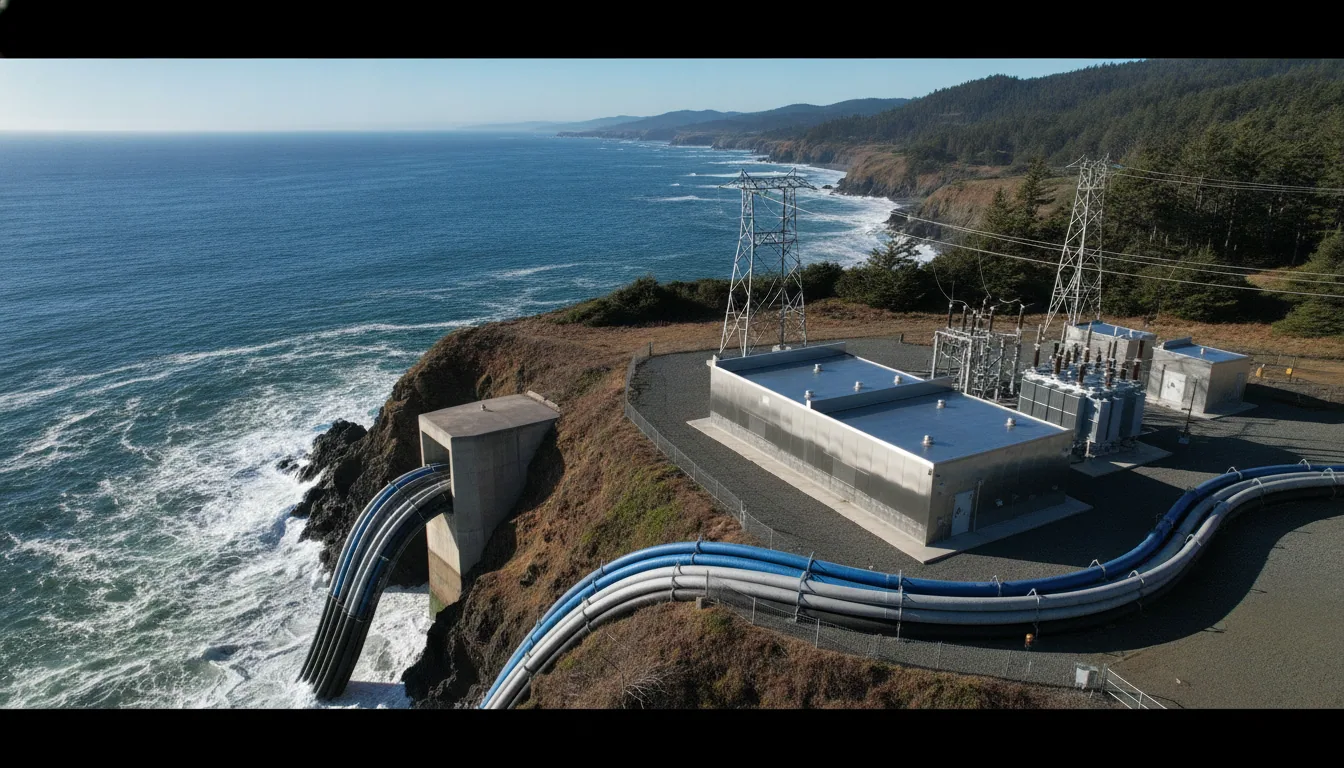
On August 27, 2026, a $150 million ocean wave energy facility on the Oregon coast held its ribbon-cutting and quietly became the most important piece of marine energy infrastructure in the United States. PacWave South is not a power plant. It is something more structurally useful: four grid-connected berths, 20 MW of total test capacity, and — for the first time in the continental U.S. — a pre-permitted site where any wave energy developer can plug in a device without navigating a separate federal licensing process from scratch. That last detail is what the press releases buried, and it is the one that matters.
Pre-permitting is a regulatory shortcut that actually shortens things. Under the old model, each device needed its own environmental review, its own permits, its own years of delay before a single wave was converted. PacWave absorbed that cost once, centrally, so developers inherit the clearance.
The Bonneville Power Administration reinforced the signal in 2025, signing a power purchase agreement to offtake electricity from the site before it even opened. A federal buyer was already waiting for the electrons.
Three months after Oregon cut the ribbon, Scotland delivered the other half of the milestone. In November 2026, the WEDUSEA project — a €19.6 million collaboration — received its marine license to deploy the OE35 at the European Marine Energy Centre in Orkney. OceanEnergy's OE35 is a 1 MW floating wave energy converter, currently the largest capacity floating device of its kind anywhere in the world.
The machine's job at EMEC is not commercial production. It is proof of survivability and grid performance under real Atlantic conditions, with the data going directly to developers, insurers, and utilities who need to know whether wave energy hardware can outlast the ocean it harvests.
Two sites, two regulatory models, one shared question: does the hardware hold.
The Problem That Killed the Last Generation — and How It Is Being Solved
The ocean does not break gradually. It breaks everything at once, without warning, at scales that onshore engineers consistently underestimate. This was the core problem of wave energy's first generation: prototypes that looked credible in a tank test met a winter Atlantic storm and simply ceased to exist. No commercial data. No lessons. Just salt water and scattered debris.
The sector learned the hard way that survivability is not a refinement problem. It is the whole problem. A device that generates cheaply for nine months and then fails costs more than a device that never ran at all, because you lose the capital and the credibility simultaneously.
CorPower Ocean's C4 converter, tested off Portugal, is the clearest public proof point that the engineering culture has changed: the device survived four major storms, with waves reaching 18.5 metres, and kept producing. That number matters: 18.5 metres is not a stress test. It is an ordinary North Atlantic winter. Surviving it is table stakes for any device that wants to be taken seriously.
What 2026 also demonstrated is that the survivability push is now broad, not isolated to one company. Seaturns ran a trial off the Atlantic coast of France in June. AW-Energy's WaveRoller, backed by EU funding through the ONDEP project, began deploying a 2 MW array at Peniche in Portugal, a site with one of the most consistent and powerful Atlantic swells in Europe.
Carnegie Clean Energy completed factory testing on its CETO unit in October, targeting offshore installation in 2027. Each of these programs is generating different data on different device architectures in different sea states. That diversity is the point: the sector is not converging yet on a dominant design, and is running the experiments that will reveal whether one is possible.
What survivability data still cannot answer is the next question: how much does a 1 MW device actually cost to maintain after three years of continuous salt-water exposure? Component degradation rates remain unquantified. That gap will close only with operating time, and operating time requires funding commitments that assume the gaps will close.
It is a rational bet, but it is still a bet.
Running the Numbers: Ocean Wave Energy Output, Scale, and the Gap That Remains
China's 1 MW Nankun device finished its South China Sea trials with peak daily yields exceeding 4,000 kWh. That is a concrete number worth holding onto: one commercial-scale unit, one good day, enough electricity to power roughly 130 average European homes for 24 hours. It tells you what wave power can do — and also, almost immediately, how far the sector still has to travel.
Eco Wave Power's regulatory approval for a 1 MW station at Portugal's Port of Leixões gives the sector another useful data point. One megawatt powers somewhere between 700 and 900 average European homes — useful, real, not transformative. The same company has also signed a Letter of Intent with an undisclosed African utility for a potential 100 MW project.
The contrast between those two numbers is the honest state of the industry in one sentence: approved deployments are measured in single megawatts; the ambition being discussed is a hundred times larger. That gap is not a reason for despair. It is a gap that every maturing energy technology has had to close, and it closes through iteration, not announcements.
China's stated target of 400 MWh of installed ocean energy capacity by 2030 gives the global ambition a fixed benchmark. A 100 MW array would supply a small city. Getting from one approved megawatt to that number requires years of operational data, component refinement, and cost reduction — none of which can be shortcut by a signed letter of intent.
The honest scorecard: the hardware is working at commercial scale, the pipeline of larger projects is real, and the distance between today's approvals and national-grid relevance remains significant.
Beyond Electricity: The Smarter Case for Wave Energy
Picture a government minister in Bridgetown, Barbados, signing a memorandum of understanding with a Danish engineering firm. The document is not only about electricity. It is also about water.
Wavepiston's system, now contracted for a Caribbean trial, would deliver desalinated freshwater alongside grid power — a dual output that reframes what wave energy is even for. If the trial succeeds, Barbados has mapped a path to a 50 MW project that addresses two of the island's sharpest vulnerabilities at once.
That duality is the more interesting story. Wave energy earns its keep fastest where it displaces something expensive. In Barbados, that something is imported fuel and trucked water.
For Panthalassa, which closed $140 million in Series B funding in 2026, the expensive thing being displaced is diesel-powered logistics for offshore AI data centers. The company's Ocean-3 platform positions wave energy not as a municipal grid workhorse but as a power source for high-intensity industries that cannot afford to be tethered to a cable.
Wave energy earns its keep fastest where it displaces something expensive.
The most striking finding, though, comes from researchers at CSIRO and the University of Western Australia. Their 2026 analysis found that hybridizing wave energy with wind and solar could reduce storage costs by 80 percent. The logic is structural: waves and wind are partly correlated, but not perfectly, and wave energy's output tends to persist hours after a storm front passes — smoothing exactly the troughs that force grid operators to overbuild battery capacity.
The pattern across all three cases is the same. Wave energy is not competing with offshore wind on cost per megawatt-hour. It is competing with battery banks, diesel generators, and desalination plants — and winning on that narrower, more honest comparison.
Scale comes from stacking those niche wins, not from waiting for the technology to become cheap in general.
The Honest Scorecard: What 2026 Proved and What It Did Not
Three things are now off the table as open questions. Devices can survive extreme sea states: CorPower's C4 held through 18.5-metre waves in Portugal, and that result will not be argued away. Grid-connected, pre-permitted test infrastructure now exists on two continents, with PacWave South in Oregon and EMEC in Scotland both accepting commercial clients.
The Bonneville Power Administration's offtake agreement with PacWave confirms that utilities will sign contracts before devices reach full scale — a commercial signal that the sector's first generation never received.
Three things remain genuinely unresolved. PacWave South carries four berths and a 20 MW total capacity; whether that figure is realised within three years is uncertain, and the site's operators have not committed to a timeline. Long-term maintenance costs — the slow bleed of corrosion, fatigue, and biofouling across multi-year deployments — remain unquantified for any 1 MW device.
Eco Wave Power's Letter of Intent for a 100 MW project with an African utility is real on paper; the utility's identity and financial seriousness are not public, which makes the number a possibility rather than a pipeline.
The near-term hierarchy of credible scale runs through two project types: hybridised offshore deployments where wave energy pairs with wind or solar to cut storage costs, and island-nation dual-use projects combining electricity with desalination. Both routes have faster cost-recovery paths than standalone grid supply to continental markets. The one number worth watching over the next two years is not installed capacity — it is levelised cost of energy from multi-year trials.
That figure — once it exists — will settle the central question the ocean wave energy sector has been circling: lever, or permanent niche. Engineers and utility procurement teams should build that answer into contracts now, before the boosterism outruns the data.