A Wave Is Worth Money — and Sea Level Rise Is Threatening It
Santa Cruz, California, runs on surf. The breaks there generate $194.7 million for the local economy every year, not from professional contests alone, but from the hotels, restaurants, surf schools, and hardware shops that exist because a particular stretch of coastline bends the Pacific into something rideable. Australia's surf sector contributes A$2.71 billion annually to its national economy. These are not estimates dressed up as facts. They are audited numbers, produced by a field called Surfonomics, which exists precisely because coastal planners kept treating waves as scenery rather than infrastructure.
Now that infrastructure is at risk. A study published October 10, 2026, in the journal Climatic Change, led by Dr. Dan Reineman of CSU Channel Islands and the Save The Waves Coalition, assessed 57 internationally significant surf breaks and found that 79% face medium or high risk from sea level rise — not in a century, but on a trajectory already locked in.
The first businesses to feel it are the ones closest to the water. A surf school cannot pivot when the break it built its reputation on stops breaking cleanly. A beachfront pub loses its off-season trade when the winter swells that used to keep the car park full start arriving on a shelf that is simply too deep. The wave is the product. Change the wave, and the entire downstream economy shifts with it.
The Physics Is Unforgiving: Why Rising Oceans Kill a Wave
A wave does not break because the ocean feels like it. It breaks because the seafloor forces it to. When water depth falls to roughly 1.3 times the wave's height, the base of the wave slows, the crest pitches forward, and the energy releases. That ratio is precise and, for a surf break, non-negotiable.
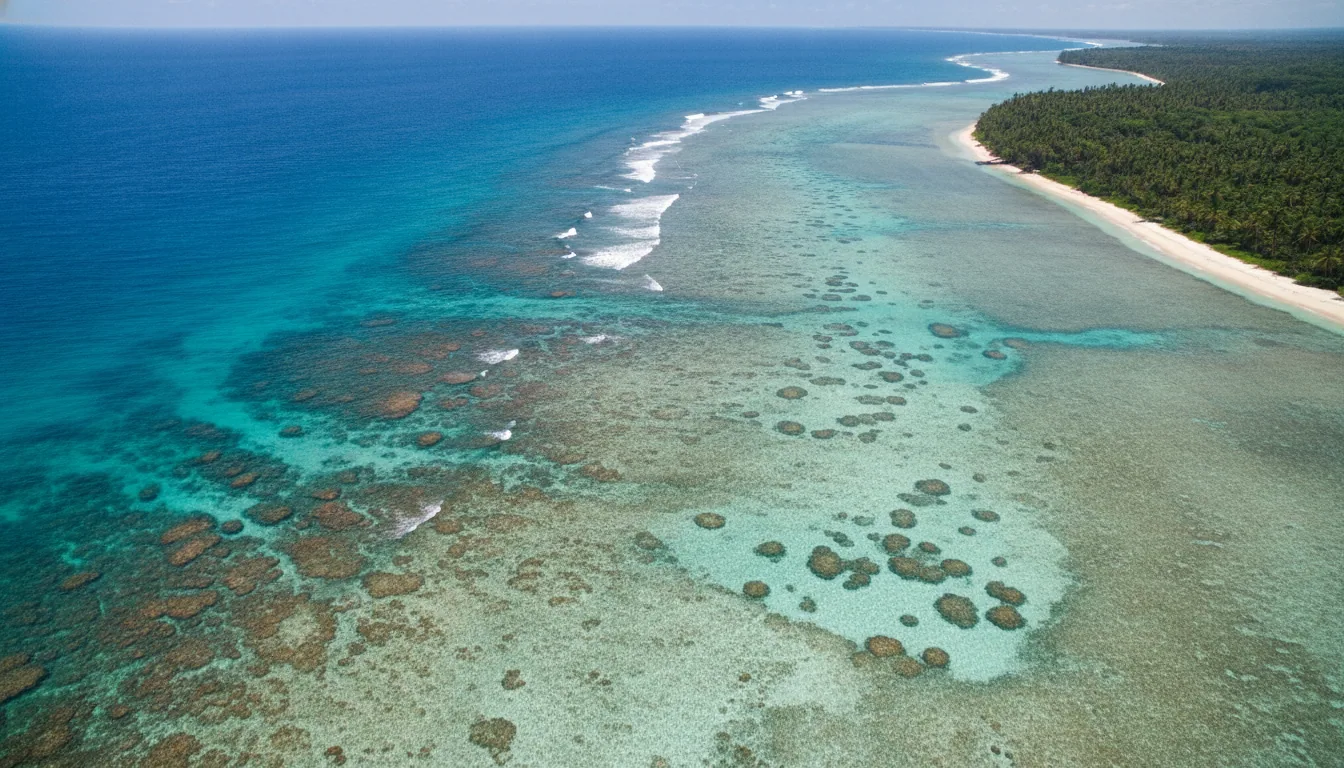
Raise the water level and the geometry shifts. The reef or sandbar that once triggered the break now sits too deep. The wave feels nothing beneath it, keeps traveling, and dies without breaking. Researchers call this reef drowning — not a metaphor, but a mechanical description of what happens when the engineering spec no longer lines up with the structure. Dan Reineman, the lead researcher on the 2026 Climatic Change study, put it plainly: "Surf breaks are incredibly unique oceanographic phenomena — a confluence of all these factors that fit together just right to make the wave happen."
The specificity of that fit is exactly what makes breaks so exposed. In Santa Cruz alone, 31 identified breaks are sensitive to drowning as water depth increases. Each one depends on a particular reef contour, a particular tidal window, a particular swell angle. Change one variable and you lose the wave. Rising seas do not change one variable. They change the depth over every shallow-water structure on every coast, simultaneously, permanently.
How Much Sea Level Rise Is Already Locked In
Global sea levels rose nearly a quarter of an inch in 2024 alone. That sounds small. Spread across every ocean on Earth, it is an enormous volume of water, and it is not going back.
NASA puts 10 to 15 centimeters of rise by 2050 as unavoidable, regardless of what happens to emissions between now and then. The carbon already in the atmosphere has committed the oceans to warming and expanding for decades. Cuts made today spare us the worst of 2100, not 2050.
Scientists project up to six feet of total rise by 2100 in the worst-case scenarios. The range is wide because the range of human choices is still wide. But the floor is no longer negotiable.
On top of the baseline, El Niño cycles add a shorter, sharper problem. Kelvin waves, generated in the central Pacific, move toward the coast at 125 to 155 miles per day. They are not waves you can surf; they are slow-moving pulses of warm water that raise sea levels along entire coastlines.
During the 2026 El Niño, a coastally trapped Kelvin wave pushed Southern California sea levels up by about one foot. Add thermal expansion from warmer water, and the combined elevation can exceed two feet. That is not a storm surge from a single event; it is a sustained high-water platform lasting weeks.
Climate scientist Daniel Swain put it plainly: what California sees at its worst this winter will resemble what a normal winter looks like later this century. The flood that felt exceptional today is the baseline being written for 2070.
The Squeeze: When Concrete Traps a Beach
In September 2026, a beachfront driveway in Malibu simply slid into the sea. No dramatic warning, no slow-motion collapse — pounding surf undermined the slab and the ground gave way. It was a small event by disaster standards. It was also a precise illustration of a much larger structural problem: we built hard things on soft edges, and the edges are moving.
That tension is now measurable. Eighty-nine percent of the surf breaks analyzed in the Reineman study are at risk not from water depth alone, but from what researchers call shoreline resilience failure. Beaches can adapt to rising seas if they have room to retreat inland, migrating gradually up the slope. Seawalls and coastal development remove that room entirely. The beach has nowhere to go, so it narrows, then disappears.
The physics compounds the problem. A hardened shoreline does not hold the sea back; it reflects wave energy, which accelerates erosion on either side. The beach in front of the wall shrinks faster than it would have without one. Croyde Beach in North Devon, rated the best beach break in the UK, is classified as highly sensitive to shifting tide levels precisely because the surrounding developed coastline limits its ability to adjust. Oriente Salvaje in El Salvador faces the same trap.
California adds another layer. Winter wave heights there have grown 12 inches — a 13% increase since 1970 — driven by warming ocean temperatures and shifting storm tracks. Seasonal king tides amplify the effect, flooding low-lying areas that once drained cleanly between sets. More power, less beach, harder walls behind. The squeeze is not a metaphor. It is an engineering fact with a shrinking margin for error.
The wave is the product. Change the wave, and the entire downstream economy shifts with it.
What Protection Actually Looks Like: Law, Reserves, and Managed Retreat
Peru got there first. Its Ley de rompientes — the law of the breakers — gives surf breaks legal standing as natural resources, requiring assessment before any coastal development can alter them. It is the clearest legislative model on earth for treating a wave as infrastructure worth protecting. Few other nations have copied it.
The World Surfing Reserves program has designated 13 sites across eight countries, from Ericeira in Portugal to Huanchaco in Peru. Adam Hall and the community around Croyde Beach in North Devon built the case for the UK's first WSR designation, showing what sustained local advocacy can actually achieve. But legal protection tells you what to preserve. It does not tell you how to move a seawall.
That is the harder problem. Managed retreat — allowing beaches to migrate inland as sea levels rise — is the engineering response that consistently works. It requires removing or not building the hardened structures that currently trap 89% of at-risk breaks in place. That is politically difficult and expensive, because it means buying out beachfront property and dismantling infrastructure that coastal communities built at considerable cost.
The honest gap between the two approaches is significant. A World Surfing Reserve designation protects a break from a new hotel. It does not finance the buyout of the car park sitting behind the beach. Legal frameworks and reserve status are necessary conditions for preservation. They are not sufficient ones. The missing piece is a managed-retreat funding mechanism that matches the scale of the problem — and right now, almost nowhere has built one.
The Honest Scorecard: What Is Worth Doing, and by Whom
Ten to fifteen centimeters of sea level rise is locked in by 2050 regardless of what any government signs this decade. That is not a reason to stop cutting emissions. It is the reason the next thirty years of cuts determine whether the 2100 number is two feet or six — and six feet drowns a category of break that two feet merely degrades.
That distinction matters because the solutions available are not equal. Seawalls feel decisive. The data says otherwise: hardened shorelines reflect wave energy, accelerate beach loss, and leave a break with no room to migrate. Managed retreat — pulling development back from the shoreline and letting beaches move — is the only coastal strategy that preserves both the sand and the surf over a multi-decade horizon. It is also the politically difficult one, which is why it rarely happens without a financial argument forcing the conversation.
Here is where Surfonomics earns its place. Santa Cruz contributes $194.7 million annually to its local economy through surfing. Australia's surf sector generates A$2.71 billion a year. Those are not recreational footnotes. They are balance-sheet entries that give coastal planners a defensible reason to choose managed retreat over concrete, and to classify a functioning break as a durable public asset rather than an amenity.
The next concrete step is legal replication. Peru's Ley de rompientes and New Zealand's resource-management framework already exist as working models. Every coastal jurisdiction hosting a significant break should be adopting equivalent statutes now — not after the wave has changed shape. What remains an open and genuinely urgent research question is whether artificial reefs can substitute for drowned natural breaks. Nobody currently knows the cost or viability. That is the next funded question, and it needs an answer before ocean rise makes it moot.