April 2025: The Month the Energy Order Changed
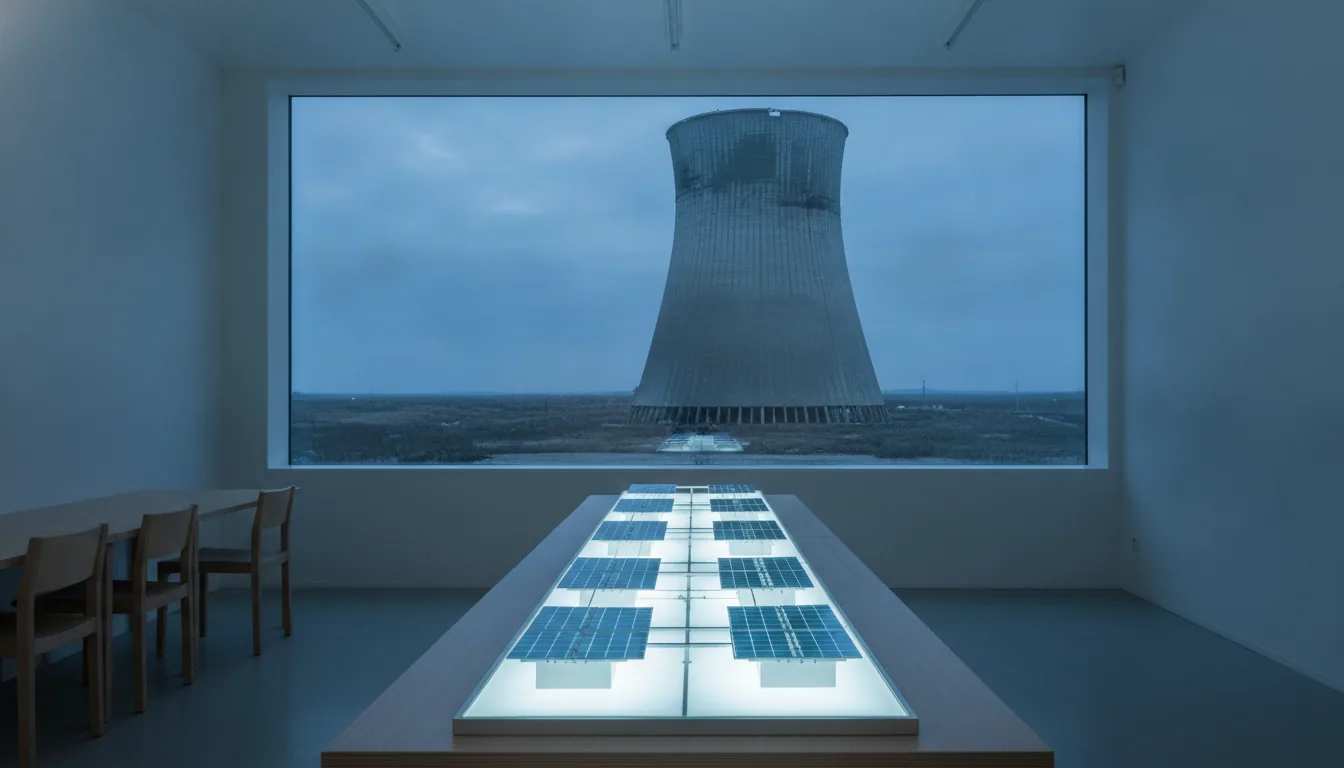
The solar vs nuclear flippening became official in April 2025: global monthly solar generation exceeded nuclear output for the first time, according to the World Nuclear Industry Status Report 2026. Wind had crossed the same threshold one month earlier, in March.
The numbers behind this shift are structural, not seasonal. Solar capacity reached 2,383 GW by end-2025 against nuclear's flat 399.5 GW — a ratio of roughly 6.5 to one. Nuclear's share of global electricity fell to approximately 8.8 to 9 percent, its lowest point in 45 years, while solar generation grew 30 percent year-on-year, adding 636 TWh in a single calendar year.
One data point demands attention precisely because it is contested. The exact month when solar's cumulative 2025 output surpassed nuclear on an annual basis remains subject to revision, because Chinese distributed solar installations are chronically underreported until retroactive correction cycles close the gap. Some analyses place the annual crossover firmly in 2025; others project it into early 2026. The ambiguity does not dilute the signal — it sharpens it, exposing how fast the transition is moving relative to the measurement infrastructure built to track the old order.
Six decades of nuclear infrastructure, engineered to last a century, were not outpaced by a rival megaproject. They were outpaced by a manufacturing curve.
The Numbers Behind the Divergence: Capacity, Growth, and the China Variable
The raw figures are unambiguous, and they demand a structural explanation. Solar capacity reached 2,383 gigawatts in 2025, approximately 6.5 times the 368.6 GW of operating nuclear capacity — a fleet that actually contracted by 0.5 GW over the year as retirements outpaced additions. One technology is on an exponential manufacturing curve. The other is running a slow-motion liquidation.
Generation data confirms the divergence without ambiguity. Solar produced 2,778 TWh in 2025, surpassing nuclear's 2,703 TWh, with that gap achieved on the back of a 636 TWh single-year increase — a 30% year-on-year expansion that no baseload technology has matched in the modern grid era. Nuclear, by contrast, managed growth of roughly 1.1%. The asymmetry is not marginal; it is structural.
The China variable is where this analysis must be rigorous and not merely gestural. Over 50% of global solar expansion originated from Chinese deployment, according to Ember data, reflecting the output of a state-industrial complex that treats photovoltaic manufacturing as a strategic export sector rather than an energy policy choice. This is a cross-border correlation that European planners cannot afford to read as purely geographic: it means the cost curve driving solar's economics is partially a function of decisions made in Shenzhen and Xinjiang, not Brussels or Tallinn.
The capacity factor argument — nuclear's remaining structural advantage, its ability to generate steadily regardless of daylight — is real but increasingly insufficient as a policy foundation. Solar and wind together met 99% of the growth in global electricity demand in 2025. If stagnation is the counterfactual for nuclear, then the capacity factor advantage is an argument for preservation, not expansion. The strategic question for European grid operators is whether that distinction still justifies the capital allocation nuclear currently demands.
The Financialization Gap: Why Private Capital Stopped Believing in Atomic Energy
The physics of nuclear power never changed. What changed was the spreadsheet. When the Levelized Cost of Electricity for solar PV fell to approximately $43/MWh in 2025 against $110/MWh for advanced nuclear, the 2.5x gap stopped being an academic talking point and became a hard constraint on capital allocation decisions made in London, Amsterdam, and Singapore.
Private infrastructure funds do not vote on energy policy. They vote with term sheets. The logic was captured precisely by an unnamed London infrastructure fund associate: "We'd love the asset. We will never own the construction risk, and neither will anyone else at this table." That sentence is a forensic dissection of the modern nuclear financing problem — the underlying asset retains strategic value, but no private counterparty will absorb the construction exposure that precedes it.
Hinkley Point C makes the abstraction concrete. Britain's flagship nuclear project has escalated to an estimated £49 billion ($65 billion), transforming a national energy project into a lesson in megaproject pathology. Taxpayers and utility rate-payers absorb the overruns; private capital watches from the sideline and continues funding solar farms that reach commercial operation within two years.
That two-year delivery cycle is the structural advantage solar holds that no lobbying effort can neutralize. A private infrastructure fund operates on a defined risk horizon. A 10-year nuclear construction timeline extends well beyond it, accumulating cost variance, regulatory revision, and supply chain disruption that compound unpredictably. Solar does not demand tolerance for that uncertainty. It delivers returns on a schedule that matches how institutional capital actually works.
If European governments want private finance in nuclear, the question is not how to sell the asset class — it is who will engineer a credible mechanism to transfer construction risk away from investors without placing it entirely on the public balance sheet.
Construction as Destiny: How Nuclear Lost the Delivery Race
Picture a concrete floor the size of twelve football pitches, surrounded by cranes that have not moved in three months. Workers wait. Lawyers negotiate. Financing tranches expire and must be renegotiated at higher rates. This is not a metaphor for nuclear energy's predicament — it is a composite portrait drawn from construction logs at projects like Hinkley Point C, where costs have reached an estimated £49 billion, and Plant Vogtle, which consumed over $30 billion before its first commercial electron reached the grid.
The numbers that explain this portrait are precise and damning. Not one of the 16 nuclear reactors connected to grids in the latest reporting period finished on schedule, with an average construction time of 10.9 years. Each additional year compounds financing costs exponentially, transforming an already capital-intensive asset into a fiscal black hole that private infrastructure funds refuse to enter.
Meanwhile, in 2025, nuclear added 1.5 GW of new capacity globally. Solar added 510 GW. The asymmetry is so large it resists intuitive comprehension.
The failure is not technological. Nuclear engineers understand fission. The failure is organisational — site-specific civil engineering cannot replicate the learning-curve economics of factory-produced panels. Solar's advantage was never about watts per kilogram or capacity factors. It was about the production line, the standardised module, the predictable schedule.
Small modular reactors were meant to answer this critique directly. Modular construction, proponents argued, would compress timelines and tame costs. The WNISR 2026 is unambiguous: SMRs have not yet delivered on either claim. If the construction model itself is broken, a smaller version of that model is still a broken model. The question for European policymakers is no longer whether nuclear is valuable in theory — it is whether the industry can solve a logistics problem that three generations of engineers have failed to crack.
The Next Bottleneck: Storage, Grids, and the Baseload Problem
Generation victory and operational reliability are not the same achievement. Grid-scale battery storage additions reached 104 GW (257 GWh) in 2025 — an impressive deployment figure that simultaneously reveals how much integration infrastructure remains unbuilt. The generation flippening has been won; the integration flippening has barely begun.
Solar's structural vulnerability is temporal. Industrial energy users face a pricing asymmetry that storage only partially corrects: solar floods midday markets, depressing wholesale prices, then withdraws at dusk precisely when industrial demand peaks. If current battery deployment rates represent the ceiling rather than the floor of ambition, that evening-peak pricing risk hardens into a structural cost disadvantage for energy-intensive manufacturers across Northern and Central Europe.
The honest comparison between solar and nuclear forces a distinction that advocates on both sides frequently elide. Nuclear's residual argument was never cost — at $110/MWh against solar's $43/MWh, that case collapsed years ago. It was never construction speed, given an average build time of 10.9 years. The argument is despatchability: the capacity to deliver consistent baseload power regardless of cloud cover, season, or grid-demand curve. That advantage is real, not rhetorical.
The defining engineering and policy challenge of the next decade is therefore not how much solar we can install, but whether despatchable renewable power — solar paired with storage and complementary grid assets — can reliably replace baseload capacity at scale. For European policymakers weighing interconnection rights and grid investment priorities, the question is strategic: how much despatchability risk are industrial economies prepared to carry while the integration infrastructure catches up to the generation curve?
Six decades of nuclear infrastructure, engineered to last a century, were not outpaced by a rival megaproject. They were outpaced by a manufacturing curve.
What the Solar-Nuclear Flippening Demands from European Policymakers — Including Estonia
The cost signal is no longer ambiguous. Solar PV delivers electricity at approximately $43/MWh; advanced nuclear costs $110/MWh. Grid-scale battery storage additions reached 104 GW in 2025 alone. For state planners still treating these as comparable alternatives, the data has rendered that position indefensible.
Estonia and the Baltic states enter this reckoning at a structurally acute moment. Synchronisation with the European grid, scheduled for completion in 2025, transforms the region from an isolated system into a competitive arena. Countries that resolve grid integration and storage buildout faster will attract capital-intensive industry first — this is the new logic of industrial policy. The Sizewell C financing precedent is instructive: at an estimated £38 billion, with private funds explicitly refusing construction risk, the public balance sheet absorbs what markets will not touch.
Solar and wind met 99% of the growth in global electricity demand in 2025, according to Ember. That is not a projection. It is a cost-weighted verdict delivered by capital allocation at scale.
The strategic question for European governments is therefore this: if private capital refuses nuclear construction risk, and solar-plus-storage cannot yet guarantee baseload continuity, who underwrites the transition gap — and under what democratic mandate does that decision get made?