A Blast Door in Paradise
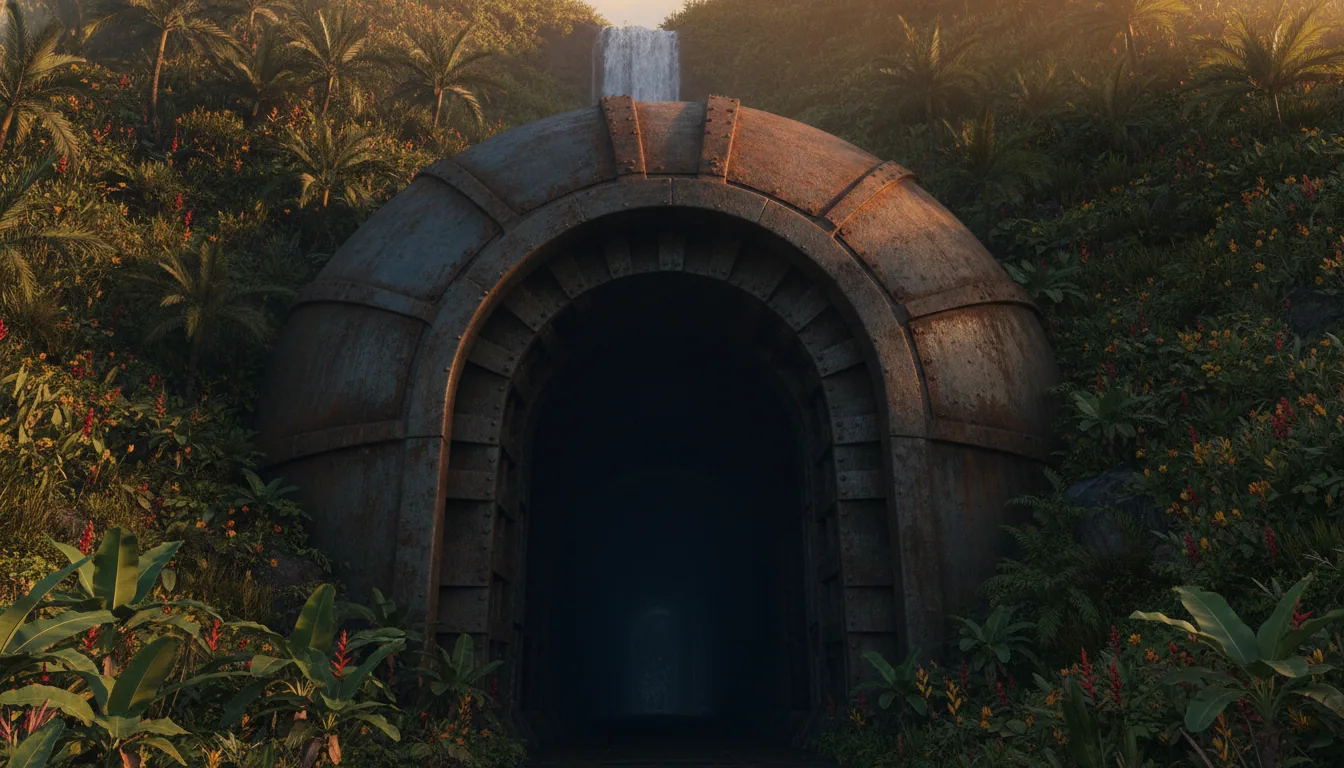
Somewhere beneath a Hawaiian hillside, behind a steel door engineered to withstand a blast, there is a 5,000-square-foot underground shelter stocked with independent food and energy systems. It belongs to Mark Zuckerberg. The whole compound on Kauai - Koolau Ranch - is estimated to have cost $270 million, which makes it, among other things, the most expensive private hedge against the future ever built on American soil.
The blast door is worth pausing on. It is not a metaphor; it is a real object, a thing you could press your hand against. And yet it functions as a symbol too, marking the precise moment when survivalism stopped being a hobby for anxious retirees with canned goods and became an asset class for people who own rockets.
The lineage is clear enough. The 1950s fallout shelter - cramped, concrete, smelling of fear - has evolved, over seventy years, into something closer to a private micro-nation. Today's luxury versions include medical bays, hydroponic farms, and security forces. The Texas-based Rising S Company, which builds them, has seen inquiries quadruple in recent years. Their top-tier models exceed $10 million. That is not a niche market. That is a market.
Here is the strange part. The fantasy does not stop at solid ground. Off the Maldives, designers have proposed the Adaptive Atoll: a $450 million floating fortress conceived to simply rise with the sea as the sea rises. No retreat, no managed relocation. Just infrastructure that refuses to drown.
What all of these projects share is the same quiet logic: that the problem of a destabilizing climate is, at sufficient wealth, an engineering problem. Solvable. Personal. Optional.
The Arithmetic of Who Lit the Fire
Start with the headcount. The richest 1% of the global population, roughly 80 million people, produce as much carbon as the poorest two-thirds of humanity combined. That is not a rounding error. It is a structural fact about who gets to burn.
Go one decimal place further and the numbers become almost arithmetically rude. The top 0.1%, about 8 million people, a crowd that would fill a mid-sized city, out-emit the entire bottom 50% of the human species. Every private flight helps explain why. Every two seconds, somewhere on Earth, a private jet releases more carbon than a person in the poorest half of the world will emit in a full year. Not a day. A year.
Researchers tracking these patterns face a persistent problem: standard consumption surveys miss the very wealthy almost entirely. The fortunes, the jets, the multiple properties, the investment portfolios that pour money into oil and gas, none of these show up reliably in household surveys. When economists at Stockholm Environment Institute and Climate Analytics corrected for this by folding fiscal records and financial accounts into the analysis, the picture sharpened into something harder to look at. The wealthiest 10% of the planet are responsible for 66% of the warming caused by carbon emissions since 1990. Two thirds of the problem. One tenth of the people.
For the top 0.1%, the multiplier reaches 125. That is how many times more their emissions contribute to extreme heat events compared to the average person on Earth. Not compared to the poorest. Compared to the average. The number behind the phrase "carbon inequality" is not a metaphor. It is a ratio, sitting inside peer-reviewed pages of Nature Climate Change, waiting to be translated into something a human body can feel. What it means, plainly, is this: the people most insulated from the consequences of a warming planet are, by a very large margin, the same people most responsible for making it warm.
The people most insulated from the consequences of a warming planet are, by a very large margin, the same people most responsible for making it warm.
Selling the Fire and the Fire Escape
Here is a number worth sitting with: 70% of billionaire investments are concentrated in oil, gas, and chemicals, the very industries doing the most to accelerate the conditions these same billionaires are now paying millions to escape. This is not irony in the literary sense. It is a business model.
Carlos Slim offers a useful case study in how the loop closes. In 2024, researchers estimated that his investment portfolio caused approximately $3.7 billion in environmental damage, the kind of diffuse, cumulative harm - contaminated watersheds, degraded air quality, destabilized local climates - that falls almost entirely on people who never received a share of the profit. Slim is not unusual. He is representative.
The other end of the loop is growing just as fast. The global disaster recovery market, currently worth $70 billion a year, is projected to reach $92 billion by 2029. The capital class that funds the industries producing the hazard is also well positioned to profit from the infrastructure built to manage it - emergency response firms, private logistics, resilience consulting, and yes, luxury bunkers. Asset owners win in every weather condition, as one investor put it with striking candor.
COP31 opens in Antalya, Turkey, in November 2026, and António Guterres will make his final appearance as UN Secretary-General, almost certainly armed with updated numbers on exactly this dynamic. The institutional machinery of climate diplomacy grinds forward. Meanwhile, the market for private fire escapes is growing at a pace that no summit communiqué is designed to address. The practical question, the one the spreadsheets don't answer, is what happens to the firefighting budget when the people who could fund it have already left the building.
The Atlas Exodus: Mapping the Escape Routes of Elite Climate Refuge
The map of the wealthy's escape routes is not theoretical. It is plotted in passport applications, ferry schedules, and wire transfers.
Start with Fisher Island, a slab of sand off the Florida coast accessible only by ferry or private yacht. Its ZIP code, 33109, records the highest average household income in the United States - roughly $2.2 million. No bridge. No walk-in public access. The island does not need a blast door; geography is the door.
Scale outward and the pattern holds, but the distances grow. New Zealand has become the canonical shorthand for what tech circles quietly call "getting out." Peter Thiel acquired citizenship there in 2011 through a provision that has since been tightened. Sam Altman has reportedly secured land. The country offers political stability, low population density, defensible coastlines, and enough agricultural capacity to feed itself. Those are not tourist brochure virtues. Those are logistics.
Then there is the aggregate number, which makes the individual stories feel less like eccentricity and more like policy. Some 165,000 millionaires are expected to relocate internationally in 2026 alone. Firms such as Global Citizen Solutions now package this migration as prudent planning, threading climate resilience directly into golden visa pitches. "A plan B is no longer a luxury," one company representative said, "but part of responsible planning."
That framing is worth pausing on. It treats the retreat of capital from vulnerable places as a reasonable private decision, not as a signal about what those places are losing, in tax base, in institutional memory, in the quiet infrastructure of a functioning society.
The Bill Arrives Somewhere Else
After a Mumbai flood, the water retreats at roughly the same speed for everyone. The damage does not. Lower-income households in the city spend fifteen times more than wealthy ones, as a share of income, to repair what the water took. Same flood, same street, arithmetic that bends sharply by postcode.
This is what researchers mean when they call disasters inequality machines. Vulnerability is not random; it is built, district by district, decade by decade, out of who can afford elevated foundations and who cannot. A disaster does not create the gap. It measures it, and then it widens it.
Scale that up. The UN projects roughly one billion people displaced by climate change by 2050. These are not, by any demographic stretch, the people buying bunkers. They are farmworkers, coastal fisherfolk, residents of floodplains that no satellite-linked alert will evacuate in time. The bunker-buyer and the displaced farmer are linked by a single ledger: the emissions that made the flood worse were disproportionately produced by the person who will not feel the flood.
The feedback loop closes quietly. Inequality creates exposure to disasters; disasters strip the assets and options that reduce inequality. Each cycle leaves the bottom more exposed and the top more insulated. One group buys its way out of the machine. The other keeps feeding it.
When Safety Stops Being a Public Good
Walls have always been sold as protection. Rome built city walls. Medieval lords built keeps. The gated community arrived in the twentieth century, and now the arc completes itself: private energy grids, independent water supplies, 5,000-square-foot underground shelters behind blast doors. Each step privatizes a little more of what societies once built together. The difference now is scale and self-sufficiency. These are not homes with security systems. They are micro-nations.
The governance question that follows is blunt: when ultra-high-net-worth individuals build infrastructure that makes public utilities optional for them, the political pressure to fund those utilities weakens. Tax bases erode alongside the incentive to maintain them. The disaster recovery market, worth $70 billion annually and projected to reach $92 billion by 2029, rewards exactly those who can already afford to opt out of public risk.
And yet the wealthy's climate fortress carries unknowns that no blast door resolves. NDA-shrouded locations make accountability impossible. Whether a $450 million floating fortress can survive a category 5 storm surge remains, bluntly, untested. Most fragile of all: private security forces run on the same social contract, the same functioning currency, the same civic trust, that their owners believe they have escaped. What happens when safety itself becomes a commodity is not a prediction. It is the question our era has not yet had the honesty to answer.