If you’ve ever wondered what it looks like when the geopolitical equivalent of a Jenga tower finally decides it’s tired of existing and collapses onto a birthday cake, congratulations: you’re looking at the Persian Gulf. US-Iran kinetic escalation is no longer a theoretical exercise for think tanks.
Between February 28 and May 26, 2026, the United States and Israel launched Operation Epic Fury, a military campaign against Iran that was basically the foreign policy version of trying to perform open-heart surgery with a chainsaw. It started because nuclear enrichment talks hit a dead end—which is diplomatic slang for "everyone stopped pretending they liked each other"—and ended with the regional map looking like it was put through a document shredder.
From February 28 to May 26, 2026, the United States and Israel conducted a high-intensity military campaign titled Operation Epic Fury against Iran following nuclear enrichment deadlocks. The conflict involved nearly 900 initial strikes on missile sites and leadership, resulting in the death of Supreme Leader Ali Khamenei and a subsequent naval blockade near the Strait of Hormuz enforced by US Central Command.
The US-Iran kinetic escalation reached its peak during Operation Epic Fury, a three-month campaign that dismantled Iranian nuclear infrastructure and fundamentally altered Middle East power dynamics. It was, to put it mildly, an epistemological dumpster fire of historical proportions.
The Twelve-Hour Firework Show
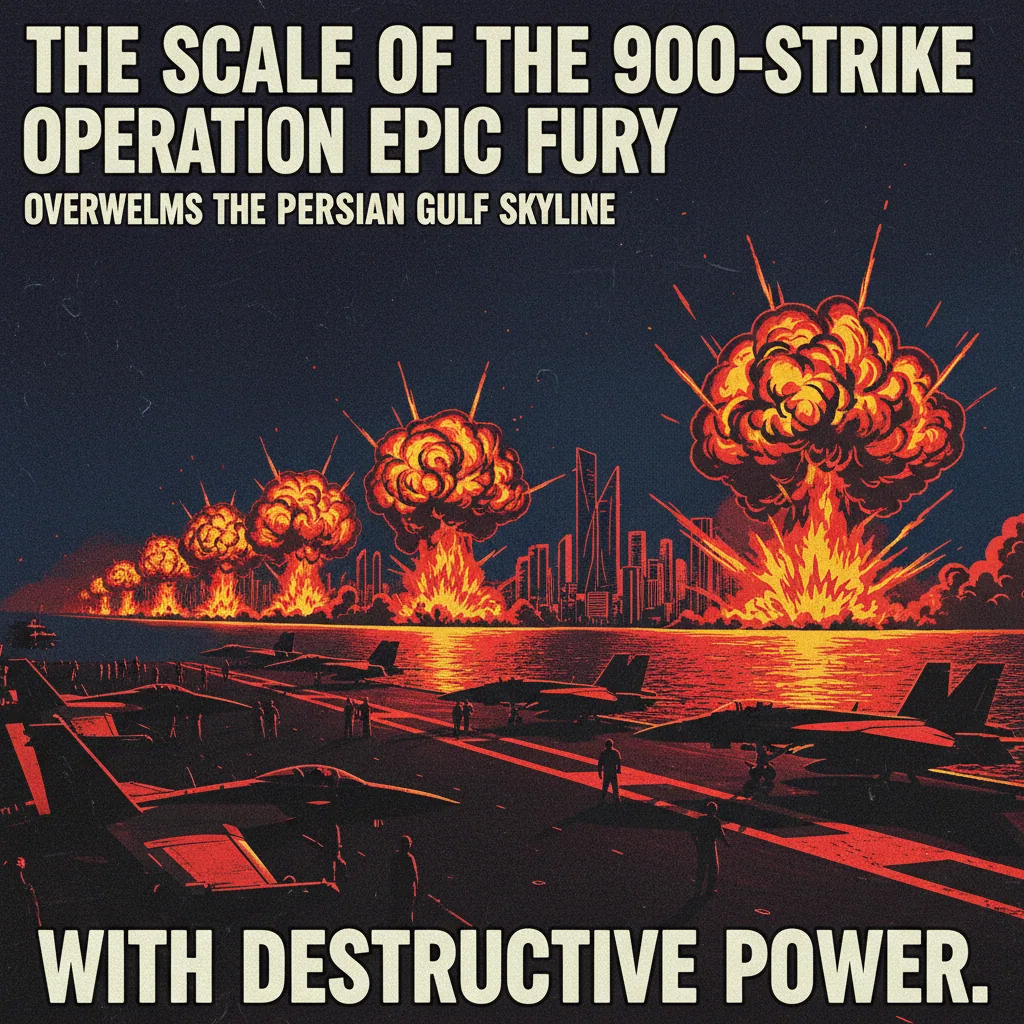
The whole thing kicked off with 900 US and Israeli strikes targeting nuclear facilities and missile sites within a single twelve-hour window. Imagine a swarm of angry metal hornets, but the hornets cost five billion dollars each and have a grudge against concrete.
Supreme Leader Ali Khamenei was killed in the initial strikes, which is one way to handle a succession crisis, and he was immediately replaced by his son, Mojtaba Khamenei. It’s like a corporate promotion, except instead of a corner office, you get a country that’s currently on fire and a to-do list that just says "SURVIVE" in all caps.
Casualties in Iran are estimated between 3,500 and 6,900, including over 1,500 civilians who were just trying to live their lives before the sky turned into a Michael Bay movie. On the other side, the US Pentagon confirmed the deaths of at least 15 US soldiers, proving once again that the "kinetic threshold" is always higher for the people actually on the ground than for the guys in the air-conditioned rooms.
Analyzing the US-Iran Kinetic Escalation at Sea
Then came the retaliation, titled Operation True Promise 4, because apparently, we’re doing sequels now. Iran hit Al Udeid in Qatar, Al Dhafra in the UAE, and the US Fifth Fleet headquarters in Bahrain, proving that they haven't lost their touch for making everyone in a 500-mile radius deeply uncomfortable.
Satellite imagery verified damage to 228 structures across 15 US military sites, which is a lot of drywall for the taxpayer to replace. President Donald Trump, never one to miss an opportunity for a dramatic gesture, ordered a naval blockade of Iranian ports on April 13, 2026.
The Strait of Hormuz remains the ultimate wild card in this game of high-stakes poker where the chips are human lives and global oil prices.
This is being enforced by US Central Command, who are currently playing a very expensive game of "You Shall Not Pass" with the Iranian coastline. US forces have intercepted 85 vessels during the blockade as of late May, and Iran has responded by closing the Strait of Hormuz—twice.
| The Cost of Doing Business (The "We're All Cooked" Edition) | |
|---|---|
| Daily Financial Loss to Iran | $500,000,000 |
| Drone/Missile Strikes Intercepted by UAE | 2,100+ |
| US Carrier Groups in Theater | 2 (USS Gerald R. Ford & USS Abraham Lincoln) |
| Status of the Strait of Hormuz | Closed, Blockaded, and Generally Unpleasant |
Pakistan: The World’s Most Unlikely Babysitter
The most surreal part of this whole spreadsheet-poisoned nightmare isn't the 900 strikes or the $500 million daily bill Iran is racking up. It’s the fact that Pakistan has suddenly become the primary global security mediator.
Pakistan Field Marshal Asim Munir has been the one mediating the temporary ceasefire since April 8, proving that the universe has a very dark sense of humor. We went from "the UN will handle it" to "the guy in Islamabad is the only one everyone’s willing to talk to" in record time.
The negotiations in Islamabad apparently involve a 15-point framework that requires the physical removal of enriched uranium from Iran. "Iran is not going to have a nuclear weapon," Trump said, which is the kind of definitive statement that makes historians start drinking heavily on a Tuesday afternoon. Meanwhile, Iran is utilizing sea mines and seizing merchant vessels like the Touska to exert its remaining influence.
Anyway, the Ship is Still Sinking
US Central Command spokesperson Capt. Tim Hawkins confirmed "self-defense strikes" as recently as May 25 near Bandar Abbas, so don't get too comfortable with that ceasefire. If you think the current disruption is bad, Fatih Birol at the IEA says the energy crisis is already worse than any previous market shock. Hostilities in the Persian Gulf have rewritten the rules of engagement for the decade.
So here we are, watching two carrier strike groups—the USS Gerald R. Ford and the USS Abraham Lincoln—loiter in the Gulf like bouncers outside a club that’s already been burned to the ground. The world is run by people who think "vertical escalation" is just a term for a promotion, while regular people are left wondering if they can afford to drive to work.
Hormuz will reopen one way or the other, but as this US-Iran kinetic escalation drags on, the "other" might be all we have left. Sleep well.