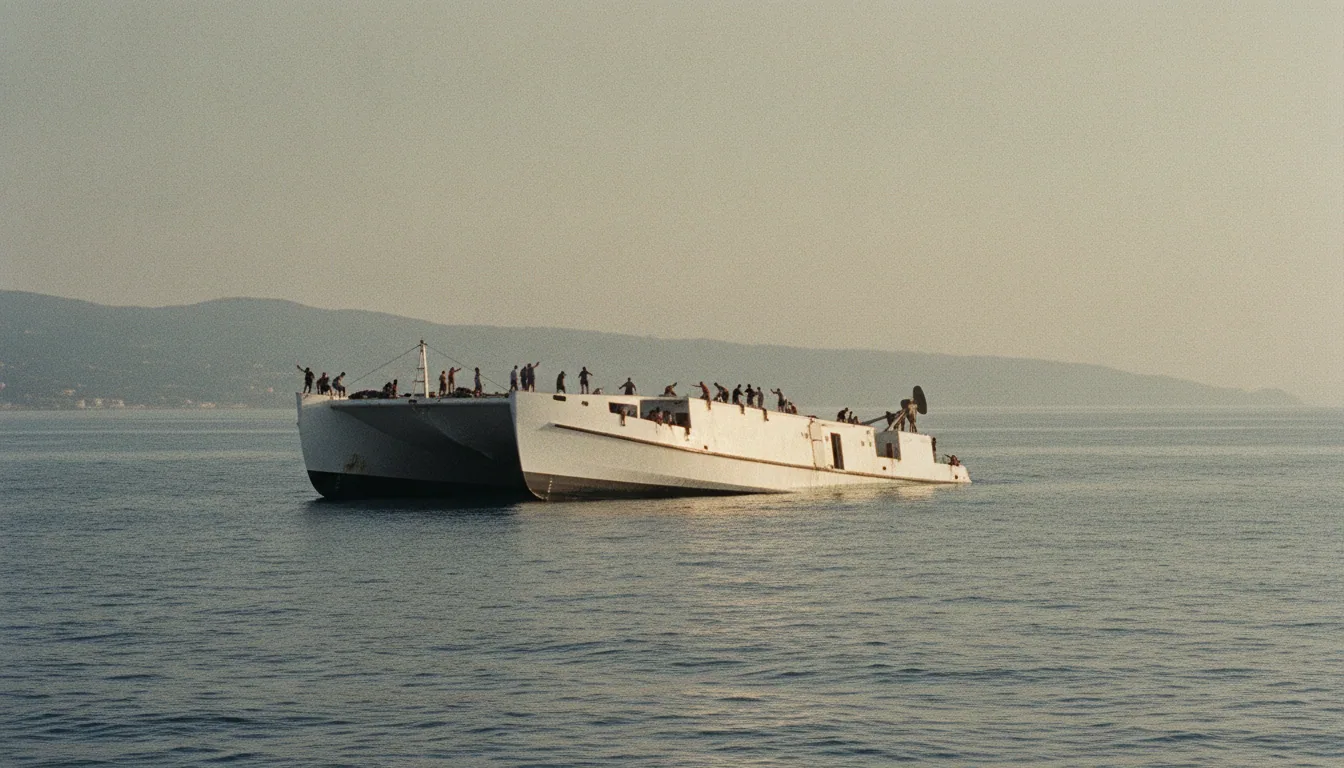
Sunday Afternoon, Two Kilometers from Shore: The Capsize
The water came in fast. The Express Passenger Ship—the vessel at the center of Sunday's Northern Cyprus ferry capsize—had barely cleared Kyrenia harbor on Sunday afternoon, August 30, 2026, when the bow began taking on water. Within minutes, the catamaran ferry was gone.
267 people were on board. That is the official count from Northern Cyprus Transport Minister Erhan Ariklı: 259 passengers and 8 crew. A normal Sunday crossing. Families, probably. Day-trippers. People who bought tickets and expected to arrive somewhere.
The vessel overturned two to three kilometers from the Kyrenia coastline. Close enough to see the shore. Far enough that you cannot swim it in a panic, in open water, in August heat, after a capsize.
What happened next is the image that will stay with you: survivors waiting on the hull of the overturned ship. Not in lifeboats. On the hull itself, sitting on a capsized ferry in the Mediterranean, two kilometers from land, waiting for someone to come.
The TRNC Ministry of Transport confirmed the ship was the Express Passenger Ship, owned by Filo Denizcilik. By 15:00 local time, 159 people had been pulled from the water. Coast guard boats, helicopters, and civilian vessels all joined the rescue effort. Mayor Murat Senkul placed every hospital and ambulance team in the region on high alert.
That still leaves 108 people not yet counted among the rescued. Their status, as of the latest available reports, is unknown.
The sea off Girne was not delivering clean answers on Sunday. It was delivering wet, exhausted survivors and a list of names that nobody wanted to be reading.
Water at the Bow: How a Ferry Sinks Minutes After Leaving Port
The Express Passenger Ship was a catamaran-type ferry operated by Filo Denizcilik, also registered under the name Filo Jet. It was not caught in open water by a sudden storm. It was barely out of Kyrenia harbor when it began taking on water.
The flooding started at the bow—the front of the vessel—almost immediately after departure. Transport Minister Erhan Arıklı confirmed this. The location matters: a catamaran's forward section is not designed to absorb progressive flooding without consequence.
A catamaran gets its stability from two parallel hulls spread wide apart. That wide stance resists rolling. What it cannot easily resist is a rapid shift in weight distribution along the vessel's length.
When water enters the bow, the nose of the ship begins to press down. The stern lifts. The geometry that makes a catamaran stable in normal seas becomes a lever working against the vessel.
The captain recognized what was happening. He attempted to turn back toward the harbor. A turn, however, is exactly the moment when a flooding vessel is most vulnerable.
Changing course redistributes the water already on board, accelerates the listing, and removes the forward momentum that had been helping hold the bow up. The ship lost balance. It overturned.
This sequence—water in, turn attempted, capsize—took minutes, not hours. That compressed timeline is why 267 people, 259 passengers and 8 crew, ended up in the sea two to three kilometers from shore rather than walking calmly back down a gangway.
What is not yet known is why the bow took on water at all. A harbor departure in calm conditions should not produce this. Someone will need to answer that question.
159 Rescued. The Count Is Not Finished.
By 15:00 local time on Sunday, 159 people had been pulled from the sea off Girne. Coast guard boats were still moving. Helicopters swept the water. Civilian vessels—fishing boats, pleasure craft, whatever was nearby—joined the search without waiting to be asked.
That number, 159, needs to be held against the other number. Roughly 267 people were on board the Express Passenger Ship when it capsized. The arithmetic leaves approximately 108 people unaccounted for.
Unaccounted for does not mean confirmed dead. It means the rescue operation is still running and the count is not closed. It means families are waiting for a call that has not come yet.
Mayor Murat Şenkul confirmed that all regional hospitals and emergency teams were placed on high alert. That is the kind of sentence that appears in official statements and sounds bureaucratic until you understand what it means in practice: triage tents, emergency departments cleared and waiting, ambulances staged at the harbor.
A rescue operation of this scale does not answer every question while it is still happening. The people in the water are the priority. Documentation comes after.
What we know is that Coast guard vessels, helicopters, and civilian boats were all working in parallel. What we do not know is the condition of many of those 159 who were pulled out, or the status of the 108 who were not yet in that number as of mid-afternoon.
The search was ongoing. In rescue work, ongoing means something. It means the window has not closed.
The Day Before: The Sea Had Already Given a Warning
The Eastern Mediterranean was already in a bad mood on Saturday.
On August 29, a storm swept through the waters near Cape Greco, on the southeastern tip of Cyprus. Three smaller boats sank. One person died. The Joint Rescue Coordination Centre worked through it.
That was Saturday. Thirty-six hours before the Express Passenger Ship left Kyrenia harbor.
Weather systems in this part of the sea don't reset overnight. A storm that sinks three vessels on Saturday does not simply exhaust itself by Sunday morning. The same pressure, the same wind patterns, the same swells—they persist, they shift, they find new coastlines.
This is what makes the departure decision worth examining. Not with hindsight as a weapon, but as a question that someone with authority will need to answer plainly. The sea around Cyprus had already killed on Saturday.
A 24-hour pattern of incidents is not bad luck. It is a signal.
The people who authorize vessel departures in Girne harbor had access to that signal on Sunday morning.
One person died near Cape Greco the day before. That fact now sits alongside the 267 people who boarded the Express Passenger Ship on Sunday afternoon, trusting that someone had read the weather, done the math, and decided it was safe to leave.
What We Still Do Not Know — and Why That Matters
When the Costa Concordia capsized in 2012, investigators spent weeks establishing basic facts the public assumed would be immediate: how many people were aboard, where they were from, what exactly went wrong and when. The Girne capsize is hours old. The silence on basic questions is not yet scandalous. But silence that persists becomes something else.
As of Sunday evening, we do not know whether anyone died in the capsize of the Express Passenger Ship itself. The one confirmed fatality belongs to Saturday's storm near Cape Greco, a different incident entirely. For the 267 people on board Sunday's ferry, the picture is incomplete.
That gap between 267 and 159 rescued is not a number to skim past.
The nationalities of passengers and crew have not been publicly confirmed. In a port like Girne, that matters. Tourists, migrant workers, and local residents move through the same gangway with very different emergency support systems waiting on the other side.
The technical cause of the bow water intake remains unestablished. 'The ship began taking on water immediately after leaving harbor' is a description, not an explanation. Whether this was a maintenance failure, a loading error, or something else, no one has said publicly.
Nor has anyone confirmed whether safety warnings were active before the vessel departed. That question will determine whether this was an accident or something a checklist might have prevented. Those are not the same thing, and the investigation cannot treat them as if they were.
Who Is Responsible for the Northern Cyprus Ferry Capsize, and What Has to Change
The North Cyprus Ministry of Transport confirmed the vessel was an Express Passenger Ship operated by Filo Denizcilik. That makes the answer to 'who is responsible' at least partly clear: the TRNC Ministry of Transport oversees port safety and will lead any investigation, while Filo Denizcilik faces potential liability as owner and operator.
Here is where the arithmetic gets harder. Northern Cyprus is recognized as a sovereign state only by Turkey. That single political fact walls off much of the international maritime oversight framework. The International Maritime Organization sets the global standards. But enforcing them requires recognized jurisdiction. In Northern Cyprus, that chain is shorter, thinner, and less tested than in any EU-member port.
What does genuine accountability look like? It starts with a transparent technical investigation into why a catamaran took on water from the bow immediately after leaving harbor. That is not an open-sea weather question. That is a maintenance question, a loading question, possibly a certification question.
267 people boarded that ferry on a Sunday afternoon. They were not asking for extraordinary protection. They were asking for the ordinary kind: a vessel that floats, an operator who checked it, an authority that made sure. Passengers on any ferry deserve exactly that. The investigation that follows this Kyrenia ferry disaster will show whether Northern Cyprus can deliver it. Someone needs to be watching whether it does.