Three Drones, Eighteen Nautical Miles
In the autumn of 1996, the Strait of Hormuz briefly closed to traffic after Iranian gunboats harassed a Liberian-flagged tanker inside Omani waters. The Black Sea maritime security crisis unfolding in October 2026 is structurally different — a sustained, sequential campaign against civilian shipping inside the exclusive economic zones of two NATO members, conducted across multiple days and with rising lethality.
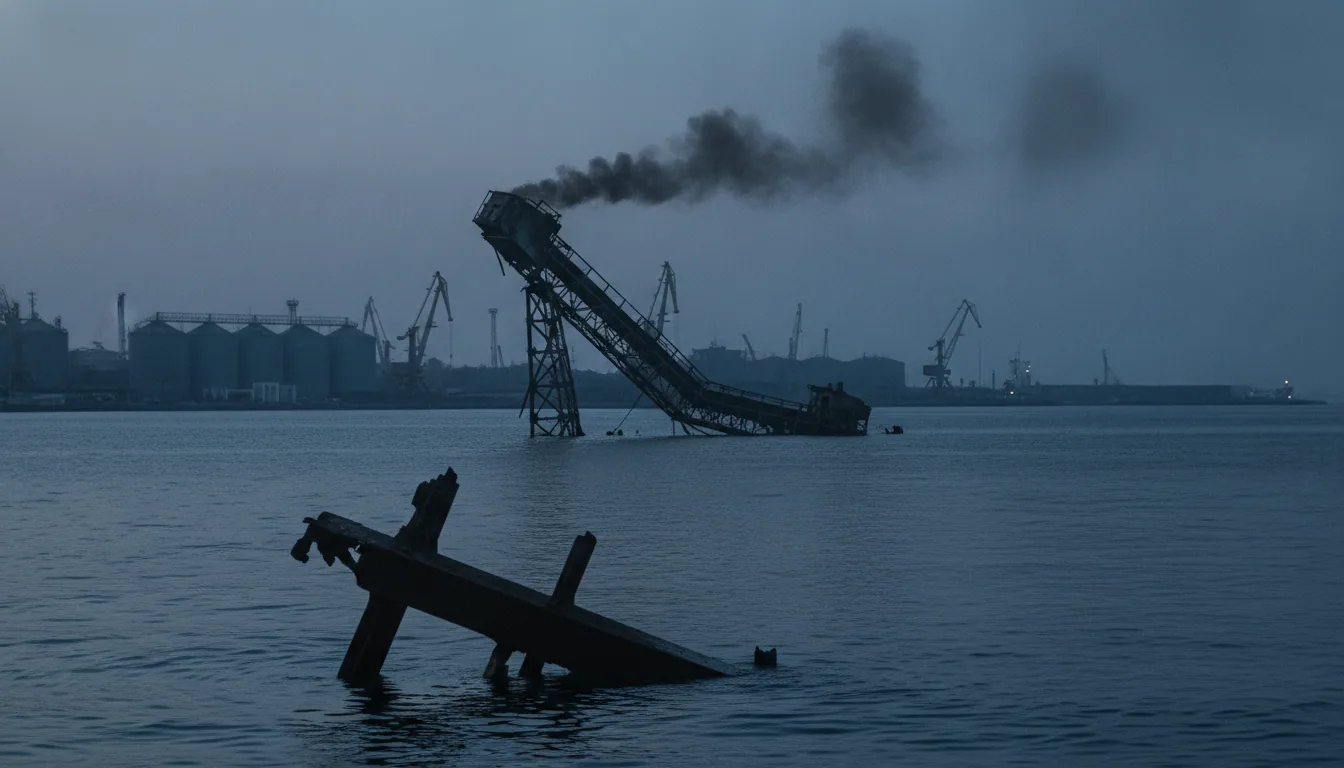
On October 13, the Maltese-flagged Chelsea 3 was struck by three aerial drones eighteen nautical miles east of Byala, Bulgaria. The same day, the St. Vincent and Grenadines-flagged Azov Concorde went down seventeen nautical miles off Krapets. Five Chelsea 3 crew members were treated in Varna. The arithmetic of what was not recovered is the relevant number: how many were aboard, minus how many reached shore.
The October 13 strikes did not open this account. Between October 5 and October 6, three merchant vessels were attacked within twenty-four hours across the Romanian and Bulgarian EEZs. The Togo-flagged Alfa Watan had already sunk in Bulgarian waters days earlier, with ten crew members still unaccounted for as of this writing. Three vessels struck within twenty-four hours, then two more in a single afternoon: this is not a stray incident the wire can file under "volatility." This is a tempo. That the ships carried flags from Malta, Togo, St. Vincent — the small registries of a world that assumes the sea is open — is not incidental. It is the point.
How the Drone Reached Open Water
Operation MoLoCHKa, launched by Ukraine on July 6, 2026, was the hinge. Before it, the war's maritime logic was port-bound, targeting grain terminals and anchorages. After it, kinetic action moved into the open sea, with Ukrainian Unmanned Systems Forces reporting strikes against 183 vessels in the months that followed. The target set was the shadow fleet — those older, flag-of-convenience hulks that had kept Russian export logistics moving beneath the threshold of formal sanctions enforcement.
That shift had a price index. By summer 2026, war-risk insurance premiums for Black Sea voyages had reached 2% of total vessel value, a number that concentrates the mind of any shipowner running thin margins on bulk cargo. The Joint War Committee in London formalised the geography of that risk on September 16, expanding its designated high-risk zone to encompass nearly the entire Black Sea. London does not issue these designations lightly; the last time the committee drew lines this wide in a regional sea, the corridor in question did not recover for years.
The shadow fleet is the detail worth holding. Russia built it as a sanctions-evasion instrument, a diffuse logistics layer that was supposed to be invisible by design — obscured ownership, rotating flags, ports that asked few questions. Operation MoLoCHKa exposed its structural weakness: vessels assembled for opacity are not assembled for survival in a contested maritime zone. The fleet that was meant to be everywhere and nowhere is now simply a target list. Ask the small question first: who is the borderland here, and who is the empire? The shadow fleet's exposure answers it more plainly than any communiqué.
The EEZ Gap: How Black Sea Naval Tensions Exploit International Law
Under international law, the distinction matters enormously. A strike inside Bulgaria's twelve-nautical-mile territorial sea would fall on sovereign territory, and the Article 5 calculus would shift from political to urgent. Eighteen nautical miles off Byala, where the Chelsea 3 went down, sits comfortably inside Bulgaria's Exclusive Economic Zone — a zone conferring economic rights under UNCLOS, not the full weight of territorial sovereignty. Moscow has read that text. The gap between the two regimes is not an oversight; it is the operational margin.
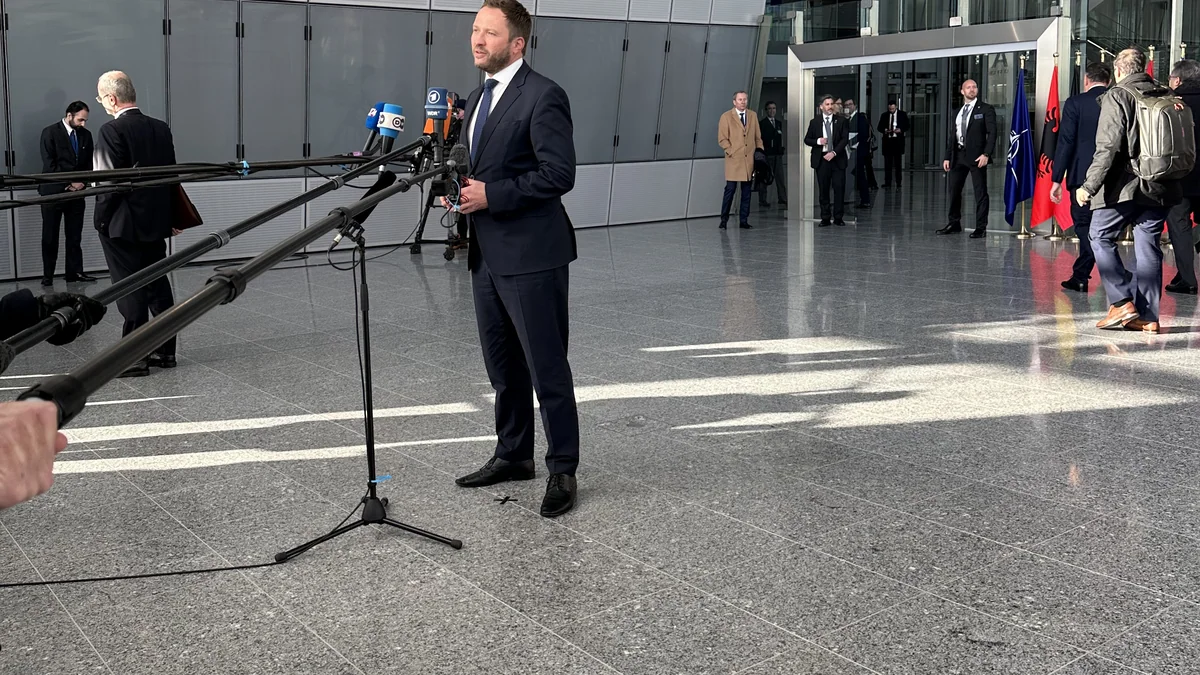
Bulgaria and Romania are the borderland here. Small NATO members holding the maritime flank between the alliance and a sea that has been a contest between empires since the Ottomans and the Tsars argued over its straits. Radev summoned Ambassador Mitrofanova after the October 13 strikes, and his public language was precise in its hedging: "we do not have clear evidence to accuse any of the parties," he said, "but logic indicates that the result is in favour of the Russian Federation." That formulation — attribution by logic, not forensics — tells you exactly what Sofia can prove and what it cannot yet say aloud.
NATO Secretary General Rutte confirmed the alliance is prepared to "adjust its defensive posture along the eastern flank." The phrase is load-bearing in one direction and decorative in another. It confirms that existing deployments will shift. It does not say the alliance will escort merchant vessels, name a responsible party, or treat an EEZ strike as a collective-defence threshold. The EEZ gap is not a flaw in the treaty architecture that someone forgot to patch. It is the room Moscow has chosen to operate in, deliberately and repeatedly, because the alliance has not yet agreed on what to call what is happening there.
1.6 Million Tonnes: The Corridor in Numbers
The grain freighter moving out of Odesa in a normal September carries roughly two thousand tonnes. To reach 7.3 million tonnes in a single month, you need that ship loading and sailing approximately three thousand six hundred times. September 2026 produced 1.6 million tonnes. The arithmetic of what vanished is not abstract.
That 77.8 percent collapse is not a supply disruption in the bureaucratic sense — it is the Black Sea corridor functionally gone, not by treaty, not by negotiation, but by the simple fact that no underwriter will price a voyage at a rate a grain trader can absorb. War-risk premiums already sat at 2 percent of total vessel value by summer; after the Joint War Committee expanded the high-risk zone to nearly the entire sea in September, the corridor became a cost structure that only desperation could justify.
Russian grain exports from the Black Sea fell by over 80 percent in early October. This detail is worth holding, because Moscow has spent two years insisting that Western sanctions, not Russian conduct, produced the food-security crisis. The corridor it helped destroy was also carrying Russian wheat. The ledger does not flatter anyone.
The states that absorb the downstream cost have no seat at any table where this is discussed. Import-dependent countries in North Africa and the Middle East do not appear in the communiqués from Sofia or Brussels. They appear in the price data, weeks later, quietly. The corridor was never just a Ukrainian export route. Its closure is a tax levied on governments that had no vote on whether the Black Sea became a war zone.
What a party will not sign tells you more than what it says it wants, and Moscow said nothing at all, which is the cleanest signal of the three available.
The Ceasefire Russia Would Not Sign
Turkey and the UN brought a maritime ceasefire proposal to the table twice, in August 2026 and again in October. Russia declined both times. That is the fact; what it discloses is the analysis.
A ceasefire in the western Black Sea shipping lanes would have constrained Ukraine's Operation MoLoCHKa and paused the drone campaign against the shadow fleet. It would also have obliged Russia to stop striking civilian cargo routes, restored grain loading volumes that had fallen to 1.6 million tonnes in September against 7.3 million the previous year, and handed the UN and Ankara a visible diplomatic win. The structural question is simple: which side bore the heavier cost of a yes?
Ursula von der Leyen called the attacks on civilian shipping unacceptable. The formulation is accurate and entirely without consequence, which is itself a kind of answer. European condemnation is the decorative moulding here; the load-bearing wall is enforcement, and no enforcement mechanism was offered alongside the language.
Reading the negative space of a twice-refused proposal is not speculation. Refusal is a policy, and policies have authors. The ceasefire would have frozen a corridor Russia had already made too dangerous to use freely, at exactly the moment when that danger was doing strategic work.
What the Hub in Constanta Has to Prove
The European Union's Black Sea Maritime Security Hub, split between Constanta and Varna, arrives at a useful moment and an awkward one. The €200 million committed across 65 projects represents a serious institutional wager. The satellite imagery now flowing to Romanian and Bulgarian maritime authorities represents its first operational layer — real-time situational awareness where there was recently a contested picture and contested claims.
That layer matters. Bulgarian Prime Minister Radev stood before cameras on October 13 and said his government lacked clear forensic evidence to assign blame, while adding, with flat logic, that the result favoured Moscow. Satellite coverage does not resolve political will, but it removes the excuse of not seeing. The EU has taken away one alibi; the next one will be more expensive to manufacture.
Here is what the architecture cannot yet do: escort a merchant vessel. The hub coordinates coast-guard sensor data; it does not put a frigate between a Ukrainian grain carrier and a drone launched from seventy kilometres away. The 65 projects are load-bearing for intelligence. They are decorative for deterrence.
The watch-marker for Black Sea maritime security, then, is simple and checkable. NATO naval escorts in the Romanian and Bulgarian EEZ — either announced or quietly confirmed through shipping-industry advisories — by the end of the first quarter of 2027. If they materialise, the hub becomes the nervous system of a real deterrent architecture. If they do not, then €200 million has purchased a very expensive map, and the winter wheat loadings will tell you the rest.