A Heat Dome Parked Over 200 Million People
On Thursday, July 3, 2026, Central Park hit 100 °F, tying a daily record set in 2012. Philadelphia reached 103 °F, a temperature the city had not seen since 1901. Washington, DC, logged back-to-back 102 °F days, shattering records that had stood for 120 years. These were not isolated anomalies scattered across a map. They were three data points on a single, enormous pressure system that had parked itself over more than two-thirds of the contiguous United States and refused to move.
The mechanism is called a heat dome: a blocking high-pressure pattern that traps warm air near the surface like a lid on a pot. More than 200 million Americans faced daytime highs above 90 °F heading into the Fourth of July weekend. Peak heat indices across major corridors reached 105 to 115 °F. That number matters because heat index combines air temperature with humidity, and it is the combined figure that determines whether a human body can cool itself. Above a certain threshold, it simply cannot.
Washington's Fourth of July parade was canceled. FIFA World Cup matches were scheduled as outdoor events in the same geography during the same days, concentrating large crowds in open air at the worst possible moment. The celebration trap was real and it was foreseeable.
World Weather Attribution concluded that the heat-humidity combination produced by this event would not have occurred without the added influence of fossil fuel pollution. That is not a political statement. It is a causal finding, the same kind of engineering logic used to identify why a bridge failed. The physics changed. The infrastructure did not. That gap is where the deaths happened.
Heat Kills More Americans Than Floods, Tornadoes, and Hurricanes — Combined
Between 2015 and 2024, heat killed an average of 273 Americans every year. That is more than floods. More than tornadoes. More than hurricanes and lightning, added together. The number sits in CDC and NOAA databases, precise and largely ignored.
On July 3, 2026, a 68-year-old man in Bethel Township, Pennsylvania, went out to trim his bushes. The temperature was 100 °F. His coroner listed the cause of death as a heart attack brought on by heat exhaustion. That entry will not make the national weather disaster ledger the way a collapsed roof or an overturned car does. Heat death leaves no wreckage.
This is the statistical invisibility problem. A tornado leaves a photograph. Heat leaves a number that epidemiologists call excess mortality: deaths above the historical baseline, inferred rather than directly counted. Because the method is statistical, not visual, the politics rarely follow.
The benchmark is Chicago, July 1995. At least 465 people died in the city; NOAA's full Midwest count exceeded 1,000. The lesson that event delivered, which took years to be acted on, was this: a few days of unbroken heat in an unprepared city kills people at scale.
Europe in the summer of 2026 repeated the lesson. Approximately 3,700 excess deaths were recorded across European countries during the concurrent heat wave. Spain and France had already lost roughly 2,000 people in a scorching June before the July dome arrived.
Heat is the leading weather killer in the United States, by a significant margin, and it remains the one disaster category that does not reliably produce the political urgency it has already earned.
That asymmetry is not a communication failure. It is a counting failure.
Why Cities Cannot Cool Down at Night
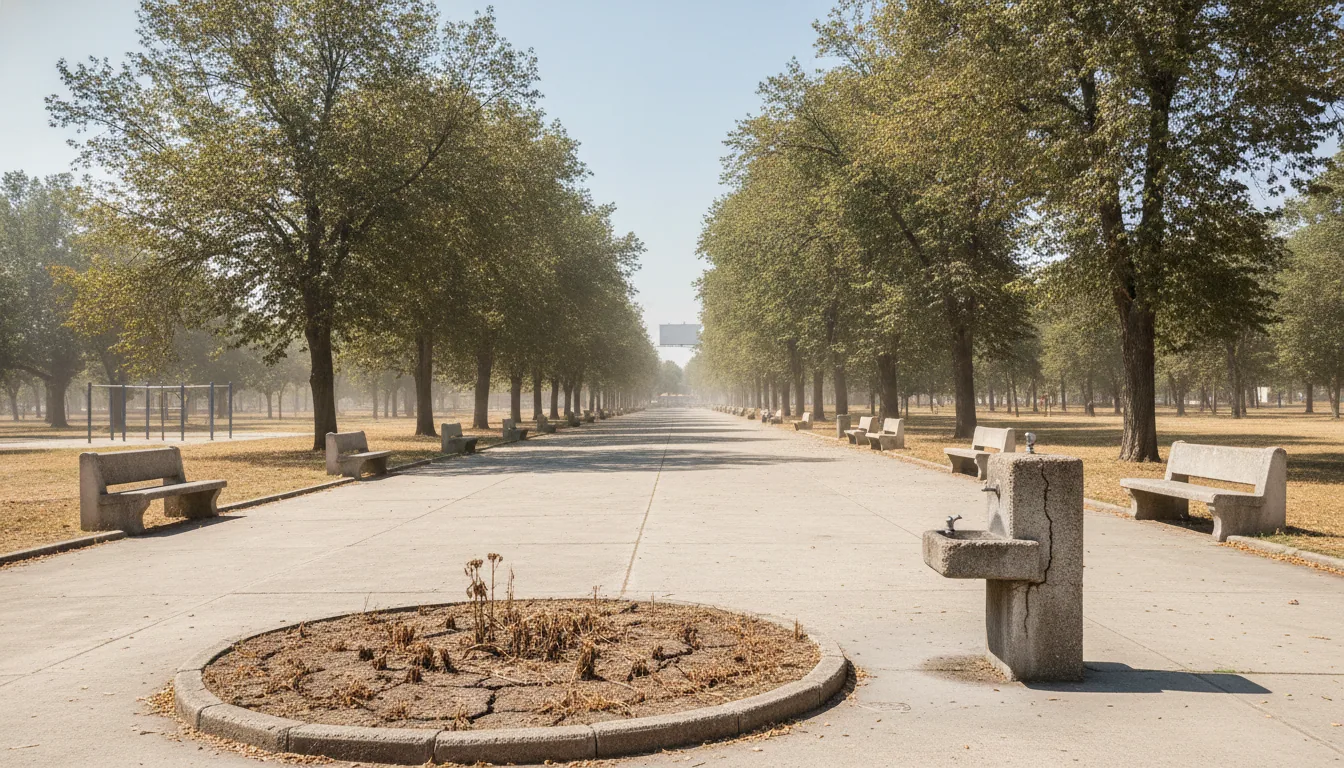
Concrete and asphalt absorb solar radiation all day like a slow battery. After dark, they release it. Urban areas can run up to 22 °F hotter than the rural land surrounding them, not because of some quirk of local weather, but because of what the streets are made of. That heat debt does not disappear overnight. It transfers directly into the bodies of the people sleeping inside.
During the 2026 heat dome, overnight lows in dense urban cores refused to drop below 75–80 °F. That number matters more than the daytime peak. The human body repairs heat stress during sleep, when core temperature has a chance to fall. Consecutive nights above 75 °F erase that recovery window entirely.
Here is what that means physiologically. Heat stroke triggers when core body temperature climbs past 103 °F and perspiration can no longer keep pace. After one warm night, a resident begins the next day already behind on recovery. After three or four consecutive nights, the body enters each morning closer to that threshold, with less margin and less capacity to compensate.
The compounding is the mechanism. A single hot afternoon is survivable for most healthy adults. A week of hot afternoons preceded by warm, sleepless nights is a different problem, one that kills elderly residents, outdoor workers, and anyone without reliable air conditioning.
The urban heat island effect is not a natural law. It is a measurable consequence of specific engineering choices: dark roofing, asphalt, minimal tree canopy, dense building mass. The gap between what cities are and what they could be has a price tag. That is an engineering question, not a climate one.
Two Opposite Infrastructure Failures, One Heat Wave
On the morning of Friday, July 4, 2026, Con Edison began cutting power to thousands of customers across the New York area. The outages were not accidents. They were deliberate — the utility's engineers shedding load to prevent a cascading failure that could have blacked out the entire grid. Every household running air conditioning at maximum, simultaneously, on the hottest Fourth of July in living memory, had pushed demand toward a threshold nobody wanted to find.
Washington's response was to improvise. Federal and state governments issued temporary waivers bypassing certain environmental restrictions, allowing power plants to run at capacity and emergency diesel generators to activate. It worked, just. Call it crisis management dressed up as policy, because that is what it was.
Now cross the Atlantic. The European failure looked nothing like the American one, and the outcome was similar anyway. Thousands of schools closed across Western Europe, not because administrators panicked, but because the buildings had no air conditioning. That gap is structural, baked into the construction era when summer temperatures in Paris or Madrid rarely justified the cost. No one made a bad decision in 2026. The decision was made in 1970, when the concrete was poured.
Meanwhile, in Southern European greenhouses, temperatures reportedly crossed 40 °C before morning was over. Harvest windows compressed. Losses concentrated. Farmers who had beaten the heat in previous years ran out of room.
The asymmetry is worth sitting with. The US grid nearly collapsed because 200 million people switched on AC at once. Europe's buildings had no AC to overload. Two opposite vulnerabilities, comparable mortality outcomes. The deadliest infrastructure failure is often the one nobody designed, only inherited.
Infrastructure Resilience During Heat Waves: What This Means If You Live in Estonia
Thousands of Western European schools closed during recent heat waves. The reason was not a policy choice or an overreaction. The buildings simply could not keep internal temperatures at a level compatible with learning or safety. They were designed to hold warmth in, not push heat out. Estonian school buildings follow the same design logic.
That is not a Mediterranean problem to observe from a distance. It is a preview.
Estonia's population is also less physiologically acclimatised to sustained high temperatures than people in southern countries. The margin between uncomfortable and medically serious is narrower than most residents assume. A body that has rarely experienced four consecutive nights above 25 °C does not manage cumulative heat stress the way a body in Seville does. The 1995 Chicago heat wave killed more than 1,000 people in a region where summer heat was familiar. Unfamiliarity is a physiological risk factor, not a cultural one.
The relevant question for Estonian infrastructure planners is not whether a comparable multi-day heat event will arrive. The honest question is what the grid, the school buildings, and the emergency health system actually do when it does. Those answers require testing against a concrete scenario now, not after the event has provided the data. Thousands of European excess deaths is the dataset that fills the gap where planning used to be.
The Honest Scorecard: What Actually Moves the Needle
The US grid survived July 4, 2026. It survived through emergency waivers that bypassed environmental restrictions to run power plants at full capacity and activate diesel backup generators — not through resilience, but through improvisation. That distinction matters. Luck does not scale, and the next heat dome will not politely arrive on a holiday weekend when demand planners are watching.
Here is what actually works: treating 273 as a policy number, not a natural floor. That figure — the average annual US heat deaths from 2015 through 2024, more than any other weather hazard — is built from building codes, utility preparedness budgets, and urban design standards. Every one of those inputs is a changeable variable.
Passive cooling requirements in new public construction cost a fraction of retrofitting. They eliminate the school-closure problem before it exists. The catch is that mandating standards feels optional until the heat arrives — and by then the budget is disaster relief, not prevention.
Attribution science has now closed the causal loop. World Weather Attribution's analysis of the 2026 event concluded the heat-humidity combination would not have occurred without fossil fuel emissions. That hands utilities and policymakers a number they can no longer claim not to have. Building heat wave resilience into infrastructure — the grid, the schools, the urban fabric — is no longer a precautionary argument. The honest next step is straightforward: use it.