The Village That Stopped Waiting for the Grid
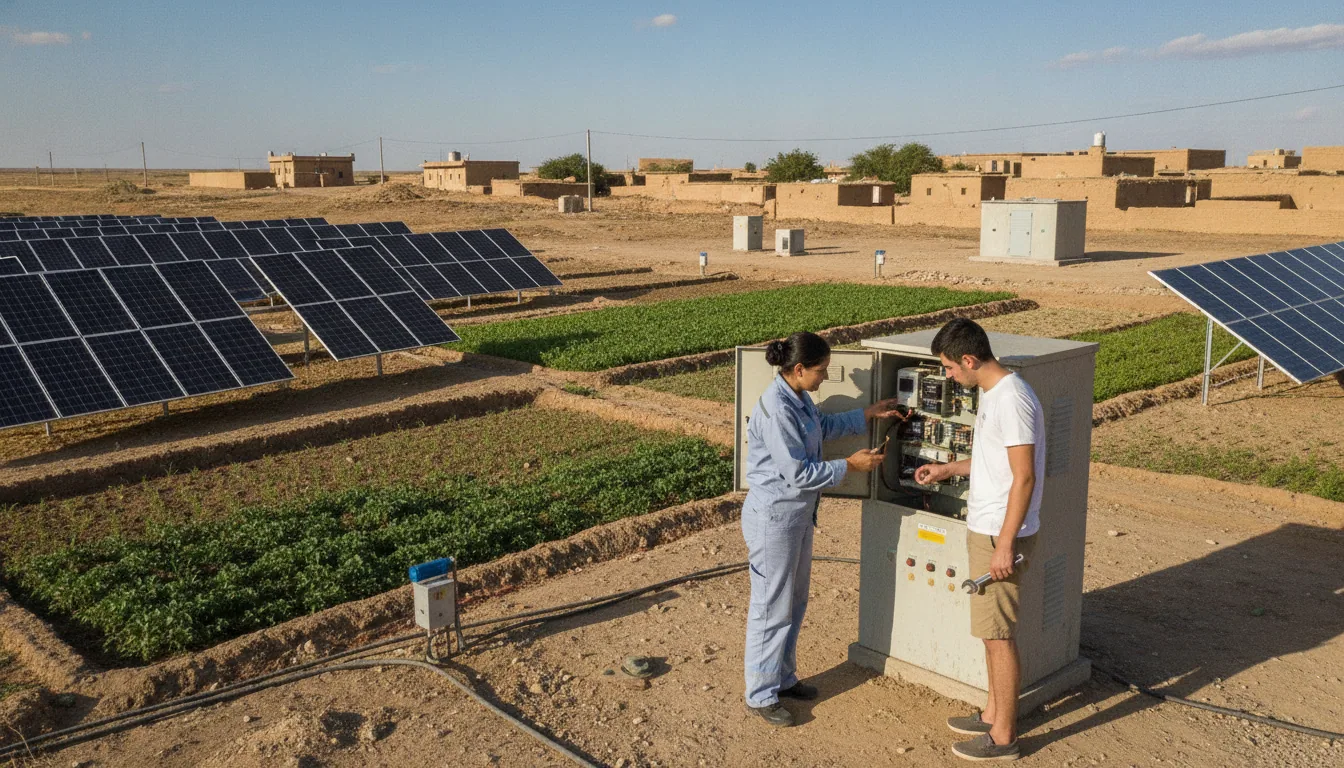
In Kulak, a village in Iraqi Kurdistan, the solar scale paradox plays out at ground level — not as theory, but as running infrastructure. The electricity used to arrive as a negotiation. Diesel generators ran when fuel did, which was not always. Now the village runs on solar power and battery storage, around the clock, and the generators sit idle.
This is not a pilot program awaiting a larger rollout. It is a working system, built deliberately small. Iraq is ranked by the United Nations as one of the most climate-vulnerable nations on Earth, with summer temperatures that regularly exceed 50 degrees Celsius. That kind of heat does not merely make life uncomfortable. It makes refrigeration a medical question, water a survival calculation, and power cuts a genuine emergency. The central grid has not kept pace. Solar, at the village scale, has.
What made Kulak stick where other rural electrification projects have stalled is worth noting: the project prioritized local maintenance training over hardware delivery. That choice is the difference between a working installation and an expensive monument. As one observer put it, the graveyard of development is full of well-intentioned infrastructure. Spare parts without trained hands are just expensive spares.
The paradox embedded in this success is precise. The places on Earth that most need scalable clean energy are the same places the central grid reaches last, if at all. The formal system fails them twice: first by not arriving, then by making decentralized alternatives look like stopgaps rather than solutions. Kulak is not a stopgap. It is an answer to a different, better question: not "how do we extend the grid?" but "what actually keeps the lights on?" The energy transition will not be won in conference halls. It will be won, or lost, in places like Kulak.
Six Ways the Sun Defies Its Own Model
The Sun is the most studied object in the universe, and it still does not behave as advertised. Four paradoxes stand out, each a gap between the model and the measurement, each a reminder that our best physics is an approximation wearing a very convincing suit.
Start inside. Helioseismology — acoustic waves that let researchers read the Sun's interior like an ultrasound — predicts large-scale plasma convection flows moving fast enough to redistribute heat efficiently through the outer layer. The flows Shravan Hanasoge of Princeton, Thomas L. Duvall Jr. of NASA Goddard, and Katepalli Sreenivasan of NYU actually measured are 20 to 100 times slower. That is not a rounding error. It suggests the standard model is missing a physical mechanism, possibly related to magnetic suppression of convection, that no simulation currently reproduces.
Move outward to the surface and above. The Sun's visible surface sits at roughly 5,500°C, which is the number everyone expects. Its corona — the wispy outer atmosphere, millions of kilometres above — reaches 1 to 2 million degrees Celsius. Heat flowing away from a source does not normally accelerate like this. The leading explanations involve magnetic wave dissipation and nanoflares, but neither has been confirmed with the precision needed to close the case.
Then go backward in time. Four billion years ago, the Sun emitted roughly 40% less energy than it does now. Standard physics predicts a frozen early Earth. The geological record shows liquid water, ancient oceans, and the chemistry of a warm planet. Somehow, the atmosphere compensated — perhaps through higher concentrations of CO2 or methane — but the exact mechanism remains contested.
Not every paradox stays open. The Solar Polarization Paradox, which concerned anomalous light signatures in the sodium D1 spectral line and puzzled physicists for decades, was declared resolved in 2021 once researchers properly modelled complex atom-photon interactions. Paradoxes do eventually close. The ones above have not yet.
The Storm Without a Ceiling
For decades, grid engineers designed protection systems around a working assumption: solar storms could only push so much electricity into Earth's atmosphere before the effect plateaued. That assumption is gone. A NASA-led study published in Nature on 15 July 2026 found no physical saturation point, no upper scale limit, for how much energy a geomagnetic storm can dump into the atmosphere. The ceiling was an artefact, not a law.
Nithin Sivadas at NASA Goddard led the study. His team traced the old "limit" back to a systematic measurement error: spacecraft positioned roughly one million miles from Earth introduced distortions that made extreme storm readings look like sensor noise. Move the measurement closer, correct for distance, and the plateau disappears. Previous models were not wrong because the physics changed. They were wrong because the instruments were in the wrong place.
The practical consequence is uncomfortable. Grid protection infrastructure worldwide was sized against historical saturation models. If those models were built on a measurement artefact, the protections may be fundamentally undersized for a sufficiently large storm. That is not a theoretical concern for a far-off future. The Sun is currently near solar maximum.
The energy transition will not be won in conference halls. It will be won, or lost, in places like Kulak.
There is a useful way to hold the scale of any of this. Scientists consider it physically impossible to build an accurate 3D model of the solar system to scale, because the cosmic void between objects swamps everything. The distances are so vast that any model large enough to show the Sun at a meaningful size would require empty corridors kilometres long before you reached the next planet. Scale, here, is not a metaphor. It is the actual problem, and it applies to the storms as much as the distances.
Distance Is Not the Variable You Think
Stand on the surface of Mercury, the closest planet to the Sun, and you would survive temperatures of 430°C. Step instead onto Venus, which orbits 50 million kilometres farther out, and you would face 464°C. Farther from the source, yet hotter. The number is not a typo.
The explanation is atmospheric. Venus is wrapped in a dense blanket of carbon dioxide so thick that atmospheric pressure at its surface is more than 90 times that of Earth's. Heat arrives from the Sun, and then it cannot leave. The atmosphere is not the backdrop to that story. It is the story.
This is not merely a curiosity for planetary scientists. It is a calibration tool. The comparison shows, with uncomfortable precision, that orbital distance from a star matters far less than what a planet does with the energy once it arrives. Composition and pressure are the dominant variables. Distance is secondary.
The analogy for Earth has an honest limit, and it should be stated plainly. Earth is not Venus. A runaway greenhouse effect like Venus's requires conditions — atmospheric mass, composition, feedback loops — that Earth has not yet reproduced. "Not yet" is doing real work in that sentence, but panic is not the appropriate response either. What the Venus comparison actually offers is a clean lesson in atmospheric leverage: a relatively small shift in what surrounds a planet can overwhelm what separates it from its star. That is not a metaphor. That is the physics, demonstrated next door.
The Real Solar Scaling Problem Is Not in Space
China generates more solar electricity than any country on Earth. It also has one of the most frustrating solar scaling problems on Earth, and it has nothing to do with physics. Generation is concentrated in Xinjiang and Inner Mongolia, in the sun-baked west. Demand is concentrated in the industrial east, thousands of kilometres away. The panels work. The geography doesn't.
Iraq faces the same structural mismatch in miniature. National grid failures there are not primarily an energy shortage problem — they are a distribution and infrastructure problem. The sun delivers, reliably. The cables, substations, and state institutions do not. When the grid cannot be trusted, the honest engineering response is to stop waiting for it.
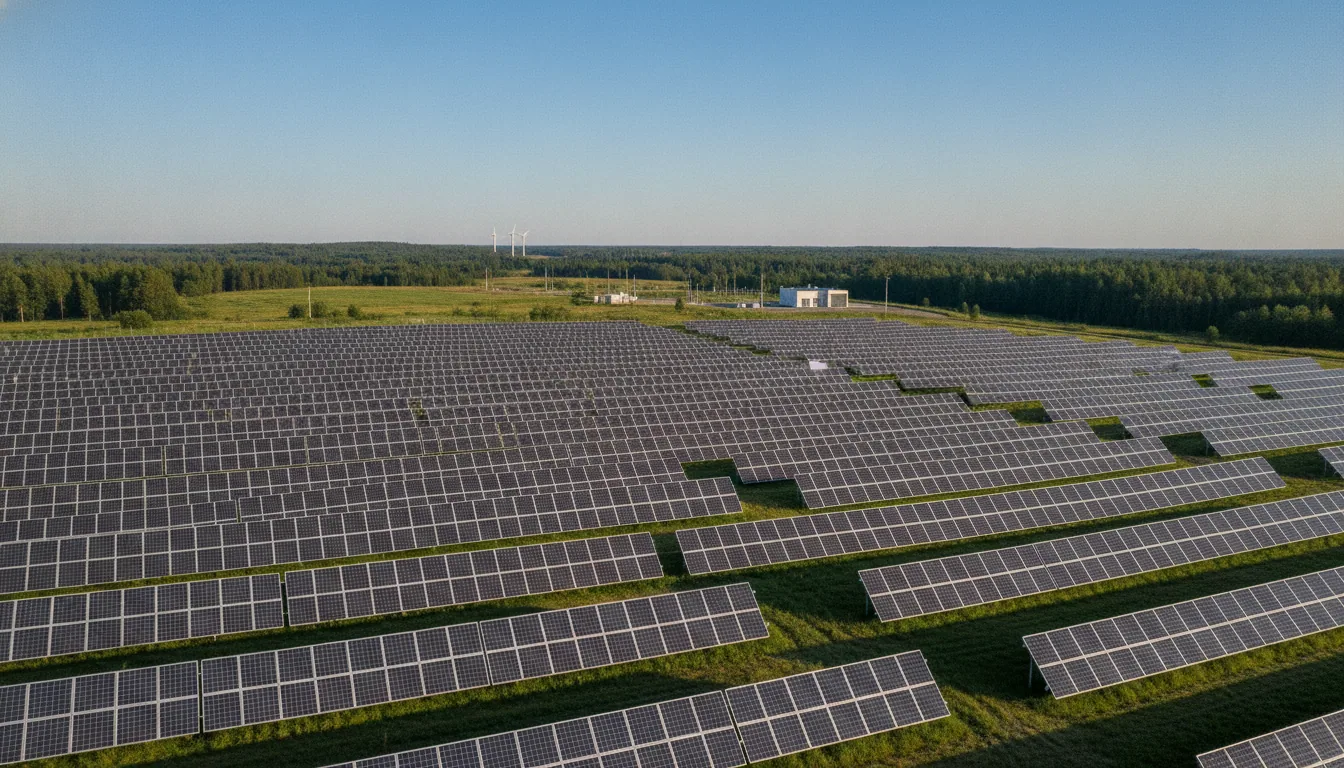
That is exactly what decentralised solar does: it treats the transmission problem as a given and routes around it entirely. A household or village that generates and stores its own power is not dependent on a grid that may never arrive. The bypass is the point.
The economics sharpen the argument further. Big-brand solar installations can cost consumers up to $20,000 more than decentralised or self-assembled kit alternatives. That premium buys branding, warranties, and sometimes genuine service — but it also buys the assumption that centralised, utility-scale rollout is the only professional option. It is not. For the household doing the arithmetic, that gap is real money with a real alternative use.
That's not a gesture. That's a lever. The genuine scaling question is not whether solar can be built large, but whether the infrastructure connecting generation to demand can match the speed at which panels are deployed. In China and Iraq alike, the answer so far is no — and the workaround is the same: go local, go distributed, stop waiting for the centre to catch up.
What We Still Don't Know — and Why That's an Honest Answer, Not a Cop-Out
The Kardashev scale is a useful reality check. It measures civilizational advancement by the total energy a civilization can harness from its star. Humanity currently sits well below Type I, meaning we do not yet fully use what our own planet receives. The scale tells us the direction; it does not tell us the physics.
Some of that physics remains genuinely unsettled. The Sun's core rotation speed is still unmeasured precisely enough to resolve the convection paradox, where observed plasma flows run 20 to 100 times slower than models predict. Until helioseismology can reach that deep with sufficient resolution, any model of solar interior behaviour carries a known blind spot. That is not a failure of science. That is science operating correctly.
At the frontier, polaritons — hybrid light-matter states formed in optical microcavities — are being modelled for many-excitation physics. Whether that translates into practical energy applications remains speculative. The word "speculative" is not a dismissal; it is a status report.
There is also a data gap that deserves plain acknowledgment. Solar farms are mandated to consider impacts on bird diversity. Rigorous population-level data at scale, tracking species distribution across large installations over time, does not yet exist in the published literature. Regulators have required the question. Researchers have not yet answered it fully. Both things are true simultaneously.
Science's track record with its own paradoxes is, on balance, encouraging. The solar polarization paradox, unresolved for decades, closed in 2021. The faint young Sun paradox has several credible candidate explanations. Patterns of resolution matter. The honest position on the solar scale paradox — in physics, in energy infrastructure, in climate modelling — is not certainty, and it is not despair. It is continued, funded, rigorous measurement, by the researchers, agencies, and institutions that have actually demonstrated they can close these gaps.