Wildfire air quality is no longer a local concern but a global infrastructure crisis driven by smoke plumes that travel across oceans and continents.
NASA’s GEOS-FP model currently provides a daily updated, five-day global window into the movement of our shifting atmosphere. It is a working technical tool that tracks smoke plumes across thousands of miles of open sky. That's not a gesture. That's a lever.
The Five-Day Forecast for a Borderless Sky
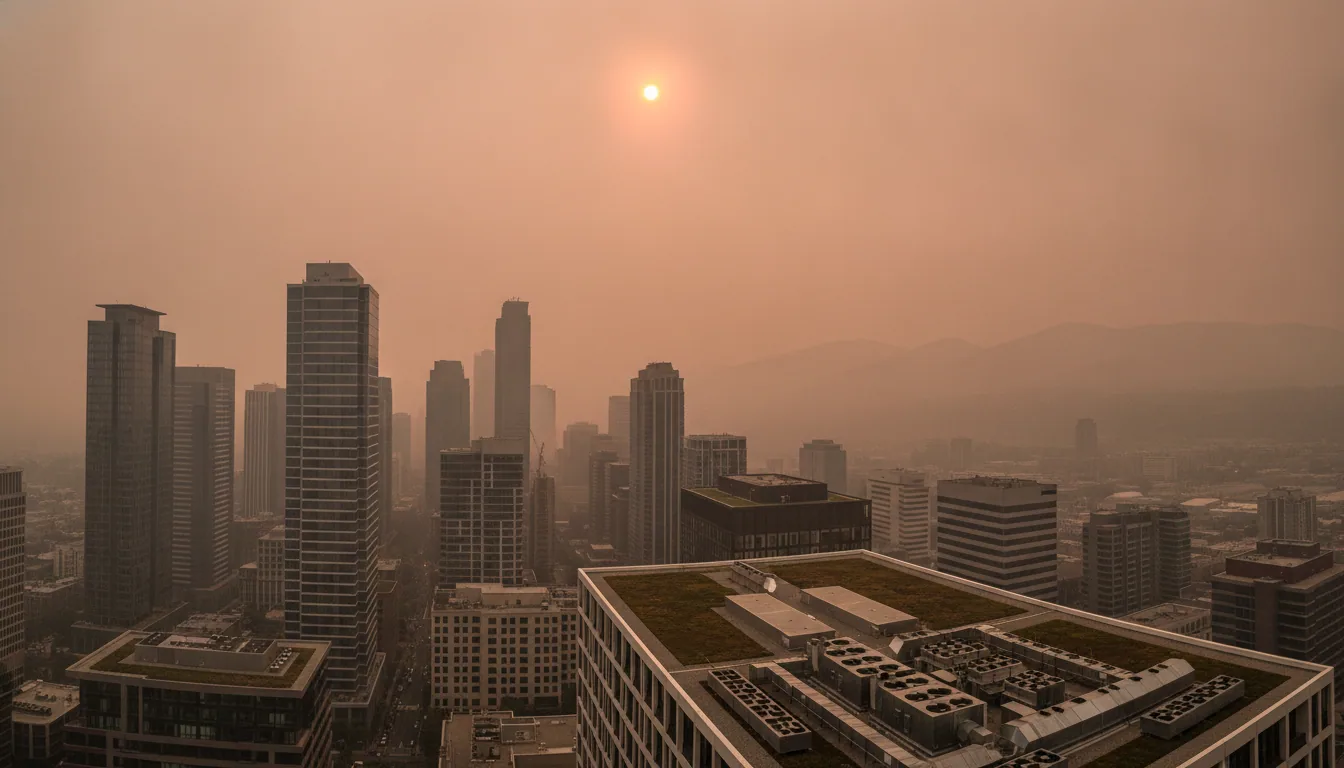
In July 2026, this predictive power became the primary defense for millions of people. As over 800 wildfires burned across Canada, with the majority burning out of control, the model mapped the descent of massive plumes into the US Midwest. Detroit, Minneapolis, and Toronto recorded the worst air quality in the world due to these transboundary events.
It feels like a localized disaster when the sun turns a bruised red, but the data says otherwise. We are dealing with a global feedback loop where smoke from Saskatchewan can trigger hazardous health alerts in New York City within forty-eight hours. Replacing vague anxiety with high-resolution coordinates and time-stamped warnings is the only strategy that actually works.
While we cannot simply stop 800 fires mid-season, we can use these models to move from reactive panic to systematic resilience. The honest scorecard depends on how quickly we integrate this data into our public health response. A hazardous level warning means very little to a household unless it comes with a specific deadline for action.
Tracking Wildfire Air Quality Across the 23-Kilometer Bridge
Wildfire smoke does not behave like the local smog from a factory chimney or a tailpipe. Intense fires generate enough thermal energy to push particulate matter into the stratosphere, reaching altitudes of 23 kilometers (14 miles). At this height, smoke sits above the clouds and rain that would typically scrub the air clean.
This altitude transforms a local disaster into a high-speed global transport system. In 2023, Canadian smoke plumes traveled over 6,000 kilometers across the North Atlantic, impacting air quality in Western Europe and parts of Asia. The atmosphere does not recognize borders, making Manitoba's fire a problem for the entire Northern Hemisphere.
The evidence for this borderless sky is consistent across both hemispheres. Siberian fires in 2023 sent smoke across the Pacific Ocean to reach Alaska and Seattle. When particulates reach the 23-kilometer bridge, they become a shared global health burden.
Despair is just procrastination with better PR.
Why Aged Smoke is More Toxic Than the Source
It feels intuitive to assume that smoke becomes less harmful as it disperses and dilutes. The chemistry tells a different story: sunlight and oxygen trigger oxidative aging that transforms smoke into something more aggressive. Research shows the toxicity of wildfire smoke doubles within hours of emission.
Smoke eventually reaches a peak of four times greater toxicity than other types of particulate matter. This means the hazy, orange sunset seen three states away is often more biologically taxing than the fresh smoke found at the fire line. Aged smoke is a chemical beast that requires a different management approach than local pollution.
In the western United States, PM2.5 levels from wildfires have increased by 5 micrograms per cubic meter over the last decade. While an increase of 5 micrograms sounds negligible, it represents a constant, additive load on the respiratory system. This increase is enough to reverse decades of policy-driven improvements in overall air quality.
Calculating the Human Cost: 100,000 Annual Deaths
Imagine standing on a street corner in Detroit during July 2026. The air is the color of a bruised peach and the skyline has vanished into a thick, metallic haze that tastes of charred pine. Every breath is a delivery system for toxic chemistry that enters your lungs and bloodstream.
Fine particulate matter (PM2.5) from wildfires now causes over 100,000 premature deaths annually. In the landmark 2023 Canadian season, smoke alone was responsible for an estimated 82,100 deaths globally. Smoke is a problem with a known size and a solvable set of engineering solutions.
Projections suggest 70,000 annual deaths by 2050 if our health infrastructure remains unchanged. This is not a doomsday scenario, but a technical requirement for modern city planning. We must treat smoke as a manageable risk through high-efficiency indoor air filtration.
The Global Dimming Paradox and the $106 Billion Bill
The cooling effect of a smoke event is a chemical illusion. Data from 2023 shows a 3-degree Celsius cooling effect that hid a massive atmospheric crisis. Global fires emitted over 8 billion tonnes of CO2 between March 2024 and February 2025.
This CO2 output represents more than double the annual footprint of the entire European Union and stays in the atmosphere for centuries. The 106-billion-dollar price tag recorded by the United Nations is a literal cost to taxpayers and insurers. Wildfire risk is a systemic drain on global prosperity that requires a numerate upgrade to our resilience systems.
We must stop treating smoke as a temporary weather event and start treating it as a permanent economic challenge. The 106-billion-dollar loss is a call for better engineering and smarter land management. That is not a gesture; that is a lever that moves us from theatrical worry to practical protection.
What Actually Works: Fixing the Communication Gap
Most air quality alerts are currently noise, with only 32 percent of materials passing clarity standards. Right now, public health messaging is failing the chemistry. Here is what actually works: using NASA’s GEOS-FP five-day global smoke forecasts to manage building ventilation systems.
For an ordinary household, a PM2.5 increase of 5 micrograms per cubic meter means a measurable spike in respiratory risks. Urban planners must move beyond simple alerts and install high-grade HEPA filtration in public cooling centers. Resilience through engineering turns a hazardous day into a manageable one for vulnerable populations.
The honest scorecard shows our tracking is world-class, but our communication is failing. Local governments must adopt standardized, plain-language protocols immediately. Improving wildfire air quality begins at home by buying a portable PM2.5 monitor and a HEPA filter to move the needle on personal safety.