The Numbers That Made 2026 Different
From January through September 2026, the global average air temperature sat 1.47°C above the pre-industrial baseline. That single figure, confirmed by both the World Meteorological Organization and the Copernicus Climate Change Service, tells you something the headlines mostly missed: we did not briefly spike past the Paris threshold and return. We held it.
Four numbers explain why 2026 was structurally different from prior record years, not simply hotter by a margin. First, a "super" El Niño reached record intensity by December, acting as a force multiplier on every other extreme. Second, 2026 marked the tenth consecutive year that ocean heat content set a new record high. That is a streak, not a spike. Third, sea levels were the highest recorded since satellite measurements began in 1993. These three are connected: the ocean absorbs more than 90% of the excess heat trapped by greenhouse gases, and that stored heat expands the water, raises the surface, and feeds the atmospheric energy that drives storms and El Niño events.
The WMO described the year's climate data as giving new meaning to the phrase "off the charts." The phrase is accurate but not mystifying once you hold the four numbers together. Ocean heat is the engine. Everything else is downstream of it. 2026 did not arrive without warning — it arrived on a baseline that had been moving in one direction for a decade.
Heat, Floods, and What They Cost in Lives
The deaths of 2026 did not distribute themselves evenly. Nepal recorded over 1,410 fatalities from floods and landslides across the year — the single largest human toll in any one country. That number is not a natural fact. It is a construction fact: steep terrain, dense river settlement, and infrastructure calibrated for a climate that no longer exists.
The heat records landed far from the tropics. Germany hit 41.7°C in June. California reached 44°C in March — a temperature the state had never recorded that early in a year. Both are numbers that stress-test the systems built around them: power grids designed for different load curves, hospital capacity planned for different patient volumes, road surfaces specified for different asphalt melting points.
Where the heat did not kill directly, the water did. On March 12, floods in Minas Gerais, Brazil, killed more than 70 people in a single event. Portugal spent January and February under Atlantic storms that damaged rail lines and power grids across two months — not one catastrophic day, but a grinding sequence that exposed how little redundancy modern infrastructure actually carries. A tornado in Delaware added to the year's tally; extreme events in 2026 did not respect their traditional latitudes.
The pattern across all of these events is the same one. Infrastructure was built for the climate of 1970 or 1990. The climate of 2026 arrived with different peak temperatures, different rainfall intensities, different storm tracks. The gap between what was built and what arrived is where the deaths happen. That gap is not a forecast anymore. It is a measurement.
Estonia's Contradictory Year: Record Low Sea, Then a Collapsed Dam
In January and February 2026, the sea around Haapsalu and Dirhami pulled back to -76 cm below normal — a record low, the kind of number that leaves boats resting on mud and harbor masters checking their gauges twice. Five months later, the same country was drowning. Summer 2026 delivered 120% of Estonia's historical precipitation norms, ranking it the 15th wettest since 1922.
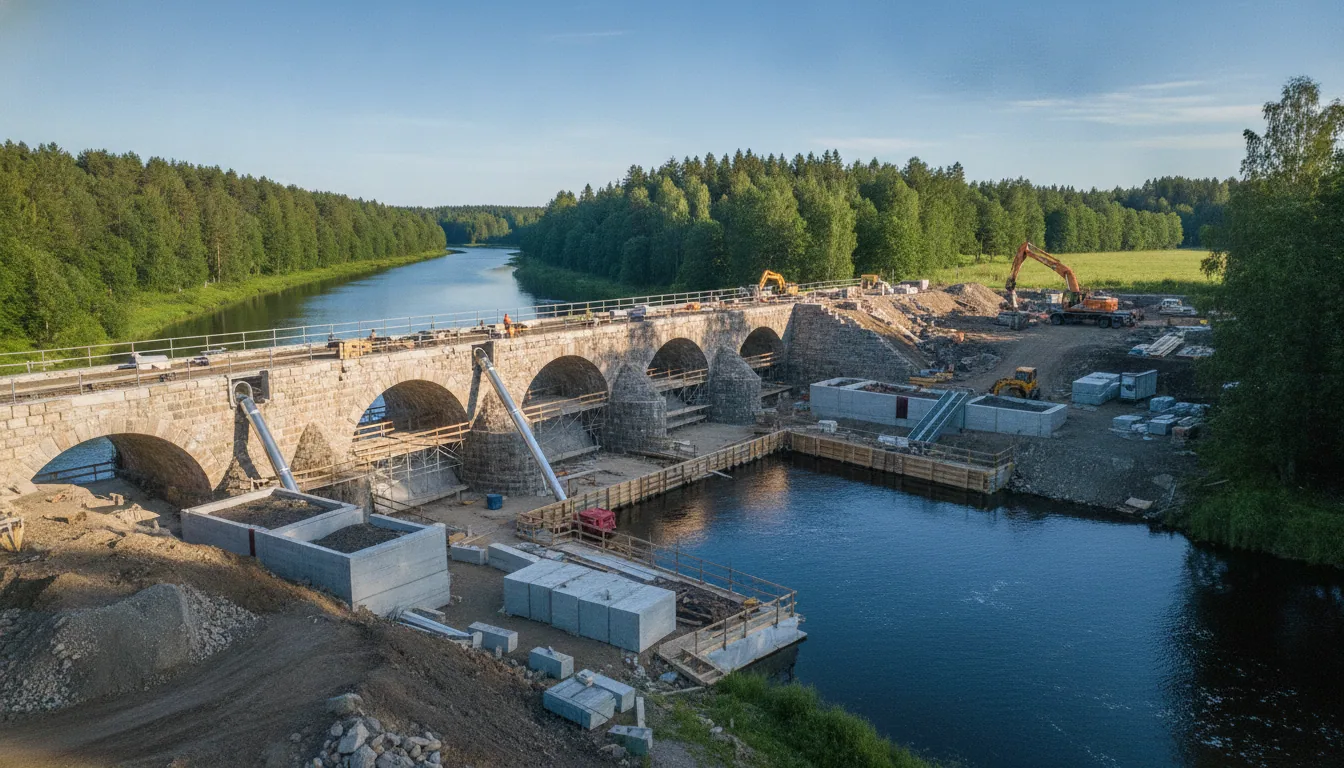
On July 9, the Pokardi dam and bridge in Tõrva collapsed after intense rainfall. Ten people were evacuated. The structure did not fail because it was poorly built for its era. It failed because its era no longer exists.
That is the practical problem hiding inside Estonia's contradictory year: infrastructure designed around historical averages collapses when those averages shift. The engineering was not wrong. The baseline was.
One country, one calendar year: record coastal retreat in winter, record precipitation in summer. The pattern is not random bad luck. It is what hydro-meteorological extremes look like when they arrive in sequence rather than once a generation. The honest question for Estonian infrastructure managers, and for every municipality still sizing drainage and dam walls to the 1980s rainfall tables, is straightforward: which of your structures were designed for a climate that no longer shows up?
When 2026's Climate Disasters Became an Economy Story
The European Environment Agency put a number on it that is hard to ignore: extreme heat cost the EU at least 1% of GDP in 2026. That is not an environmental footnote. It is a macroeconomic line item, sitting alongside interest rates and trade deficits as something that moves the whole machine.
The drought damage runs deeper than the headline figure. Losses to the European energy sector alone reached 2 billion EUR annually, representing 23% of all drought-related costs. Picture a hydropower plant operating at reduced capacity through August, then a gas plant unable to draw adequate cooling water from a river running low. The cascade is not dramatic in the way a flood is. It is quiet, cumulative, and expensive.
The Rhine tells that story precisely. When water levels dropped in 2026, freight barges across the continent slowed or stopped. One river: chemicals, coal, grain, industrial parts — all backed up. The disruption did not stop at the riverbank. It moved through supply chains into factory output, into delivery timelines, into prices. A drought in the German interior became a logistics problem in Rotterdam and a production problem in a factory somewhere further east.
Then there is the insurance layer. As extreme weather events grow more frequent, insurers are recalibrating what they will cover and at what price. Premiums rise, coverage narrows, and in some exposed regions, private insurance disappears. That gap does not vanish. It shifts onto governments, households, or no one.
The EEA framing is blunt: infrastructure must be redesigned, not just repaired. Fixing the same bridge to the same specification is no longer rational engineering. It is expensive delay.
Countries with functional multi-hazard early warning systems lose six times fewer people to natural disasters than those without.
Six Times Safer: The Case for Early Warning Systems
Countries with functional multi-hazard early warning systems lose six times fewer people to natural disasters than those without. Not marginally fewer. Six times. That is the most actionable number to come out of 2026, and it comes from the UN Office for Disaster Risk Reduction. No new technology, no decade-long infrastructure rebuild — just the unglamorous work of monitoring, modeling, and getting information to the right people before the water rises.
Compare that against the alternative. Nepal recorded over 1,410 deaths from floods and landslides in 2026. The question that number forces is not whether the storms were severe — they were — but how many of those deaths were unavoidable versus how many arrived because no one had a reliable fifteen-minute warning. History suggests the gap between those two figures is large.
The technical capacity to close that gap already exists. In 2026, space and ocean monitoring technologies were deployed specifically to help governments and industries anticipate El Niño impacts before they arrived. That is not a proof of concept. That is a working system showing what is possible at scale.
The catch: nearly half of the world's countries still lacked functional early warning systems in 2026, at a build cost that is a fraction of the losses now being absorbed without them. That's not a gesture. That's a lever. The arithmetic is not close, and the blueprint is already written.
The Honest Scorecard: What Is Actually Worth Doing
Treat 1.47°C as a planning number, not a headline. That is the global temperature anomaly Copernicus recorded from January through September 2026 — and infrastructure engineers, city planners, and agriculture ministries need to design against it today, not against the gentler baselines their current standards still assume. The past is no longer a reliable guide to the near future.
Two investments return more than any other. First: multi-hazard early warning systems. The technology is not exotic and the operational cost is modest relative to the losses it prevents — Nepal's 1,410 flood and landslide deaths in 2026 are partly a warning-system story. Second: rebuilding critical infrastructure to current climate loads, not 1990 norms. The Tõrva dam collapse cost ten evacuations; a larger dam, an older grid, a busier rail line would have cost far more.
COP31 in Turkey, November 2026, produced commitments. Commitments are not engineering contracts. The honest question is whether those pledges translate into funded drainage upgrades, retrofitted heat-resilient housing, and national warning networks — within budget cycles that actually exist.
The lessons of 2026's extreme weather events are not abstract: the gap between what we know and what we build is the only gap that still matters. Policymakers: fund warning coverage and enforce updated infrastructure standards. Founders and engineers: build products that price in physical climate risk. Farmers: use seasonal forecasts; they are free and they work. Individuals: skip the symbolic gesture, support the structural lever.