China’s first commercial brain chip, known as NEO (Neural Electronic Opportunity), received official NMPA approval on March 13, 2026, for clinical use. Developed by Tsinghua University and Neuracle Medical Technology, this semi-invasive brain-computer interface helps paralyzed patients regain motor function by decoding neural signals from the brain’s surface.
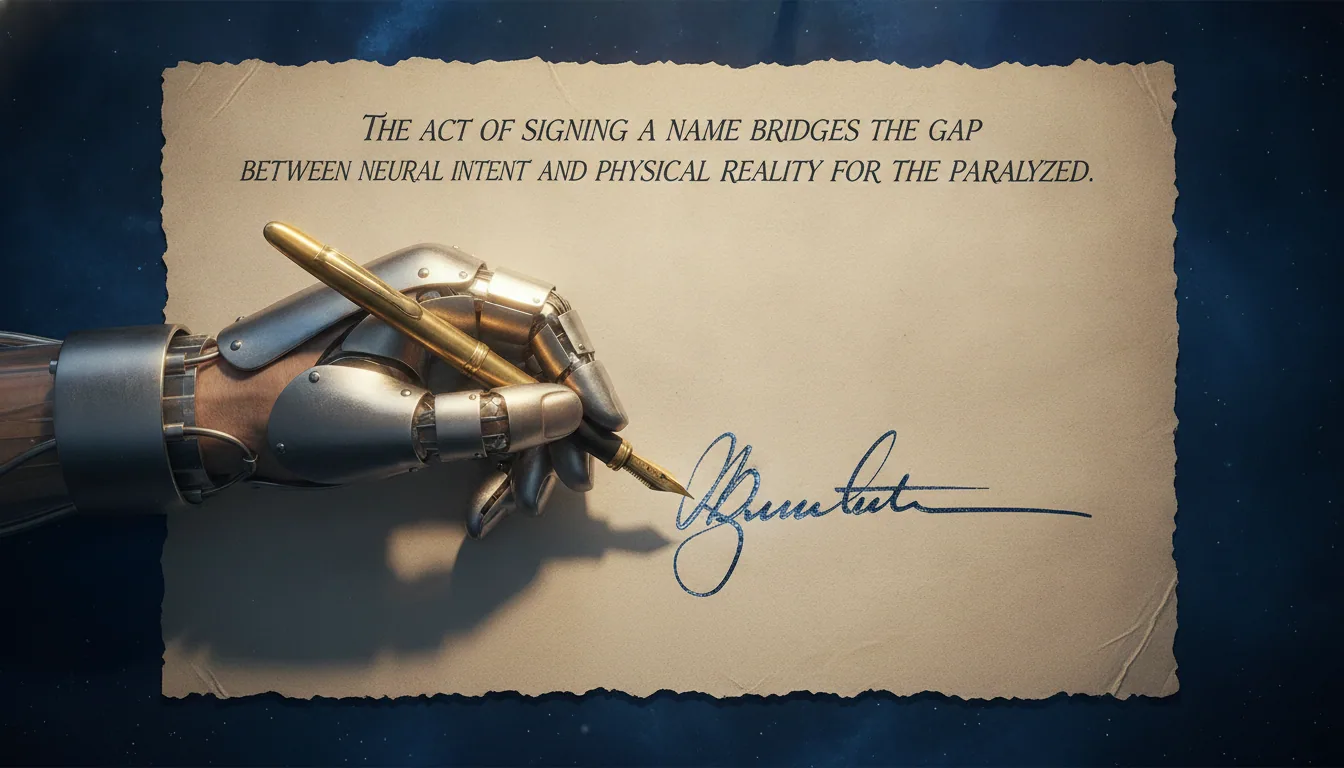
Imagine watching a hand move across a white sheet of paper. For most of us, signing a name is a mindless reflex, a twitch of muscle and habit. But for Dong Hui, those few ink strokes were a miracle.
Dong Hui is paralyzed, the result of a severe spinal cord injury. After 11 months of daily training with a chip in his skull, he finally wrote his name. This act turned a quiet laboratory hope into a loud, undeniable reality.
The Chinese National Medical Products Administration (NMPA) granted commercial approval to NEO as a translator for the mind. Developed by Neuracle Medical Technology and Tsinghua University, NEO beat global competitors like Neuralink to the pharmacy shelf.
To someone standing here in 1610, this would have been indistinguishable from magic. Even today, the idea of a chip translating a thought into a physical motion feels like a leap across a canyon. But for the 36 patients in the initial trials, that canyon just got a lot narrower.
The NMPA gave NEO a Class III medical device certificate, its highest level of regulatory scrutiny. This means the device is treated with the same gravity as a heart valve or a pacemaker. It is no longer just a breakthrough; it is a tool doctors can actually prescribe.
Knocking on the Brain’s Front Door
To understand how NEO works, we have to look at the geography of the human skull. Most brain-computer interfaces act like uninvited guests, using tiny needles to pierce the brain to catch signals. This creates a biological stalemate where the brain eventually wraps those needles in muffled scar tissue.
NEO does not enter the house at all; it sits on the porch. The designers at Tsinghua University chose a semi-invasive path by placing the chip on the dura mater, the brain's leather-like protective jacket. This placement means the device is technically outside the brain, yet close enough to listen.
By resting on this membrane, the eight wireless sensors avoid the neuro-inflammatory response that often ruins deeper implants. While this keeps the brain tissue healthy, it presents a significant challenge for physics. Distance naturally muffles any electrical signal.
It is the difference between being inside a room and listening through a thick wall. For the NMPA, this trade-off acted as a regulatory shortcut for a Class III medical device. By prioritizing safety-first design, Neuracle moved to the commercial market while competitors were still navigating clinical trials.
The Engineering Behind China’s First Commercial Brain Chip
Designing electronics that survive inside a human body is notoriously difficult. It requires more than just clever coding; it requires a deep understanding of how warm biology reacts to silicon. It took a partnership between Tsinghua University and Neuracle Medical Technology to bridge that gap.
The hardware is elegant, using eight wireless sensors to pick up neural signals through the protective layers of the head. This is what researchers call neural decoding, or the art of turning a thought into a digital pulse. We only need to hear eight specific voices in the crowd of neurons to achieve basic motor control.
The human story has always been about narrowing the gap between a thought and an action.
Scientific breakthroughs are rarely sudden sparks; they are built on the foundation of grueling repetition. This careful testing through 36 separate clinical procedures was the only way to prove the bridge actually worked. This massive evidence base is why the device received its high-level certificate.
Each procedure was another rung on a ladder of understanding for the researchers. The "aha" moment arrived as something felt through years of data, not just promised in a pitch. This level of rigor is what turns an experimental surgery into a routine medical option.
The Industrialization of Intention
The NEO system uses neural decoding to turn a thought into a digital command. The chip sends those commands to a pneumatic robot glove, a web of tubes and soft actuators that fits over a paralyzed hand. When the patient thinks about gripping a glass, the chip triggers the air pressure that curls the mechanical fingers.
This technology is currently tailored for patients between the ages of 18 and 60 who live with quadriplegia. These are years usually defined by movement and career, making the loss of autonomy particularly devastating. The regulators are making a pragmatic bet on restoring autonomy and moving people from permanent care back into the active world.
Innovation often fails because it remains a luxury that nobody can afford. China has bypassed this hurdle by assigning a formal health-insurance product code to NEO immediately upon its commercial approval. This moves the device from being a laboratory miracle to a routine medical procedure.
Two Paths Through the Gray Matter
To see where NEO fits, we have to look at its biggest rival across the Pacific. Elon Musk’s Neuralink often grabs headlines with its N1 chip, a device that uses thousands of tiny threads to pierce the brain. While Neuralink targets high-resolution data by going deep, China’s NEO has taken the lead by staying on the surface.
By early 2026, the Neuralink N1 remained in clinical trials with just 21 participants. The American approach is a performance-first philosophy, aiming for the highest possible signal. In contrast, China’s NMPA prioritized a safety-first regulatory path by placing the chip on the thick protective skin of the brain.
This is not just a two-player game between giants. A second wave of Chinese technology is already gathering pace. The Beinao-1 project is currently targeting 2028 for an approval that could help patients with ALS regain speech and movement.
We are watching two different maps being drawn of the same territory. One map prioritizes the sharpness of the image, while the other prioritizes a safe path for the traveler. To someone standing here in 1610, this choice would have been indistinguishable from magic.
The Horizon of the Unwritten
We have the regulatory approval, but the ledger is still missing its most practical numbers. The NMPA granted NEO its Class III medical certificate on March 13, 2026, yet the retail price remains a secret. We do not yet know the final cost of the implant or the specialized surgery required.
For the patients who qualify, the price tag will determine if this is a common tool or a rare privilege. Then there is the matter of endurance. While clinical procedures have proven the system works, the long-term durability of these sensors in a corrosive biological environment remains to be seen.
We do not yet know if the neural signal will hold its clarity after a decade. If the bridge fails, the silence returns. There is also the question of functional range; right now, NEO translates motor intent, helping Dong Hui write his name. We still don't know if the system can be adapted for non-motor tasks like speech.
That is the best part of the story. To someone standing here in 1610, this would have been indistinguishable from magic. Today, it is a matter of engineering and stubborn, rigorous patience. While China’s first commercial brain chip is just the beginning of a long road, the map is finally being drawn from the inside out.