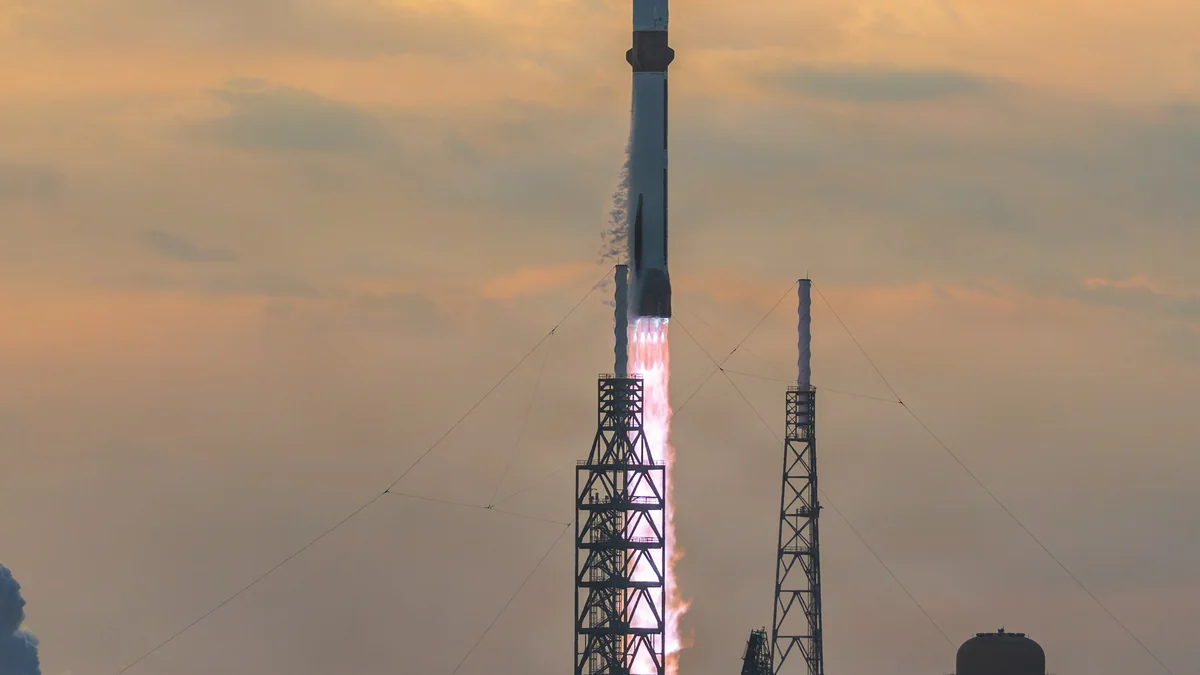
The Blue Origin New Glenn explosion occurred on May 28, 2026, during a static fire test at Launch Complex 36, resulting in the total destruction of the company's fourth heavy-lift vehicle. While all personnel remained safe, the massive fireball caused significant damage to the launch infrastructure and forced an indefinite suspension of future missions.
21:00 at the Cape: When a Static Test Becomes a Fireball
Imagine standing near Launch Complex 36 at Cape Canaveral. It is 21:00 on May 28, 2026, and the Florida humidity is thick enough to chew. You are waiting for the familiar, controlled thunder of a static fire test.
To someone watching from a distance, a hot-fire test looks like a launch that simply changed its mind. The rocket is bolted firmly to the pad while its engines roar at full throttle. On this night, the chains were the only thing that worked as planned.
The fourth New Glenn rocket was undergoing this routine check when something went catastrophically wrong. Instead of a controlled burn, a massive fireball erupted, illuminating the coast for miles. The shockwave was powerful enough to shake the walls of nearby homes.
We often treat these machines like invincible monuments, but they are really just thin metal balloons filled with volatile fury. When the vehicle was consumed by the flames, the manifest was ruined, but the most important components survived.
Blue Origin reported that all personnel were safe and accounted for. In a field where we regularly dance with explosive physics, that is the only win that truly matters. A rocket can be rebuilt, but the people who understand how it works are the real hardware.
The Seven-Meter Giant: Translating the Scale of New Glenn
To understand why this explosion rattled windows miles away, we first have to grapple with the sheer, improbable size of the machine. New Glenn is a 98-meter tower of precision engineering, standing nearly as tall as the Statue of Liberty.
The seven-meter diameter is what really defines its presence. Most modern rockets look like slender needles, but this vehicle is a thick, heavy-lift giant. To someone standing here in 1610, this would have been indistinguishable from magic.
The first stage relies on seven BE-4 engines firing in perfect synchronization. Seeing seven of these beasts fire at once is like watching a localized earthquake. Above those sits a second stage equipped with BE-3U hydrogen burners.
Jeff Bezos has poured at least 2.5 billion dollars into this project. This was an investment meant to challenge the very limits of orbital flight. That sum could buy a fleet of luxury cruise ships.
Every piece of this 98-meter stack was a bet on a reusable future. When the fourth vehicle disintegrated, it wasn't just metal that vanished. It was years of calibration and billions in capital, turned into a cloud of orange smoke.
A Pattern in the Smoke: The Long Road from 2024
In the high-stakes game of rocketry, progress is rarely a straight line. To understand why engineers are staring at their data with such grim faces, we must look back at the momentum Blue Origin had built.
The journey began in earnest on January 16, 2025, with the successful inaugural NG-1 flight. By November 13 of that same year, they achieved their first booster landing. To someone standing here in 1610, this would have been indistinguishable from magic.
The rhythm of success broke sharply on April 19, 2026, when a second-stage engine issue derailed the NG-3 mission. This resulted in the total loss of the AST SpaceMobile BlueBird 7 satellite. This was a very real and expensive blow to their growing commercial promises.
Warnings were present back in August 2024, when two hardware failures occurred during a factory stress test. We often treat these ground anomalies as part of the necessary friction of pioneering engineering.
The math of a heavy-lift rocket is a fragile balance between controlled power and total destruction.
This May 2026 explosion is the latest data point in a long, difficult struggle with massive scale. We still don't know the cause, and that is the best part because it points toward the next great adventure.
The Kuiper Delay: 48 Satellites and a Quiet Sky
Forty-eight satellites sit in an expensive, vibrating silence in a cleanroom not far from the charred remains of Launch Complex 36. These are the nodes of Project Kuiper, Amazon’s answer to global connectivity. They were scheduled to be tucked into the fairing by June 4.
Instead, they are high-tech orphans of a test gone wrong. We think of space as infinite, but the path to get there is a narrow door. When a rocket explodes on the pad, it ruins the door itself.
The damage to the infrastructure at the Cape is significant, turning a busy launch pad into a restricted debris field. For Amazon, Project Kuiper is a vast web of orbiting routers designed to wrap the Earth in high-speed internet.
Every day these satellites stay on the ground, competitors tighten their grip on the market. It is a high-speed game of musical chairs played at seventeen thousand miles per hour.
The FAA and Blue Origin have suspended all flights indefinitely. Today, it looks like a logistical bottleneck that could last for months. The scale of this network is so large it stops meaning anything.
A single thermal anomaly has silenced 48 voices that were meant to speak to the world from orbit. We still do not know when they will get their turn.
The Blue Origin New Glenn Explosion and the Artemis Ripple Effect
In 2016, SpaceX saw a Falcon 9 vanish in a fireball on the pad. It took them over a year to recover and fly again. Blue Origin now faces a similar reckoning at Launch Complex 36.
LC-36 is the only gate New Glenn has to the stars. If the support towers are warped or the cryogenic plumbing is shredded, the manifest stops cold. Infrastructure is often harder to replace than the vehicle itself.
NASA Administrator Jared Isaacman is watching the soot settle with concern. The agency is currently evaluating the explosion's impact on the Artemis moon program. NASA isn't just an observer; they are a customer with an expensive appointment.
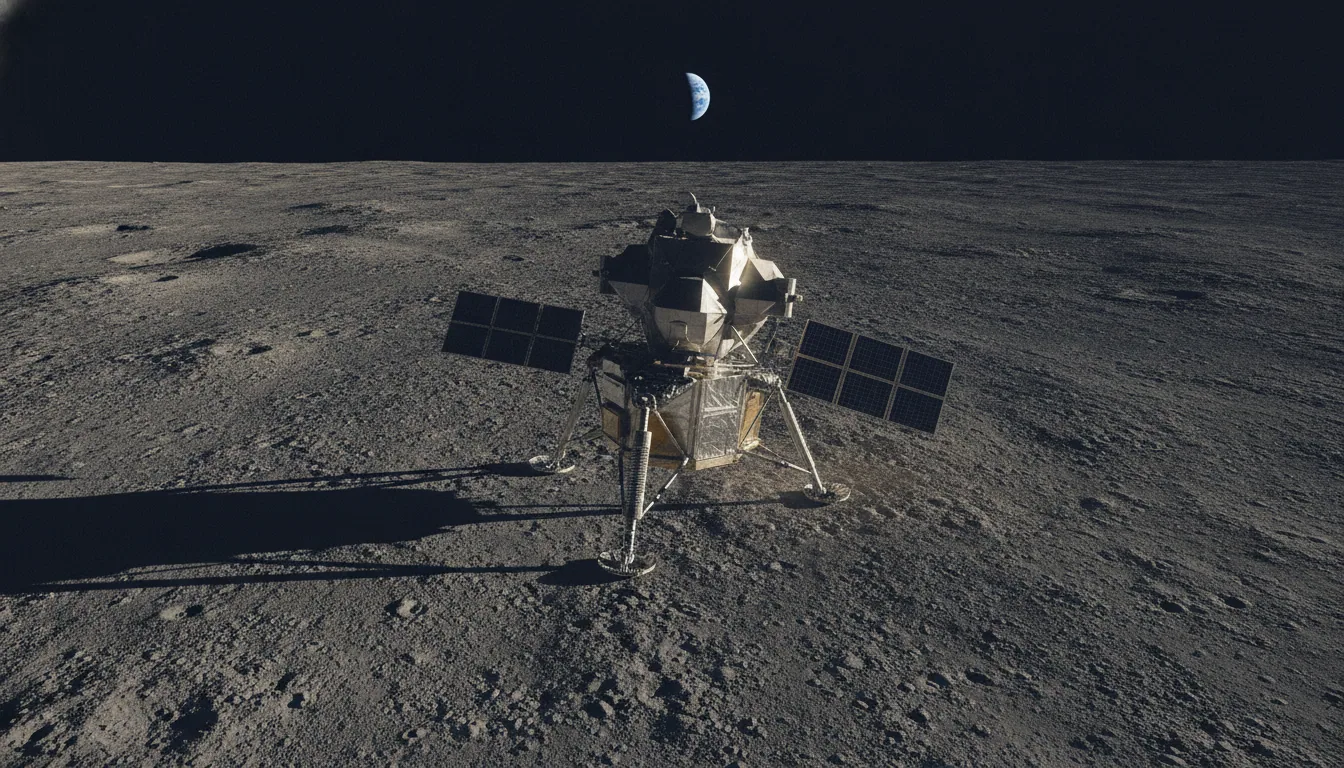
Blue Origin’s Blue Moon Mark 1 lander depends entirely on this vehicle. It is the heavy lifter designed to carry the hardware for our return to the moon. Without New Glenn, that lander is effectively a high-tech sculpture.
If the launch schedule slips significantly, the entire lunar timeline begins to wobble. We still don't know the full extent of the site damage. That is the part that keeps mission planners awake at night.
Every day the pad stays silent is a day the moon stays just a little bit further out of reach. It is a reminder that the ground can be as dangerous as the vacuum.
'Rockets are Hard': The Science of the Unfinished Adventure
Jeff Bezos called it "a very difficult day." For a company with a 66 percent success rate, those words carry the weight of billions in lost hardware. New Glenn had reached orbit exactly twice out of three total attempts.
Space flight has a way of humbling even the deepest pockets. Elon Musk, no stranger to launch pad craters, noted it was "most unfortunate" because "rockets are hard." This mirrors the 2016 SpaceX AMOS-6 disaster, where a test turned a vehicle into a scrap yard.
One tiny cryogenic leak or a thermal state anomaly can ruin a billion dollars of work. Keith Cowing of NASA Watch observed that this event "certainly changes things for NASA’s Artemis plans." The lunar timeline depends on these massive, temperamental pillars of fire.
We still don't know the specific cause of the anomaly, but sifting through the telemetry data is the best part. We are left with a charred pad and a mountain of numbers to climb. Whether we reach the lunar south pole on schedule remains a question parked on the horizon, obscured by the smoke of this Blue Origin New Glenn explosion.