Seventy-Six, and Every One of Them Has a Name
Seventy-six. That is the whole number of Southern Resident killer whales alive on the planet as of the July 1, 2026 census — and orca conservation researchers don't just know the count, they know every individual. Each animal has a name, a known history, a pod affiliation, a face recognizable by the notch pattern on its dorsal fin.
That intimacy of scale is not accidental. The Center for Whale Research has conducted this census every year for 51 consecutive years, building a longitudinal record with no parallel in cetacean science. It is less a population survey than a family register, updated annually with the same meticulous attention a parish clerk might once have brought to births and deaths in a small Estonian village.
The 2026 tally brought two additions: K47 and L130, two new calves whose arrivals were recorded with the particular mixture of relief and held breath that now accompanies every birth in this population. Relief, because any addition to 76 is statistically significant. Held breath, because the odds against a calf surviving to adulthood in this depleted ecosystem are steep enough to make celebration feel provisional. The names are entered. The watching continues.
The Salmon That Shrank, and What That Means for a 69 Percent Failure Rate
Start with a salmon. A hundred years ago, a Chinook pulled from the Pacific Northwest's rivers could weigh over a hundred pounds — a substantial, calorie-dense animal, the kind of prey worth diving for. Today, the average Chinook weighs 12.5 pounds. That is not a different fish in some minor respect. That is a collapsed food source, an eight-fold reduction in the energy a Southern Resident receives per catch. For a predator whose entire evolutionary history was built around chasing large, fatty salmon, this is not an inconvenience. It is an arithmetic disaster.
The body absorbs the shortfall in a precise and ugly way. When prey is scarce, orcas burn their blubber for energy, as any mammal would. The problem is that blubber is also a chemical warehouse. PCBs, DDT, flame retardants — legacy toxins from decades of industrial and agricultural contamination — accumulate in fatty tissue and sit there, inert, so long as the fat stays put. Nutritional stress unlocks the warehouse: the same crisis that starves an orca also floods its bloodstream with the toxins it had safely sequestered, compounding the physiological damage at precisely the moment the animal can least absorb it.
The reproductive outcome of this cascade is documented and bleak. Sixty-nine percent of Southern Resident pregnancies end in miscarriage, nearly all traced to nutritional stress. Sit with that number. More than two in three pregnancies fail before a calf draws breath. And the hunting itself is now harder than it should be: vessel noise in the Salish Sea interferes with the echolocation Southern Residents use to locate salmon, making an already-scarce prey harder to find. The chain runs from a depleted river, through a shrinking fish, through a poisoned mother, to a calf that never arrives. That chain is exactly what the monitoring effort is trying to make visible, link by link.
Drone Technology and the Breath That Carries a Diagnosis
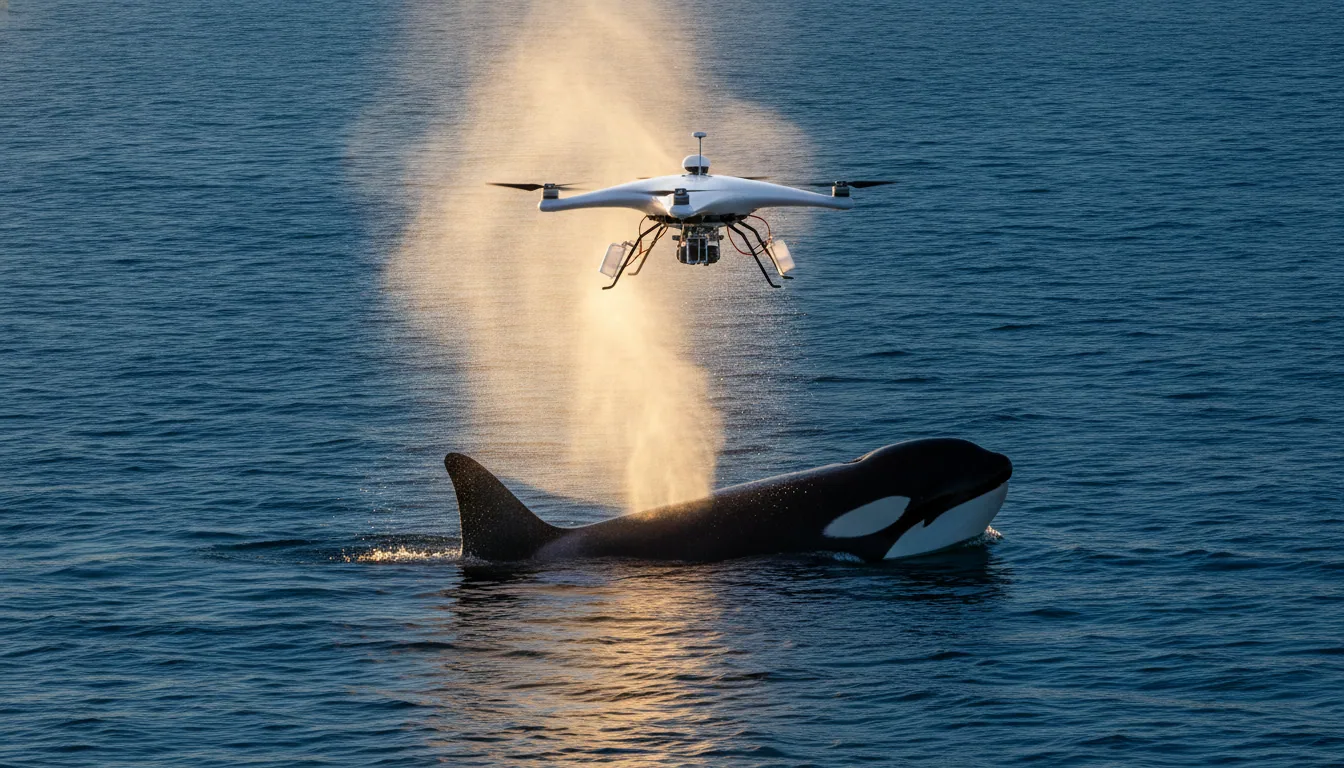
Picture a petri dish strapped to a drone, hovering six meters above a surfacing whale. The animal exhales. The plume — warm, misted, full of biological information — rises directly into the collection plate. In under a second, researchers have bacteria, hormones, and DNA they would otherwise need to draw from a biopsy dart.
That single maneuver is doing the work of several labs at once. The blow sample tells you about respiratory health, reproductive status, and stress chemistry. Meanwhile, infrared sensors mounted on the same drone scan the orca's surface temperature, flagging inflammation before it shows up in behavior — before the animal starts swimming differently, eating less, falling behind. By the time an illness is visible from a boat, it has usually been running for weeks. From above, you can see it earlier.
The photogrammetry work is starker still. Researchers use aerial photographs to measure body proportions with the same precision a tailor uses a tape measure. The specific thing they are looking for is called "peanut head" — a visible constriction just behind the skull where the neck meets the body. It develops when a whale has been burning blubber long enough that the fat reserves directly behind the skull are depleted. Finding it means advanced starvation. Missing it, in a population where 69 percent of pregnancies already fail, means losing time you do not have.
Across more than 1,000 documented drone flights, the orcas showed measurable behavioral reactions only 4.3 percent of the time.
That figure is the core justification for the entire approach. Traditional health assessments required boats to close within meters of the animals, which causes stress and interrupts foraging. The drones accomplish more, from farther away, with less disruption. That is not a minor improvement. For a population of 76, it is the difference between watching and actually knowing.
One Nautical Mile, One Dog, One Floating Archive
Eba does not look like a research instrument. She is an 11-year-old rescue dog, mix-breed, working the bow of a research vessel somewhere in the Salish Sea. Her handler, Dr. Deborah Giles of Wild Orca, watches her nose. When Eba locks on a scent and orients downwind, the crew follows her line of sight. The target, invisible to every human on deck, is a smear of orca feces floating on the surface, up to one nautical mile away. That is roughly the distance a person can walk in twenty minutes. Eba crosses it with her nose alone.
The sample she finds is not simply waste. It is an archive. Each collection carries a compressed record of that animal's recent life: hormone levels that reveal pregnancy status, stomach contents that map what the whale has been eating, and a chemical ledger of everything its body has stored over decades. That ledger makes for uncomfortable reading. Scat analysis has found PCBs, DDT, and flame retardants locked in orca blubber — legacy toxins from industrial decades that never fully left the food chain. When a whale burns fat during lean salmon months, those compounds re-enter its bloodstream in a pulse. The scat catches that signal.
Now something new has been added to the ledger. Microplastics and synthetic fibers have recently appeared in scat samples, a category of contamination that no one was measuring twenty years ago. Tucker, a now-retired detection dog, gathered over 300 samples across his career, a dataset that would have taken a conventional search effort a staggering number of seasons to match. Each sample he found is a data point. Together they form something rarer: a longitudinal portrait of a population's chemical burden, written by the whales themselves.
What the Cameras Witnessed: Kelp Play, Shared Meals, and a Population Adapting
A researcher on a boat would never have seen it. An orca lifts a strand of bull kelp, passes it to another, receives it back. The behavior, which scientists now call "allokelping," was documented only because a drone was watching from above, far enough away not to matter, close enough to record everything.
A hydrophone array or a biopsy dart would have captured none of this. That is the point. Each tool type asks a different question of the whale. The drone asks: what does your body look like, and what are you doing? The scat, retrieved by Eba a nautical mile downwind, asks: what are you carrying inside? Blow chemistry asks: what is your breath telling us? Alone, each answer is partial. Together, they produce a health portrait with genuine depth.
Then there is the sharing. Southern Residents distribute prey among pod members significantly more often than their Northern Resident cousins do — researchers interpret this as a collective response to salmon scarcity, the population pulling toward each other as the food supply pulls away. It is, depending on how you look at it, either heartening or heartbreaking, and probably both.
Social adaptation is real. It is also not a solution. Behavior can change; the need for Chinook salmon cannot. The whales are adjusting. The ecosystem has not.
K47, L130, and the Questions the Data Cannot Yet Answer
Two new calves entered the census in 2026. Their names are K47 and L130, and right now that is almost everything we can say about their futures. Historically, 69 percent of Southern Resident pregnancies end in miscarriage; the calves that are born carry that same statistical shadow forward into their first winters.
Whether salmon recovery can outpace population decline is the central question the killer whale protection effort illuminates but cannot answer. Drone photogrammetry and scat analysis now supply a precision the data never had before — body condition scores, hormone curves, toxin loads measured across seasons. That precision shows the problem more clearly; it does not dissolve it.
There is a further edge to the detection envelope. Microplastics and novel flame retardants are appearing in scat samples, but their specific reproductive effects remain unmeasured. The tools that found them are newer than the chemistry they are tracking.
Here is something the instruments cannot map at all. When researchers analyzed public comments on orca conservation, they found sentiment that blended trust, joy, and genuine grief in proportions that resisted easy summary. People were not simply rooting for a species. They were processing something about loss, about belonging, about what a coastline is allowed to become.
That is the frame the data lives inside. Seventy-six animals, two new calves, a salmon run still far short of what it needs to be — and an open, unresolved question about whether the speed of understanding will ever quite match the speed of what is disappearing. The work of Southern Resident orca conservation is not finished when the drone lands or the dog finds her sample. It is finished, if it is ever finished, when the fish come back.