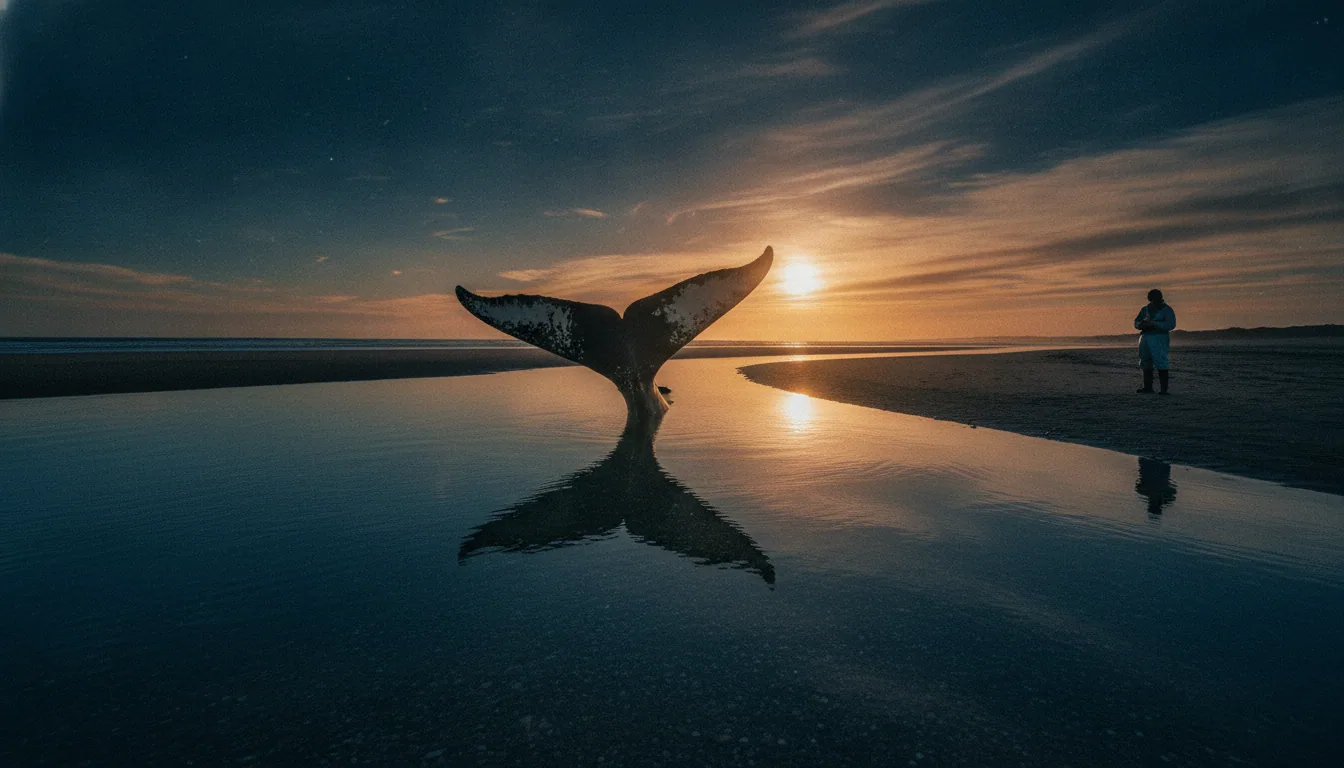
Dead Calves on El Doradillo Beach
The 2026 whale nursery crisis left its first evidence at El Doradillo Beach in the worst possible form: small bodies, scattered across the sand south of Puerto Madryn, where southern right whale mothers had come, as they always do, to give birth in the shallow green waters of Patagonia's nursery coast.
The numbers were wrong. Not slightly elevated, the way a bad season looks. Record numbers of calves washing ashore dead, their lives measured in days or weeks, their carcasses outnumbering anything researchers had documented before on this stretch of Argentine coastline.
Here is the strange part. Elsewhere in the ocean, a different species was posting its best birth numbers in nearly two decades. The same season that was killing calves in Patagonia, a closely watched population on the other side of the Atlantic was producing more new lives than at any point since 2009.
Two threads run through this crisis, and they are not the same thread. One is biological: bacteria are suspected in the Argentine deaths, though scientists have not yet identified the specific strain or its source.
The other is systemic, slower, and harder to fix. It runs through warming seas and shrinking food supplies and a conference room in Tasmania where the same vote failed for the twenty-fifth consecutive year.
Neither thread, followed alone, will explain what is happening to the world's whale nurseries in 2026.
What Is Killing Whale Calves — and Why the Answer Is Complicated
Bacteria are the suspect most investigators point to first. Researchers examining the Patagonian calf deaths have identified bacterial infection as a likely contributing cause, though the specific strain and its source remain unconfirmed. That honest uncertainty matters, because it keeps us from settling too quickly on a single villain.
The harder truth is that bacteria rarely kill in isolation. A calf born to a well-nourished mother arrives with a stronger immune system, more blubber reserves, and a better start at surviving the pathogens that patrol every ocean. When mothers are stressed and underfed, their calves enter the water already compromised, and an infection that a healthy newborn might shake off becomes fatal.
The bacteria may be the final blow, but the setup was written earlier.
That setup begins at the feeding grounds. Dr. Claire Charlton, a researcher at Flinders University, found that southern right whales in the Great Australian Bight have quietly stretched their calving cycle from three years to four or five. Put it in human terms: imagine a population where the average gap between pregnancies doubled.
The reproductive slowdown does not announce itself with a headline; it bleeds the numbers slowly, year by year, until the deficit becomes a crisis. For a species that needs a minimum number of new calves each year just to hold its ground, this is the difference between recovery and collapse.
The mechanism connecting these threads is food. Krill and forage fish populations under pressure from warming, altered currents, and industrial fishing leave nursing mothers in a state of chronic energy deficit.
Stressed bodies produce longer gaps between pregnancies and weaker calves. Weaker calves fall to bacteria. The chain is short, and every link is under strain.
The Vanishing Gray: A Population in Free Fall
Seven thousand whales. That is the gap between where the Pacific gray whale population stood in 2019 and where it stands today. Twenty thousand animals swam those coastal migration routes seven years ago. Fewer than thirteen thousand do now.
To make that concrete: imagine every person in a small Estonian city simply gone, vanished into an ocean that left almost no trace.
The mechanism is a cascade, and it starts at the top of the world. As Arctic sea ice retreats, the shallow, cold-water habitat that sustains amphipods — the tiny shrimplike crustaceans gray whales depend on — shrinks with it.
Less ice means warmer, deeper water where amphipods struggle. Whales arrive at their feeding grounds and find a pantry that has been quietly emptied. They migrate south carrying less fat than they need, and the ones carrying calves carry less still.
What NOAA and the Marine Education and Research Society (MERS) have documented is almost certainly the tip of the problem. By July 2026, confirmed strandings stood at 145. By autumn, the number had risen to at least 187 along the U.S. West Coast.
But MERS estimates the true death toll for 2026 sits somewhere between 1,015 and 3,625 animals. Roughly ninety percent of gray whale carcasses never reach a beach. They sink.
We count the ones the ocean returns to us, and the rest are arithmetic.
An unusual detail from September sharpens the picture. El Niño conditions pushed a pod of thirteen killer whales into Newport Beach, California, an appearance striking enough to draw news cameras.
Orcas following warm water anomalies into nearshore urban areas is not normal behavior. It is ecosystem displacement wearing a dramatic face, the kind of thing that looks like spectacle until you understand what it signals.
NOAA has formally designated the gray whale crisis an Unusual Mortality Event. The designation triggers additional resources and coordinated investigation. What it cannot do is put the amphipods back.
Twenty-Three Calves, and Why That Is Not Enough
Sometime in early 2026, a North Atlantic right whale calf took its first breath in the cold green waters off the southeastern United States. Then another. Then another.
By the end of the calving season, researchers counting from small planes and research boats had tallied 23 births, the highest number since 2009. For a moment, that felt like something worth holding.
It is worth holding. Twenty-three calves are twenty-three chances, and the people who spend their careers watching this species through binoculars know how rare good news is. They let themselves feel it.
Then comes the arithmetic.
Approximately 380 North Atlantic right whales remain alive on the planet. Not in a region, not in a hemisphere — on the entire planet. To put that in human terms: if every individual gathered in one place, they would fit inside a small concert hall.
The International Fund for Animal Welfare estimates the species needs at least 50 calves born each year just to stabilize, not recover — stabilize. Twenty-three is less than half that threshold. The baby boom is real, and it is still not enough.
Meanwhile, off the U.S. East Coast between January and October 2026, at least 31 whales were found entangled in fishing gear. Vertical ropes, set for lobster and crab traps, run from the seafloor to the surface like invisible curtains. A whale swims through, gets tangled, and either drowns or drags the weight until it starves.
Thirty-one confirmed entanglements against 23 births is not a recovery story. It is a subtraction problem, and the numbers are close enough to make a scientist's hands go cold.
It is a subtraction problem, and the numbers are close enough to make a scientist's hands go cold.
What the Mothers Cannot Find
Pull back from the dead calves on the beach for a moment, and look one level down the food chain. Not at whales. At the small, silver, almost invisible fish that make whales possible.
Menhaden in the Atlantic, amphipods in the Pacific: these are the hidden variables underneath every population curve in this crisis. A nursing right whale mother burns through her fat reserves to manufacture milk rich enough to grow a calf from newborn to weaned in less than a year.
That milk comes from somewhere. It comes from hundreds of thousands of small, oil-dense forage fish consumed on feeding grounds before the mother ever arrives at the nursery.
Remove those fish, and you do not simply make whales thinner. You interrupt the entire reproductive chain.
This is a trophic cascade in slow motion. A depleted mother produces less milk. A calf nursed on less milk is weaker, more vulnerable to infection.
A female that arrives at the calving ground already running a deficit stretches her next pregnancy further out, until a species that once calved every three years now needs four or five. Dr. Claire Charlton's findings for southern right whales in the Great Australian Bight put numbers on exactly this pattern.
The Atlantic States Marine Fisheries Commission has been watching menhaden the way miners once watched caged canaries. The phrase is theirs, not a metaphor I've added for color. When the canary goes quiet, the crisis does not begin — it was already underway, invisible, while the numbers still looked almost fine.
The Room That Meets Every Five Years — and Still Cannot Agree
On October 2, 2026, the 70th International Whaling Commission meeting closed in Hobart, Tasmania. The date carries a particular irony: 2026 marks the 40th anniversary of the global commercial whaling ban, the single greatest conservation victory large whales have ever seen.
The anniversary party, if there was one, was muted.
A proposal for a South Atlantic Whale Sanctuary — a protected corridor spanning some of the most critical breeding waters on Earth — was blocked for the 25th consecutive year. The votes were 39 in favor and 18 against. That sounds like a victory. It is not.
IWC resolutions of this kind require a 75% supermajority to pass, which means 18 nations can indefinitely outvote 39. A structural minority veto, dressed as procedural fairness, has held for a quarter century.
Meanwhile, Iceland killed 80 fin whales during its 2026 season. Then, in a pivot that would be remarkable if politics were ever straightforward, Iceland announced plans to submit a bill in February 2027 to permanently ban whaling. The nation that hunted fin whales through the summer intends to legislate them into protection by spring.
The science emerging from the 2026 whale nursery crisis — collapsing gray whale populations, lengthening calving cycles, 380 right whales clinging to existence — is asking a very specific question: how much time remains before some of these populations cross thresholds they cannot return from? The room in Hobart meets every five years. The whales do not wait.