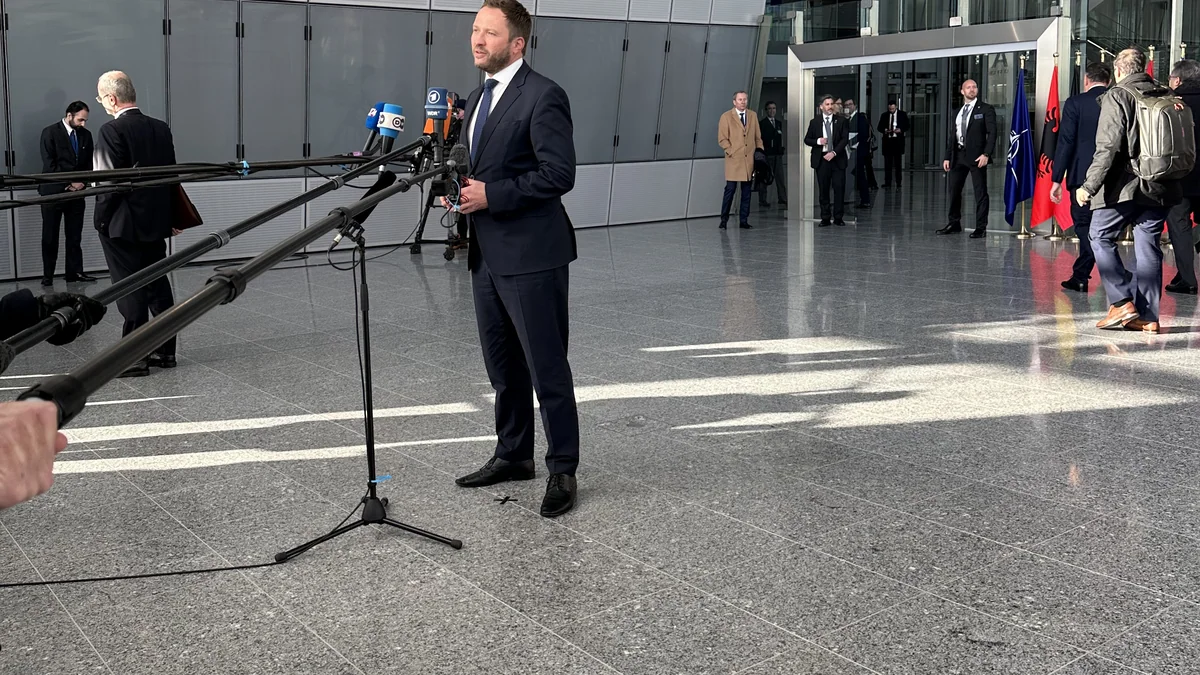

Estonia’s defense spending is set to reach 5% of GDP by 2026 to fund a "drone wall" and 24/7 border surveillance. Under NATO operations Eastern Sentry and Eastern Flank Watch, the transition to active air defense aims to neutralize border violations, including 11 intercepts recorded in a single week.
At 8:00 AM on Monday, June 8, 2026, the kitchen cabinet doors in a house near the Latvian border started to rattle. It wasn't the wind. It was a French fighter jet, scrambled to intercept an uninvited guest in our airspace.
That Monday, an unidentified drone was brought down after entering our territory without warning. It was not a rare event. It was one of 11 sorties flown by allied jets in just seven days.
Eleven alerts in a week means eleven times a child’s sleep is broken. It means eleven times a mother has to explain a noise she can’t quite name. We have moved past the era of polite air patrolling into a harder reality of kinetic defense.
Five percent: Do the arithmetic
When politicians talk about national defense, they are talking about the choices made in our wallets. Prime Minister Kristen Michal has set a target for Estonia’s defense spending to hit 5% of GDP by 2026.
Do the arithmetic. That means one out of every twenty euros our economy produces goes directly into military capability.
Take the "drone wall" project as an example. The Estonian government had to find 12 million euros for the Police and Border Guard Board to develop this alone. They did this because the European Union rejected the request for joint funding.
Between 2024 and 2025, framework contracts worth nearly 200 million euros were signed for loitering munitions. This is the mathematics of survival. Without a secure border, there is no foundation for a stable life.
A chronicle of the 2026 spring
On the morning of March 31, 2026, several drones entered Estonian airspace, part of a deepening pattern of hybrid activity. This isn't a headline from a distant country anymore. It is a daily challenge monitored by our radar screens in real time.
On May 19, a Romanian F-16 intercepted another drone violating Estonian airspace. These incursions aren't limited to the Baltics; they affect the entire Baltic Sea region. It is why Defense Minister Hanno Pevkur is pushing for a shift from passive air policing to active air defense.
Think of air policing as a silent alarm that tells you a thief is in the house. Active air defense is the lock and the bolt on the door. It is a more expensive calculation, but it is the only one that changes the outcome.
The stress test on the Eastern Flank
NATO’s Operation Eastern Sentry, launched in late 2025, brought a sharper edge to our borders. Decisions here are now made in fractions of a second. Since 2024, the Baltic Sentry operation has also focused on our subsea cables and pipes.
Our daily lives depend on those cables more than we realize when we turn on a light or check a bank balance. In May 2026, the TIE 26 exercise tested whether billions of euros in technology from different countries could actually talk to each other.
NATO and Ukraine have prepared a 50-million-euro joint fund to speed up this technology. It is a necessary investment. We cannot afford to lose the technological race to the east, where drone production could reach massive scales by 2028.
Local wisdom and the drone wall
At the SSD 2026 defense fair, a local company called Rantelon showed off its fourth-generation drone gun. At the Nurmsi drone center, innovation is meeting the cold reality of the border. During the Kevadtorm 2026 exercise, 12,000 soldiers practiced using and countering over 500 drones.
We are no longer just asking for help; we are providing solutions. One drone gun costs a fraction of a fighter jet sortie, but its impact on the border is immediate.
This is what policy feels like when it’s smart: investing in tools that protect the taxpayer’s peace without wasting the taxpayer’s money. The drone wall is, in many ways, an insurance policy for our daily lives.
The price of silence
The Center for Defense Investment (RKIK) expects major drone defense systems to arrive in Estonia through 2027. General Andrus Merilo is currently integrating these tools into every branch of the military. Technology is useless if it sits in a warehouse; it must be part of the patrol.
By 2030, Europe’s total defense needs are estimated at 800 billion euros. That is a staggering number that reveals the size of the gap we are trying to fill.
Five percent of GDP is a heavy weight for any nation to carry. But we have to be honest: security is the floor under our feet. I write this so that our children can sleep through the night, and so a rattling cabinet door remains just a noise, not a threat. NATO’s drone defense is an investment in the silence we all need.