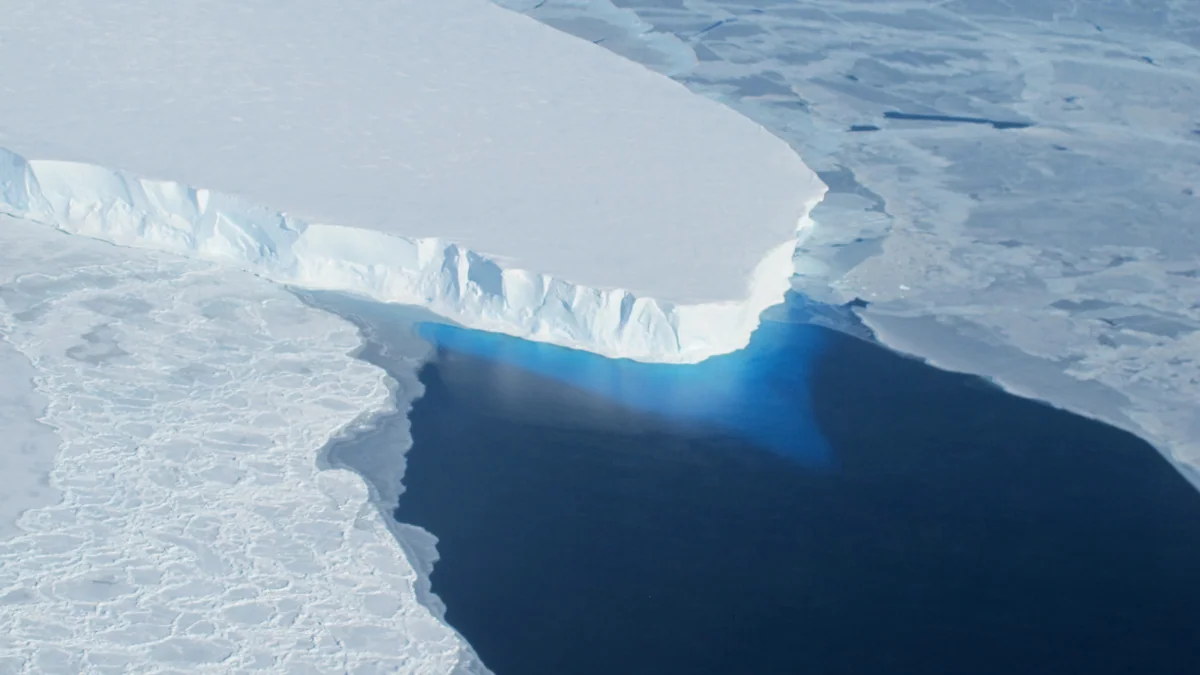
One Trillion Tonnes: What Antarctica's Doomsday Glacier Is Actually Doing Right Now
Every year, Thwaites — Antarctica's Doomsday Glacier — sheds roughly 50 billion tonnes of ice into the Southern Ocean. Stack that into one-cubic-metre blocks and you have a column reaching past Pluto. That number is not a forecast. It is last year's measurement, and the year before, and the year before that.
Since 2000, the cumulative loss has crossed 1 trillion tonnes. The glacier covers 192,000 square kilometres — an area almost exactly the size of Great Britain — and it is currently responsible for 4% of all annual sea-level rise on Earth. Not 4% of Antarctic melt. Four percent of the total global figure, from one glacier.
The geometry of the loss matters as much as the volume. Thwaites sits on a bed that slopes downward toward the Antarctic interior, meaning retreat exposes progressively thicker ice to seawater. There is no natural brake built into the landscape. The more it melts, the more surface area is vulnerable.
What started the retreat in the first place? The best current evidence points to a single powerful El Niño event in the 1940s. Warm water, pushed south decades before satellite monitoring existed, appears to have kicked the glacier off a stable position it may not recover from. Distant events leave long tails.
This sets up the question that matters for everything that follows: is Thwaites in a slow, manageable bleed, or is it approaching a structural threshold where retreat becomes self-sustaining and effectively irreversible? The answer is not yet settled. But the researchers now measuring tidal seawater reaching kilometres beneath the ice suggest the honest answer is closer to the second option than the models assumed five years ago.
Why the Forecast Just Doubled: Tides, Warm Water, and a Moving Floor
The revised number is 30 millimetres. That is the sea-level contribution now projected for Thwaites by 2100, published in October 2026 by Mattia Poinelli's team at UC Irvine and NASA Jet Propulsion Laboratory. It is exactly twice the previous estimate of 15 millimetres.
The mechanism behind the revision is precise, and worth understanding. Tidal cycles periodically lift the ice sheet from its bed. When that happens, pressurised seawater does not simply lap at the edge — it flows kilometres inland beneath the glacier, deep into what researchers call the grounding zone, the boundary where the ice transitions from resting on bedrock to floating.
Previous models treated this boundary as essentially fixed. The new model treats it as what it actually is: a dynamic, tidally-driven threshold that warm water crosses repeatedly, melting ice from below on each cycle.
The data that made this revision possible came from Sentinel-1, the European radar satellite constellation. Its high-resolution passes captured grounding-zone movement at a spatial detail earlier instruments could not resolve, showing warm seawater penetrating kilometres inland — a distance previous satellite datasets had simply missed. That is not a modelling choice that changed the number. That is a measurement.
What Poinelli's team changed was the parameterisation of sub-glacial hydrology: how water moves under the ice, how tidal lift gates that movement, and how the grounding line responds dynamically rather than staying put. The headline doubling matters less than that methodological shift. Once tidal dynamics enter the model correctly, the physics drives the projection up.
The question now is whether other major ice-sheet models are still running with the old, fixed-boundary assumption.
The Cork in the Bottle: What Sits Behind Thwaites
Thwaites does not stand alone. It sits at the edge of the West Antarctic Ice Sheet like a plug in a drain, and the physics of what happens next depends heavily on whether that plug holds.
The numbers scale fast once you look behind it. Complete collapse of Thwaites itself would raise global sea levels by approximately 65 centimetres — enough to redraw the coastlines of Bangladesh, Florida, and the Netherlands. That is a large number.
The larger one sits further back: full destabilisation of the West Antarctic Ice Sheet would push sea levels up by as much as 3.3 metres. That figure is a plausible worst case, not a certainty, and the difference matters when you are deciding what to build, where, and to what standard.
The structural reason for concern is a process called Marine Ice Sheet Instability. Thwaites rests on a bed that slopes downward toward the interior of Antarctica. As the glacier retreats, it exposes progressively thicker ice to warm seawater — each step back feeds the next.
There is no natural braking mechanism built into the geometry.
The specific trigger scientists watch most closely is the Muginot Ridge, an underwater bedrock rise that currently props the glacier from below. Models give a 60% probability that Thwaites will detach from that stabilising ridge by 2100. Once detachment occurs, the self-reinforcing retreat dynamic has one fewer obstacle.
Sixty percent is not a guarantee. It is, however, the kind of probability that engineers building a coastal barrier or a port expansion in 2026 cannot reasonably ignore.
The question is no longer whether the risk is real. The question is whether the plans account for it.
150 Years of Ice Loss, Already Locked In
Picture a seismograph needle jumping in a cold room somewhere near McMurdo Station. Between 2010 and 2023, instruments recorded hundreds of glacial earthquakes at the Thwaites calving front — not metaphorical tremors, but real seismic events triggered when icebergs the size of city blocks calve off, capsize, and crash into the Southern Ocean.
Each one a small announcement. Each one already factored into nothing that will change the outcome.
This is the finding that deserves the most careful reading. Rosie Williams at the British Antarctic Survey modelled every plausible ocean cooling scenario and arrived at the same answer every time: Thwaites will continue losing ice for at least 150 years regardless of what happens to water temperatures now. The retreat is committed.
It is not a warning about a future we might still avoid; it is a description of a process already underway in bedrock and physics.
Thwaites will continue losing ice for at least 150 years regardless of what happens to water temperatures now.
"Irreversible on a human planning horizon" is a phrase that sounds like despair. It is actually a planning instruction. It means the question shifts from prevention to adaptation — and those are genuinely different engineering problems.
Prevention asks: can we stop this? Adaptation asks: what does a 150-year retreat demand of every coastal city, every port authority, every building code written today?
The honest map looks like this. We cannot stop what is already in motion at the grounding zone. We can still influence how much ice follows after — the difference between 30 millimetres and 65 centimetres is not nothing.
That distinction is where the remaining choices live.
The 80-Kilometre Wall: Scientists Stop Watching and Start Building
For decades, the International Thwaites Glacier Collaboration has been the largest coordinated glacier study ever mounted: more than 100 scientists, a joint $50 million commitment from the US National Science Foundation and the UK's Natural Environment Research Council, years of drilling, diving, and satellite tracking. The ITGC's mandate was to understand. Now the field is asking whether understanding alone is enough.
The proposal on the table is stark: build an 80-kilometre underwater wall across the Amundsen Sea seabed, blocking the warm circumpolar deep water that is currently eating the glacier's grounding zone from below. The comparison that matters here is historical. Coastal engineers have built seawalls, breakwaters, and surge barriers for centuries.
Rotterdam's Maeslantkering storm barrier took 6 years and roughly 450 million euros. An Antarctic underwater barrier would need to survive crushing pressures, near-zero temperatures, and zero maintenance access — a problem of an entirely different order.
The engineering unknowns are real and should be stated plainly. Nobody has anchored a structure of that scale to a dynamic Antarctic seabed. Nobody has tested the materials.
Nobody has priced it at the required scale. What the proposal does signal, unmistakably, is a shift in the field's posture: from passive monitoring to active intervention.
That shift is not a plan yet. It is a direction. Moving from direction to plan requires political will that has not been committed, budgets that have not been allocated, and international agreements that do not exist.
The science has moved. The governance has not caught up.
The Honest Scorecard: What a Doubled Projection Demands of Planners
Three numbers define the decision ladder. The 30 mm baseline — Thwaites' confirmed contribution by 2100, now twice the previous estimate — is the floor planners must design to immediately. Full Thwaites collapse adds 65 cm.
A full West Antarctic Ice Sheet cascade reaches 3.3 metres. Each tier demands a different planning response, and conflating them is how governments either overbuild into paralysis or underbuild into catastrophe.
The infrastructure problem is already compounding. Coastal defences approved today under 2020-era projections may be undersized before their concrete cures. A seawall designed for 15 mm of Thwaites contribution is not designed for 30 mm — and design standards, unlike glaciers, can be revised quickly.
That's not a gesture. That's a lever. The proportionate action right now is revising coastal infrastructure design standards to the 30 mm baseline as the non-negotiable minimum, with formal decision triggers written into approval documents: if grounding-line retreat data crosses defined thresholds, the 65 cm scenario automatically upgrades to planning baseline.
Port engineers and municipal planners do not need to act on 3.3 metres today. They need to stop acting as though 15 mm was still credible.
The honest scorecard on Antarctica's Doomsday Glacier: the loss is partially locked in, the higher scenarios are not yet inevitable, and the window to build smarter is open. Use it.