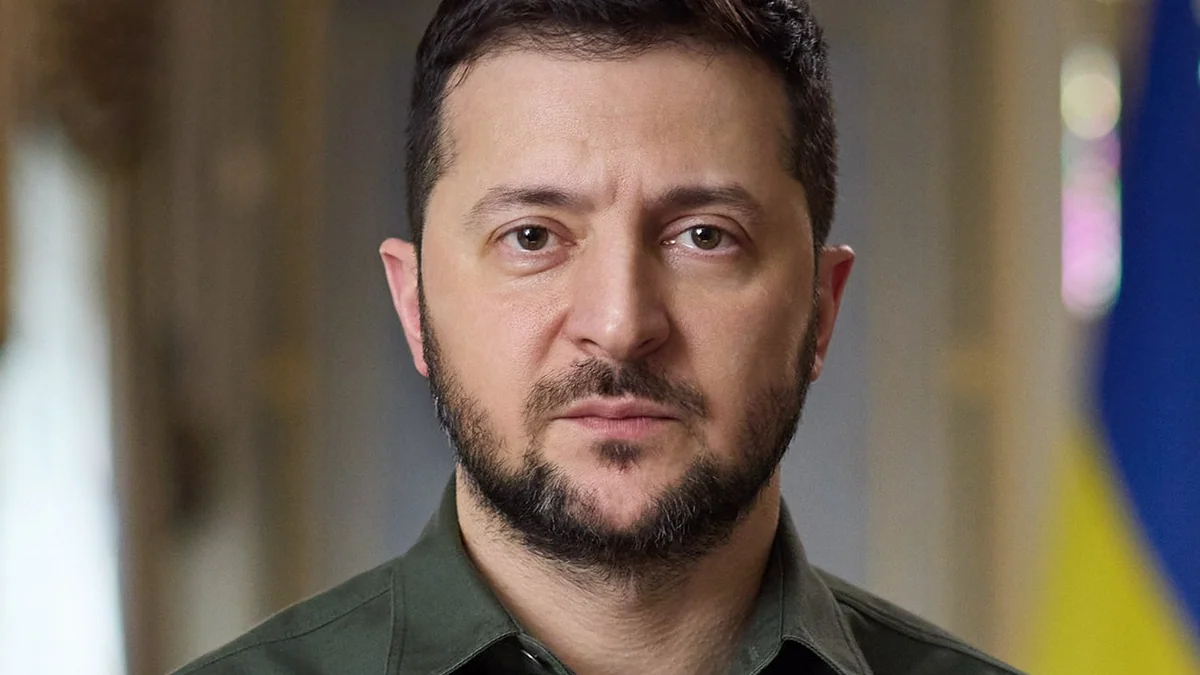
Zelensky's Warning from Kyiv: The Comparison Nobody Wanted to Print
Zelensky's warning about the West's drifting focus arrives framed by a photograph on Truth Social: Donald Trump, arms around Vladimir Putin, the caption reading "my friend." Read that image as a document rather than a gesture, and his BBC interview of 26 November 2026 becomes not a press appearance but a formal counter-filing.
Zelensky sat with Sarah Rainsford in his Kyiv office and chose his words with the precision of a man who knows they will be parsed in Washington before morning. He called the Trump-Putin friendship "strange" — a word that in diplomatic usage carries more load than it appears to. Strange, not wrong. Strange, not dangerous. The restraint was deliberate, and the restraint made the analogy that followed land harder.
The analogy is the Hitler comparison. Zelensky did not deploy it loosely. He used it structurally: calling Putin a friend in 2026, he said, is the same as calling Hitler a friend during the Second World War. The comparison is designed to close a logical escape route — the one that says a leader can be an aggressor in one context and a partner in another. Zelensky's formulation allows no such partition. "He is an aggressor, and a killer," he said. "He can't be a friend. Just cannot be."
The Hitler analogy will draw objection, and some of the objection will be fair. Historical comparisons flatten what they illuminate. But the precise logic Zelensky was pressing — that a wartime aggressor does not become safe company by virtue of a summit photograph — is not the same as claiming identity of scale or ideology. That is the load-bearing wall. The outrage about the analogy is the moulding.
Four Thousand Square Kilometres: What the Maps Actually Show
The number is not rhetorical. In 2024, Russian forces seized approximately 4,000 square kilometres of Ukrainian territory — a figure drawn from open-source tracking, not from Kyiv's press office or Moscow's. To place that against the previous year: the rate of Russian advance in 2024 ran seven times higher than in 2023. The front that looked frozen, the stalemate that Western commentary had half-decided was permanent, was not frozen. Somewhere a spreadsheet was quietly updated.
The acceleration has a mechanism. The 2023 Ukrainian counteroffensive absorbed substantial Russian defensive reserves and attention; its failure left Ukraine exposed along axes that Russian commanders had been probing for weaknesses. The Patriot interceptor shortage — a consequence, in part, of competing delivery claims from another theatre — meant that Russian glide-bomb operations faced diminished attrition. Territory followed. The maps are not a reflection of Russian strength in isolation; they are a reflection of a ratio, and the ratio shifted.
What comes next is not speculative. Intelligence assessments reported in late November 2026 point to a planned mass strike on Ukrainian energy infrastructure for the coming winter — a repetition of the grid-destruction strategy employed in earlier winters, now against a system already carrying accumulated damage. Ukraine's answer to its own strategic compression has been asymmetric: expanded drone operations targeting Russian naval assets in the Mediterranean and in the Gulf of Finland. The reach is real, and it is meant to be seen. Whether reach substitutes for the missing interceptors along the Zaporizhzhia axis is the question the maps will answer, not the press conferences.
The Interceptor Arithmetic: What Goes to Tel Aviv Does Not Go to Kharkiv
A Patriot battery is not a budget line. It is a physical object, manufactured at a fixed rate, allocated from a production queue that does not expand because two wars happen to coincide. When Washington redirects interceptors toward the Israel-Iran theatre, the missiles do not exist in some parallel stockpile waiting for Ukraine. They are simply elsewhere. Zelensky's complaint about Patriot delays is not a diplomatic grievance dressed in operational language. The delays are the operational reality, and Ukrainian casualties are the direct, measurable consequence.
The competing demand is structural, not incidental. US attention to Middle Eastern tensions has pulled both diplomatic bandwidth and munitions priority away from the Eastern European front at the precise moment Russia's territorial advance is running at seven times its 2023 rate. Those are not parallel facts. They are the same fact, described from two different map rooms.
Zelensky's answer to this arithmetic is the investment framing: aid to Ukraine is not a cost but, as he has put it, an investment in a democratic way of life. The argument is not wrong. It is also insufficient. An investment argument appeals to a long-term calculus, and long-term calculus loses to a production-line constraint every time the queue is short. The case for prioritising Ukraine over competing theatres requires not only a moral claim but a manufacturing one, and Western defence industry has not yet closed that gap. Until it does, the interceptor arithmetic remains unchanged: what goes to one theatre does not go to the other, and the front line in Kharkiv absorbs the difference.
The borderland in a negotiation is never the state that sets the agenda.
Abu Dhabi, November 2026: The Room Where the Framework Is Being Written
The UAE does not host peace talks by accident. Abu Dhabi is a venue chosen precisely because it sits outside NATO's institutional gravity — neutral enough for Moscow, comfortable enough for Washington, and sufficiently distant from Kyiv that the Ukrainian side arrives at a structural disadvantage before the first handshake.
The November 2026 tripartite talks brought together Steve Witkoff and Jared Kushner for the American side, Rustem Umerov for Ukraine, and Vladimir Medinski for Russia. Read the personnel list slowly. Witkoff is a property developer; Kushner is a family adviser who brokered the Abraham Accords. Medinski is a former culture minister who served as Moscow's lead negotiator at the failed Istanbul talks of 2022. This is not a diplomatic track in the traditional sense. It is a business-style channel, and that matters, because the vocabulary of business negotiation — deal, concession, closing price — does not map cleanly onto a war in which one side has seized 4,000 square kilometres of another's territory and is not done.
Which brings the room to what Zelensky has called the "reality gap." Russian delegates arrived with demands that treat occupied Ukrainian territory as a settled baseline. Ukrainian delegates arrived having watched that baseline expand at seven times the 2023 rate. The gap between those two positions is not a negotiating margin. It is the structural contradiction that every venue choice and every personnel list in Abu Dhabi is quietly arranged to make invisible.
The bypassing of NATO channels here is not incidental. It is the architecture of the deal being built.
The Load-Bearing Question: Who Is the Borderland in This Negotiation
The Molotov-Ribbentrop Pact was signed in August 1939 by two powers who had agreed, in a secret protocol, to divide the countries between them. Estonia did not attend the meeting. This is what Zelensky is talking about — not history as metaphor, but history as mechanism.
The Hitler analogy is blunt, and Zelensky knows it. Its function is not comparison but collapse: it is designed to make transactional friendship rhetoric structurally incoherent. You cannot call an aggressor a friend and simultaneously hold the line that this war is about principle rather than real estate. The analogy forces a choice the Trump administration has conspicuously avoided making.
Whether Trump's "my friend" posture is tactical positioning or genuine realignment, Zelensky's argument is that the distinction may matter less than it appears. Strategic fatigue in donor nations is not primarily an ideological condition. It is a signalling condition. Moscow reads the gap between declared commitment and delivered interceptors. Four thousand square kilometres in a single year is partly a territorial fact and partly a deterrence reading — an assessment, made in the Kremlin, of how much the West will absorb before the cable shifts to the next crisis.
The small-nation floor asks a narrower question than the great-power calculus does: not whether the framework is elegant, but who was not in the room when it was written. The borderland in a negotiation is never the state that sets the agenda.
One Thing to Watch Before the First Hard Frost Passes
The Abu Dhabi talks have produced no published framework. That absence is itself a data point: Witkoff, Kushner, Umerov, and Medinski were in the same room, and the communiqué has not materialised. Russia seized approximately 4,000 square kilometres of Ukrainian territory in 2024 alone, a rate seven times higher than in 2023. Any framework text that emerges from that room will be drafted against those numbers, whether it names them or not.
Watch for the verb. If the final Abu Dhabi document says the parties shall withdraw to defined lines, someone conceded something enforceable. If it says should, the text is decorative and the front will move again before spring. The distinction is not grammatical pedantry. It is the load-bearing wall versus the moulding, and every territorial settlement since Helsinki has turned on exactly that word.
Russia's intelligence-assessed winter strike on Ukrainian energy infrastructure makes the timeline tighter than any diplomat's calendar. What the evidence forces us to conclude, quietly, is this: the verb in that communiqué — if it appears at all — will tell you more about the next twelve months than any statement from either capital. Kyiv's strategic alarm about drifting Western attention finds its sharpest test not in any interview, but in that single word's absence.