Shenzhen Is Not Yalta — Which Is Precisely the Problem
At Yalta in February 1945, three men sat down in a Crimean palace and drew lines across a continent. No Pole, Romanian, or Estonian was in the room. The lines held, after a fashion, for forty-six years. The comparison to what is now being arranged for Shenzhen is obvious, which is exactly why it should be handled carefully before being set aside.
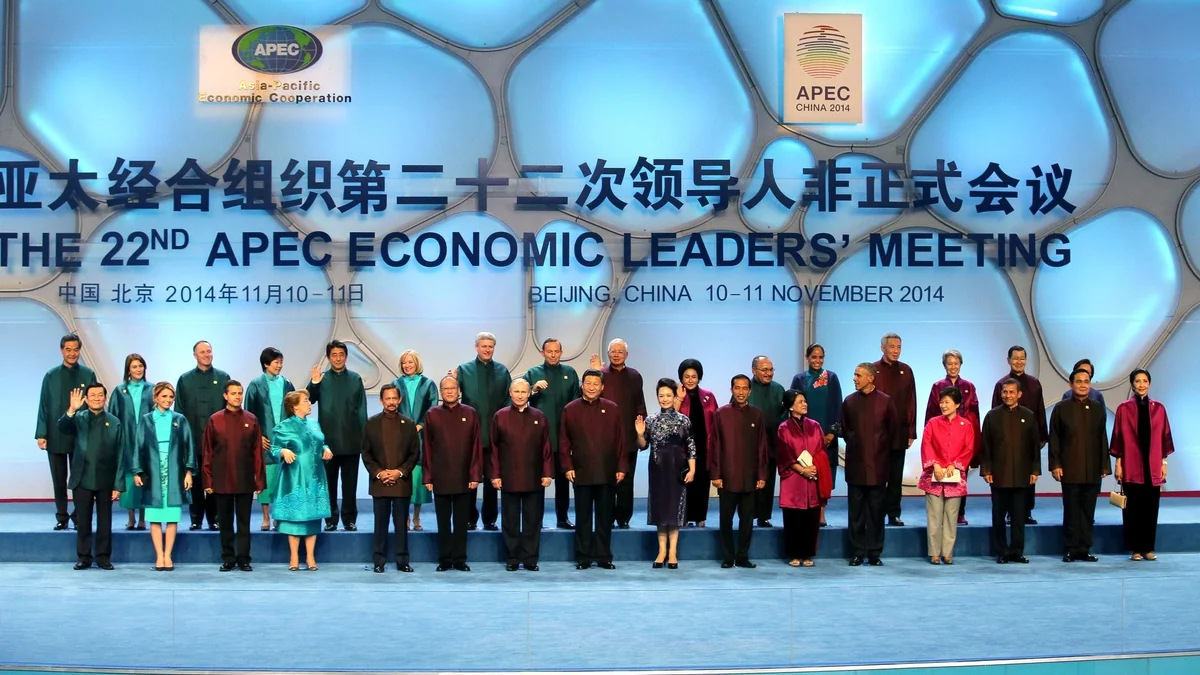
On October 9, 2026, Vladimir Putin proposed a trilateral summit with Donald Trump and Xi Jinping. The Kremlin, which had been quietly floating the idea since at least September 1, confirmed the proposal the same day, with Yuri Ushakov providing the outline and Dmitry Peskov describing the prospect as a "hypothetical possibility" — the Kremlin's preferred register for something it is pushing hard. The chosen venue is the APEC summit in Shenzhen, November 18–19: a multilateral forum pressed into bilateral, or in this case trilateral, service.
The Yalta analogy fits on the surface and breaks underneath. Three powers, no smaller nations present — that much holds. But in 1945 there was shared military exhaustion and a defeated common enemy to divide. What is converging in Shenzhen is not a postwar settlement but a transaction: each principal arrives with a separate ledger, and the columns do not overlap as cleanly as a conference photograph will suggest. There was no joint victory here. There is only a coincidence of short-term interests severe enough to require a room.
Ask the small question first: who is the borderland this time, and who is the empire? The answer is not singular, which is the structural problem the Yalta comparison raises before it is discarded.
The Arithmetic of Abandonment: How Washington Cleared the Table
The Iran war came first. When the United States entered the conflict alongside Israel in February 2026, it did not merely redirect a carrier group. It reordered the entire hierarchy of American strategic attention. Ukraine, already a contested budget line, became a rounding error.
The numbers are not metaphorical. U.S. military aid to Ukraine has been cut by 99 percent under the second Trump administration. Not reduced, not restructured. Ninety-nine percent. Somewhere a spreadsheet was quietly updated, and a country's defensive capacity followed.
The concessions then moved from the implicit to the formal. On October 9, 2026, the same phone call that produced the summit proposal also produced the Diesel Deal: an agreement for U.S. purchase of Russian fuel, justified in Washington as a domestic energy measure. The rationale was not strategic restraint or a negotiated reciprocal concession. It was the price of gasoline. On October 16, Trump suspended several bipartisan sanctions against Russia to facilitate negotiations. The legal mechanism was executive authority; the political mechanism was a war in another theatre that had exhausted the administration's appetite for any confrontation that could not be framed as a win by Christmas.
The table was not cleared in one motion. It was cleared incrementally, each concession framed as provisional, each frame left standing long enough to become a fact. Trump remains receptive to the summit proposal, according to senior officials, but has issued no formal written acceptance. That gap — between signal and commitment — is where all the work is being done. A signal costs nothing to withdraw. A commitment, once made in Shenzhen with Xi Jinping as host and witness, is a different instrument entirely.
The Host's Ledger: What Xi Jinping Has Already Secured
Beijing did not wait for November. China hosted Trump from May 13 to 15, then Putin from May 19 to 20 — separate state visits, six days apart, the sequencing itself a signal. Xi received the American president first, the Russian second. The order names the hierarchy without requiring anyone to say so aloud.
The structural evidence arrived with the Power of Siberia 2 pipeline. Russia wanted it; China did not agree. That failure, confirmed in May 2026, is the load-bearing fact beneath every subsequent headline about "Sino-Russian solidarity." Moscow needs Beijing's market, Beijing needs Moscow's compliance, and the gap between those two needs is where the junior-partner relationship lives. Analysts at the New Eurasian Strategies Centre have named it plainly; the pipeline's absence names it more plainly still.
The tariff record rounds out the ledger. Washington applied a 145 percent rate on Chinese goods in early 2025 — a genuine shock, not a negotiating gesture. By 2026 a management arrangement had softened the confrontation. Beijing absorbed the hit, recalibrated, and arrived at Shenzhen holding the convener's chair and a trade relationship that Washington had, functionally, agreed to manage rather than sever.
What chairing the room is worth, before a single agenda item is agreed, is this: Xi sets the physical frame, controls the communiqué's drafting calendar, and positions China as the indispensable third party in every bilateral that matters. Neither Trump nor Putin travels to Shenzhen to do Xi a favour. They travel because the alternatives suit Beijing less. The host chooses the table. The table shapes the deal.
Three states representing roughly 4,000, 4,000, and 620 nuclear warheads are negotiating the borders of a fourth country that was not invited.
The Nuclear Shelf: Denuclearization as a Third Agenda
On October 15, 2026, Trump announced that the United States was engaged in trilateral denuclearization talks with Russia and China. The announcement carried no treaty text, no verification framework, no named negotiators. A word was placed on the table. The shelf it landed on was not load-bearing.
The arithmetic of the room explains why. The United States and Russia each hold approximately 4,000 nuclear warheads. China holds roughly 620. Beijing has spent three decades building toward minimum credible deterrence — a posture designed to survive a first strike, not to match the superpowers warhead for warhead. Any framework that begins with parity as its premise asks China to negotiate downward toward a number it has not yet reached and upward toward a vulnerability it has spent a generation engineering away.
What "denuclearization talks" plausibly means in this configuration is different from what the phrase has historically promised. It may mean a moratorium on new deployments, a transparency measure, a ceiling attached to the Ukraine settlement as decorative confidence-building. It will not, under any foreseeable arrangement, mean symmetrical reductions. The phrase does the work of sounding historic while the actual ceiling remains unbuilt.
Here is the load-bearing question: is nuclear arms control the structural purpose of this summit — the wall that holds the architecture up — or is it the moulding, applied afterward to make the room look finished? The October 15 announcement was shaped like moulding.
The Absent Parties and What Their Absence Costs
Ukraine Foreign Minister Andrii Sybiha put it plainly: a summit without Ukraine would only encourage Putin to continue the war. The logic is sound as far as it goes. What it cannot say aloud is the harder corollary — that Kyiv's exclusion is not an oversight but the architecture. A party whose territory is the subject of negotiation is also the party most inconvenient to have in the room.
European leaders have arrived at the same wall from a different direction. The Council on Foreign Relations has documented their alarm over a spheres-of-influence arrangement that treats the EU's eastern neighbourhood as a ledger entry to be balanced between Washington, Moscow, and Beijing. The concern is not procedural. It is structural: if three powers draw lines across a continent without consulting the states that live on that continent, the resulting settlement is not a peace agreement. It is a lease.
The historical pattern requires no elaboration — Yalta 1945, the Congress of Vienna, the Nixon-Brezhnev back channels on European security. Smaller nations absent from the room when the map is redrawn do not later recover the territory of their interests by appealing to the minutes. What changes for Europe in practice is the question of strategic autonomy. An EU that cannot guarantee its own eastern flank through Washington's commitments must either build the capacity to do so independently or accept the lease on whatever terms the triad sets. Neither option is cost-free, and the continent has not yet chosen between them.
The Putin–Trump–Xi Dynamic: One Line to Watch Before November 18
Trump's posture as of October 16, 2026, is described in sourced reporting as "receptive." That word is not acceptance. No formal written agreement to attend the Shenzhen summit has been issued from Washington, and the gap between receptive and committed is where this story either becomes structural or dissolves into studied ambiguity. The APEC opening session falls on November 18. The marker is simple: a written U.S. acceptance before that date closes the gap; its absence confirms that Trump is using the invitation as leverage, not as a threshold to cross.
The secondary marker is the text itself, if a joint communiqué emerges. Read the operative verb. If the parties shall withdraw forces or shall cease weapons transfers to Ukraine, someone signed something load-bearing. If the text reads should, the architecture is decorative, and the borderland absorbs the cost of that ambiguity on schedule.
What the public record forces us to conclude is this: the Putin–Trump–Xi configuration means three states representing roughly 4,000, 4,000, and 620 nuclear warheads are negotiating the borders of a fourth country that was not invited. That is not a prediction. It is a geometry. Watch for the written acceptance, then read the verb.