
Kuwait Between Empires: A Geography That Does Not Expire
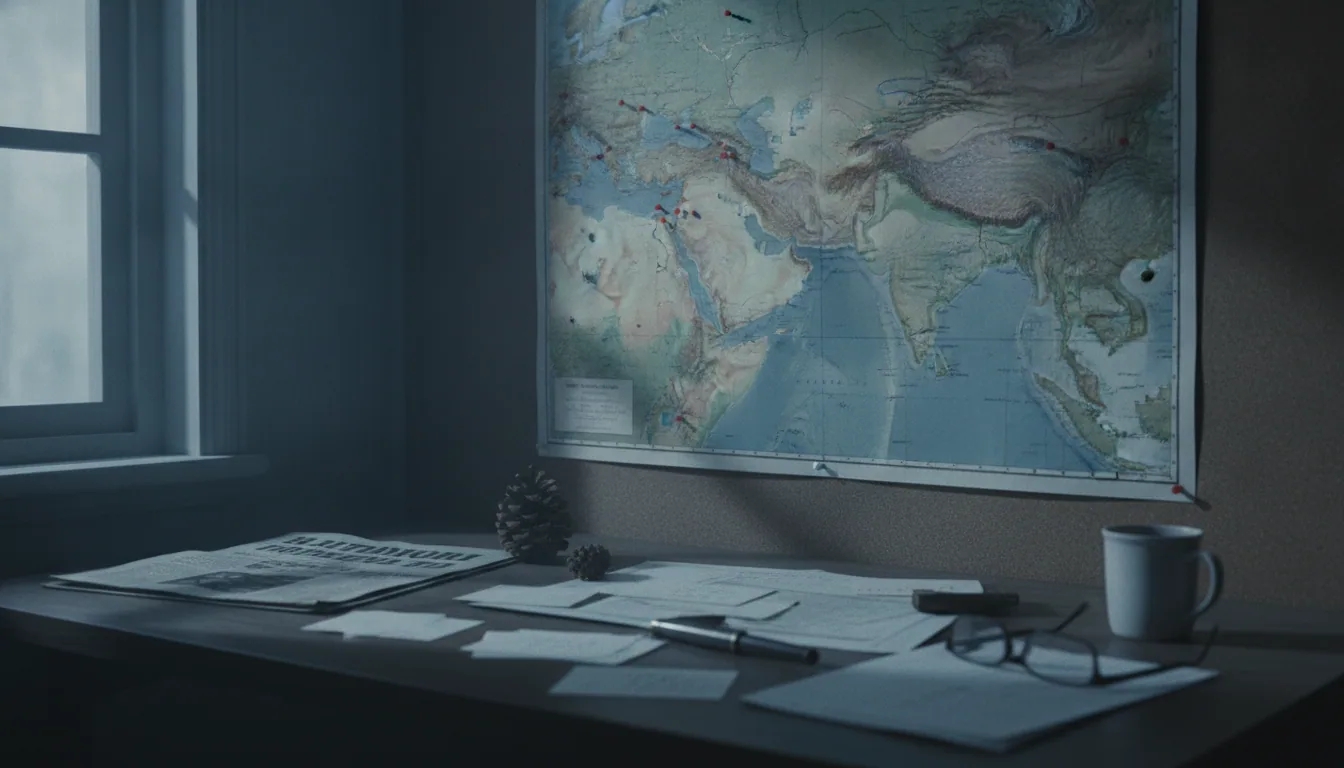
Iran's attack on Kuwait was written into the map long before the first drone launched on November 26. In 1987, Kuwaiti tankers sailed under the American flag because the alternative was sailing under fire. The arrangement worked, after a fashion. Iran mined the Gulf approaches, struck civilian vessels, and then watched Washington draw a line Kuwait had not asked to stand behind.
The logic of that decade has not aged out of the map. Kuwait sits at the northern apex of the Gulf, sharing a land border with Iraq and a maritime one with Iran, hosting American armour and airpower in quantities that make neutrality a legal fiction rather than a policy. That geometry is not a choice any Kuwaiti cabinet made in 2026.
It is the inheritance of the Anglo-Indian frontier, the 1961 independence crisis, and every alignment decision made in its wake. Ask the small question first: who is the borderland here, and who is the empire? The answer has been the same for the better part of a century.
The Tanker War analogy is tempting and, up to a point, honest. Iran tested Kuwait's neutrality then, found it structurally impossible, and filed the lesson. But the 1980s comparison breaks on one point: Kuwait was then a bystander to an Iraqi-Iranian war.
In 2026 it is a node in an American war network, hosting the installations that give U.S. and Israeli operations their logistical spine.
The sequence is public record. U.S. and Israeli strikes on Iranian sites at Qeshm Island and Sirik opened the account. Iran collected.
In March 2026, a missile strike near Port Shuaiba killed six U.S. soldiers on Kuwaiti soil. The war, by then, had a Kuwaiti address. November 26 is a later entry in a ledger that opened before most Western editors had filed their first dispatch.
November 26: Iran's Strike on Kuwait — Drones, Debris, and a Two-Day Warning
The Kuwaiti Ministry of Defense confirmed on November 26 that Iranian drones had struck an air defense detection station — a 'vital site', in the ministry's phrasing, chosen with care. What the ministry did not confirm: the exact location, the number of drones launched, or whether the two Italian technicians servicing the Skyguard system's detection antennas were the intended targets or simply present when the debris arrived. The public record is precise enough to be useful and vague enough to protect something.
Kuwaiti air defenses intercepted multiple drones. The intercepts worked, in the technical sense. What fell was shrapnel, not warheads, and shrapnel is not a lesser category of harm — it killed both Rheinmetall Italia technicians and injured four others, among them one Kuwaiti army captain and one Pakistani national.
Civilian passenger flights were diverted as the intercepts were conducted, the moment when military exposure bleeds visibly into the civilian schedule.
The U.S. Embassy in Kuwait issued a security alert on November 24 — forty-eight hours before the strike. An embassy security alert is not a declaration of foreknowledge, but it is not issued against nothing. Someone had assessed that something was probable, and the question the alert leaves open is narrower than it sounds: whether the warning reached the maintenance crew working on the detection antennas at the target site, and in what form.
Iran's spokesperson Abolfazl Shekarchi denied Iranian responsibility. The denial is the standard one, identical in structure to denials issued after the Port Shuaiba attack in March, after Ali Al Salem, after each increment of the year's escalation. The pattern of denial does not prove authorship, but it does suggest that the communiqué is performing a function other than factual accounting.
Two Names from Rome: The Cost of Maintaining an Alliance's Shield
Antonio Tajani confirmed the deaths in plain language. 'A powerful explosion occurred,' he said, 'and, according to reports reaching us from Kuwait, both of our fellow citizens have unfortunately died.' Giorgia Meloni issued condolences.
The diplomatic register was correct, careful, and entirely inadequate to the structural fact it was forced to describe.
The two men were technicians employed by Rheinmetall Italia, a Rome-based subsidiary of the German defense group. They were performing maintenance, repair, and overhaul work on the detection antennas of the Skyguard air defense system — the eyes, not the interceptors, of Kuwait's protective layer. This is how European defense contractors come to be inside Gulf military installations: not as combatants, not as advisers, but as the people who keep the hardware running.
The risk travels with the contract, and the contract follows the system sale. When Iran targeted the detection station, it was not targeting Italy. Italy absorbed the cost regardless.
That gap — between who is targeted and who pays — is the supply chain logic made visible. Gulf air defense is a European and American industrial product. Its integration requires European and American specialists to be physically present at the antennas, the processors, the relay nodes.
Those specialists are not shielded by the interceptors they maintain. When the drones come for the radar, the technicians are already there.
Italy is now a party pulled into a conflict Iran frames as exclusively a matter between Tehran, Washington, and Jerusalem. Rome did not choose that framing. It chose a defense export contract, and the two framings have now collided, in Kuwait, on November 26, at a detection station whose precise location the Kuwaiti Ministry of Defense has not disclosed.
Remove the sensors, and the interceptors become men listening for a train in the dark.
Targeting the Eyes: The Logic of Striking Early-Warning Infrastructure
A runway absorbs a strike and reopens. A fuel depot burns and is resupplied. An early-warning radar, destroyed with its maintenance crew still inside, leaves a gap that cannot be patched by the next morning — and everyone in the region knows exactly where that gap is.
The November 26 Iranian drone strike on Kuwait's air defense detection station was not arbitrary. It was architectural.
The pattern had been visible for months. Earlier 2026 strikes struck Ali Al Salem Air Base and Kuwait International Airport — high-visibility targets, symbolically resonant. The progression to a detection station represents a different kind of ambition: not headline damage, but structural subtraction.
An Integrated Air Defense System is a network of sensors and interceptors working together; remove the sensors, and the interceptors become men listening for a train in the dark.
The distinction matters precisely because the losses are not equivalent. Kinetic interception capacity — the Patriot batteries, the radar arrays, the F-15E aircraft lost across the conflict's ledger — can be replaced by procurement, by alliance transfer, by American resupply channels. Early-warning capacity, the detection infrastructure that tells an interceptor where to look, runs on something harder to ship: trained technicians, calibrated antennas, institutional knowledge embedded in the system itself.
Two Rheinmetall Italia specialists were maintaining Skyguard detection antennas when the drones arrived. Their deaths are recorded in Rome's foreign ministry. The knowledge they carried is recorded nowhere.
That is the load-bearing element. The runways and depots were the decorative moulding. Kuwait's air defense now has eyes it cannot immediately replace, and the drones already know the address.
Tehran's Denial and the Communiqué's Preferred Verb
Abolfazl Shekarchi, spokesman for the Iranian Armed Forces, denied Iranian responsibility for the November 26 strike. The formula was familiar: not a denial that the strike occurred, not a denial that drones crossed into Kuwaiti airspace, but a denial of responsibility. That is a carefully load-bearing verb.
'Denied responsibility' leaves the operational question structurally open while closing the diplomatic one — it is designed to be cited, not tested.
The public record makes it harder to cite without comment. In July 2026, the IRGC claimed to have targeted 85 U.S. military objects in Bahrain and Kuwait, a figure released with evident satisfaction. A force that counted and published 85 targets in the summer does not typically lose situational awareness of its own drones by November.
The November denial and the July claim sit in the same public record. They do not cancel each other; one illuminates the other.
Gideon Sa'ar, Israel's Foreign Minister, named Iranian aggression directly — 'Iran's unchecked aggression threatens stability and security in the Middle East and beyond.' He is not a disinterested analyst. His framing neither proves nor disproves the operational question, and treating a belligerent's characterisation as evidence is a methodological error that wire copy commits more often than it should.
What it does confirm is the diplomatic velocity: within hours, a European death in Kuwait had become an Israeli statement about Iranian impunity.
The communiqué's preferred verb is always the passive. Responsibility was denied. The drones appeared.
Two men died. Somewhere in that construction, the subject disappears — which is precisely the point.
The One Thing to Watch
Over 420 U.S. military personnel have been wounded in Kuwait across the course of 2026. That number has a threshold logic: at some point it forces a decision in Washington, and that point is not far away. The question is whether Kuwait will still be standing in its current posture when that decision arrives.
The near-term marker is not American. Watch Kuwait's own diplomatic language toward Tehran in the days following November 26. Kuwaiti officials have thus far absorbed each strike into bureaucratic communiqués, naming damage without naming authors.
If that changes, if a Kuwaiti minister says publicly what every radar operator in Kuwait City already knows, the regional geometry shifts. If it does not change, that silence is also data.
The second marker, narrower but checkable: whether Italy triggers Article 51 consultations with NATO partners over Iran's attack on Kuwait. Two Italian nationals are dead on a Kuwaiti military installation.
Rome's silence would confirm what small states have long understood. The bill for being the borderland falls on whoever cannot refuse it, and no alliance charter has yet repealed that arithmetic.