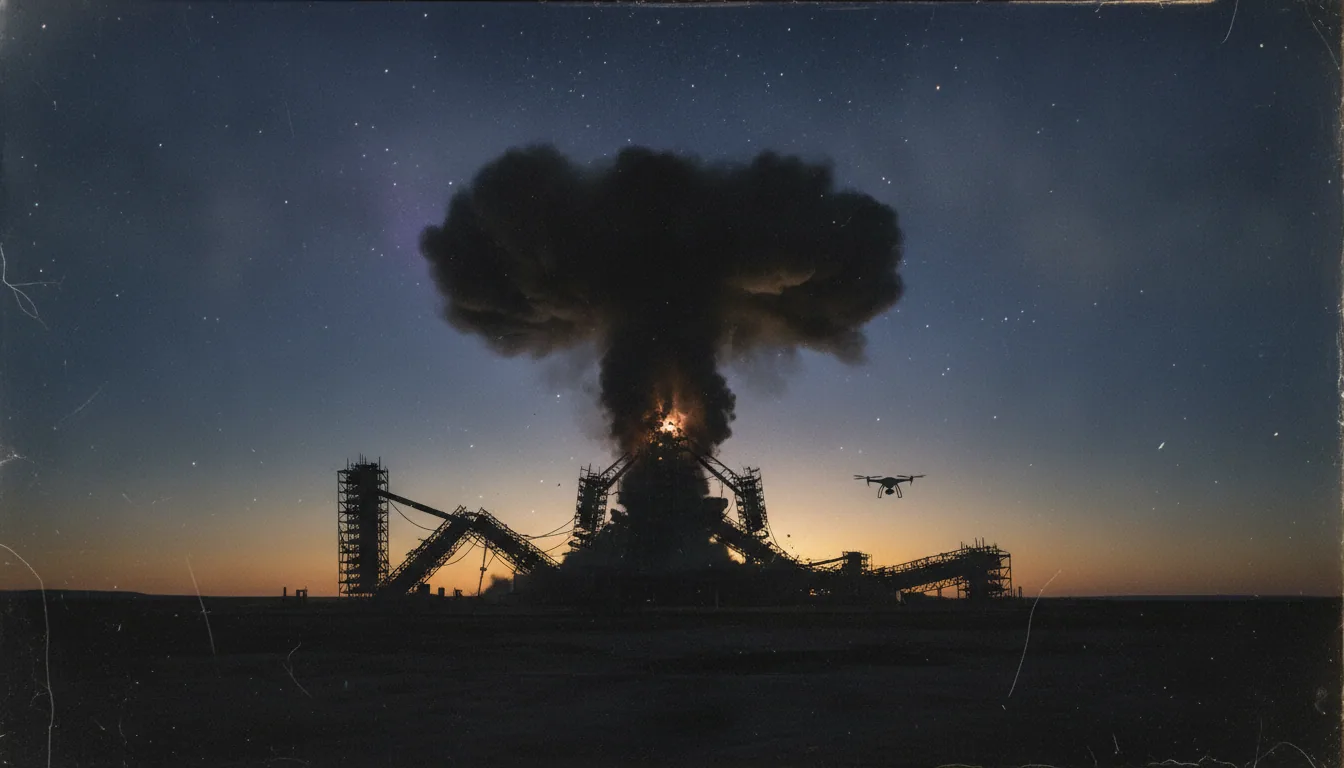
The Man the Ministry Received on October 18
A ministry that receives a new minister under ordinary circumstances receives a bureaucrat. A ministry that receives one because the previous minister was killed during a war receives a signal. On October 18, 2026, Iran named Mehrdad Akhlaghi Ketabchi as its Defense Minister — the appointment confirmed by Iran International — and the signal was not subtle.
His predecessor did not retire or lose a factional struggle. He was killed during the twelve days of fighting with Israel in June 2025, a conflict short enough to fit inside a news cycle and consequential enough to reorganize an entire military doctrine. The vacancy Akhlaghi now fills was made by that war, and the choice of who fills it tells you what Tehran concluded from it.
Akhlaghi is a missile architect — not an administrator — and doctrine appointments go to men who built the weapons the last war proved necessary. The appointment date is not a biographical detail. It is an analytical starting point: the war established what failed and what held, and Iran's new technological military on October 18 received the man Tehran chose to build what comes next. Watch what he builds.
What the Twelve Days Taught Tehran
The June 2025 war lasted twelve days. That is not long enough to rewrite a doctrine on paper, but it is long enough to confirm what a decade of sanctions-pressured planning had already concluded: conventional symmetry against Israel and the United States was a losing proposition. The losses were absorbed; the lesson was institutionalized.
Operations Roaring Lion and Epic Fury in early 2026 deepened the read. Each engagement added weight to the same structural diagnosis — that matched-force confrontation consumed resources Iran could not replace at the rate its adversaries could manufacture them. The institutional response was not a retreat. It was a pivot, deliberate and systematic, toward asymmetric low-cost high-tech systems: drone swarms, cyber capabilities, AI-accelerated kill chains.
The economics of that pivot deserve attention, because they are its actual load-bearing logic. A Western air defense interceptor costs somewhere between one and three million dollars. A Shahed-136 loitering munition costs roughly twenty thousand. Send enough of the latter and the former runs out first. The arithmetic is not sophisticated. Its consequences are.
The doctrine Iran has assembled from this arithmetic is sometimes called drones-against-drones, but the label undersells its ambition. The goal is not to win the drone exchange. The goal is to exhaust the interceptor stockpile — to make the cost of defense so disproportionate that deterrence itself becomes unaffordable for the adversary. Iran transitioned to exactly this posture as a coherent institutional response to conventional losses, not as improvisation. The appointment of a missile architect to run the Defense Ministry on October 18 is the personnel signature of that same decision, made visible at the top of the chain.
Iran's Technological Military Doctrine: AI Inside the Air Defense Network
Brigadier General Ali Haddadi-Samani, speaking from Khatam al-Anbiya headquarters, described the integration in clinical terms: AI compresses the OODA loop, the detect-orient-decide-act cycle that determines whether a missile battery fires in time or too late. The claim is specific enough to take seriously. Shortening that loop by even seconds changes the geometry of an air campaign entirely.
Kioumars Heidari, commander of the Army Ground Forces, went further. Iran possesses, he said, top-secret AI-based weapons that are currently operational. The operational details remain unverified — that is, of course, the point of classifying them. But the pattern of the claim matters: states do not routinely advertise systems that do not exist in some working form, because failure embarrasses the advertiser in exactly the theater where credibility is the deterrent.
The Shahed-136 loitering munition offers the one case where external verification exists. Units recovered in Ukraine carry Iranian markings and feature AI-enhanced anti-jamming systems — not the rough radio-frequency jamming of an earlier generation, but software-adaptive suppression designed to maintain terminal guidance when the electromagnetic environment is contested. Ukraine's defenders noticed. So did NATO's analysts. The drone that costs $20,000 and forces the launch of a missile worth fifty times that is not merely a weapon; it is an accounting instrument.
The "Persian Gulf" missile extends the logic outward. An optical camera, not a radio seeker, guides it to moving targets at ranges between 400 and 500 kilometers. Optical guidance is harder to blind than radar. A moving ship in the Strait of Hormuz is no longer a safe assumption. Ask the small question first: who is the borderland here, and who commands the strait?
The drone that costs $20,000 and forces the launch of a missile worth fifty times that is not merely a weapon; it is an accounting instrument.
The Hard Inventory: Hypersonics, Cyber Battalions, and a Captured American Drone
In September 2026, somewhere in the Strait of Hormuz, an American Dive-LD autonomous underwater drone went silent. Iranian naval forces recovered it. The incident produced the usual brief official silence from Washington, the usual brief official pride from Tehran, and then the cables moved on. What the cables did not dwell on was the quieter implication: that a military assembling this kind of inventory is not building for show.
The inventory is worth reading item by item. The IRGC Cyber Command now administers approximately 3,000 cyber battalions — a figure that functions less as a battlefield statistic than as an organizational statement about how Tehran has decided to structure its digital reach. Those units did not develop in isolation. Russian and Chinese technical experts provided training and tools, a cooperation arrangement that serves as a sanctions bypass by another name: Western export controls close the front door, and Moscow and Beijing hold the side entrance open.
The headline procurement claim sits at the other end of the spectrum from a captured drone. Iran asserts that the Fattah-2 hypersonic glide vehicle reaches Mach 15 and can maneuver in the upper atmosphere, which, if the claim holds to specification, places it in a category of weapons that existing intercept architectures were not designed to meet. Independent verification of the full performance envelope remains unavailable. The claim should neither be dismissed nor treated as confirmed engineering fact.
Somewhere a spreadsheet was quietly updated in more than one Western defense ministry. Three lines: cyber battalions, hypersonic vehicle, recovered underwater platform. The hard inventory is not the same thing as a hard capability, and the gap between what Tehran asserts and what Tehran can reliably field in sustained operations is real. But the gap is no longer as wide as it was before twelve days in June 2025 forced a doctrine.
Deterrence by Threat of the Soft Target
The Cold War logic of deterrence ran on missiles, submarines, and the mutual arithmetic of annihilation. Tehran has revised the syllabus. Mohsen Rezaei, Secretary of the Expediency Discernment Council, stated plainly: if the United States attacks again, Iran will target American technological infrastructure in the Persian Gulf — data centers and AI facilities valued at over two billion dollars. The threat is not bluster dressed as strategy; it is strategy dressed as bluster, and the distinction matters.
The underlying logic is precise. Modern Western military operations run on data. The kill chain from satellite to strike package depends on processing infrastructure that is, in the end, physical — buildings, power cables, cooling systems. If the adversary's command architecture runs on data centers, the data center becomes a military target. This is not a new observation in theory; it is a new capability in practice, and Iran is one of the few non-great-power states that has assembled the tools to act on it.
The British have noticed. MI5 Director Ken McCallum stated that Iranian state threats now consume more of the service's resources than Soviet operations did during the Cold War. That comparison is worth sitting with. The Soviet Union was a superpower with global reach and a nuclear arsenal. Iran is a sanctions-constrained regional power. The resource comparison does not reflect equivalent capability; it reflects a specific kind of proliferating threat — distributed, deniable, and aimed precisely at the infrastructure layer that the West has been slow to harden.
Infrastructure deterrence is not a replacement for the missile inventory. It is a second tier, cheaper to threaten than to deploy, and considerably harder to defend against than a hypersonic glide vehicle moving at Mach 15.
The Small-Nation Ledger, and the One Thing to Watch
Defsecintel Solutions, an Estonian defense firm, reported an eleven-million-euro loss while redirecting capital into drone-monitoring technology. That figure is not a footnote. It is the Baltic cost of a doctrine built in Tehran: the market pressure alone, before any weapon is fired, forces small defense industries to retool around threats they did not design for and cannot price in advance.
MI5 Director General Ken McCallum has stated that his service is devoting more resources to counter Iranian state threats than at any point during the Cold War. The comparison carries weight precisely because it is institutional, not rhetorical. When a Western security service reorganizes its budget around a single adversary's technology program, the program has cleared a threshold.
The one thing to watch is the Iranian nuclear site previously struck by Israel, where construction is now reported to be nearing final stages. If work continues through the next inspection window, the ceiling on every negotiation between Washington and Tehran shifts upward — and Iran's new technological military posture returns the borderland question in its oldest form: who is not at the table when the ceiling is set, and who lives under it.