The Name They Chose
Iran's economic collapse did not begin with a press conference. The United States has been at economic war with Iran since November 1979, when the Carter administration froze Iranian assets following the embassy seizure in Tehran. That precedent matters here, but only up to a point: what the intervening four decades built is a sanctions architecture so layered that each new measure requires a fresh act of naming to signal it is somehow categorically different from the last. On August 24, 2026, Treasury Secretary Scott Bessent supplied that name. He called it "Economic D-Day."
The choice is not accidental. D-Day forecloses negotiation as a frame. It invokes unconditional defeat, not diplomatic leverage, and it positions the announcement inside a martial narrative where the only acceptable outcome is surrender. Bessent described the package as "the single greatest financial offensive ever marshaled against an adversary." A Trump administration official added the declared aim: to "sever every economic lifeline sustaining Iran." The language is built to perform irreversibility.
The legal scaffolding was already in place. In September 2025, the UN snapback mechanism restored the full architecture of multilateral sanctions that the 2015 nuclear agreement had suspended, removing the last institutional argument against coordinated Western pressure. What the August 2026 announcement adds is not a new legal instrument but a declared intention to enforce with a severity that previous administrations treated as optional. The name "Economic D-Day" is, in that precise sense, the load-bearing announcement: everything before it was moulding.
Iran's Economic Collapse: What the Ledger Shows
On August 24, 2026, the rial traded at 2,020,000 to one US dollar on the open market. That is not a typo. The figure has added a zero since the round of sanctions that followed the UN snapback in September 2025, and another since the "Epic Fury" strikes destroyed what remained of Iran's petrochemical export capacity in February 2026. The IMF projects consumer price inflation at 68.9% for the year. Somewhere a spreadsheet was quietly updated.
The GDP numbers follow the same arithmetic. The Iranian economy contracted 2.7% in the 2025/26 fiscal year, before the full weight of the blockade and the bombing settled onto the accounts. Post-strike projections from the World Bank and IMF now range between 8.8% and 10.4% further contraction. That is not a recession. It is the controlled demolition of an economy, proceeding at a measurable pace.
The parliament understood the problem well enough to vote on it. In October 2025, the Majlis approved a currency reform: remove four zeros from the rial, rename what remains, restore the impression of order. Iran has attempted versions of this twice before, and the result each time was the same — the new unit simply devalued faster because the monetary base generating the inflation had not changed. The reform addressed the denomination. It did not address the budget deficit, which stood at roughly 50% at the start of 2026 — a number that tells you a government is not managing a currency but borrowing against a future it does not control.
Read those four figures together — the exchange rate, the inflation projection, the GDP trajectory, and the deficit — and the ledger is unambiguous. The question the ledger cannot answer is how much of the collapse was structurally predetermined and how much was deliberately accelerated from outside. The next sections address that wall.
The Strait as Instrument
On February 28, 2026, Operation Epic Fury struck Iranian petrochemical and military infrastructure. The strikes were not designed to end a war. They were designed to end an export industry — and the arithmetic that followed is exact.
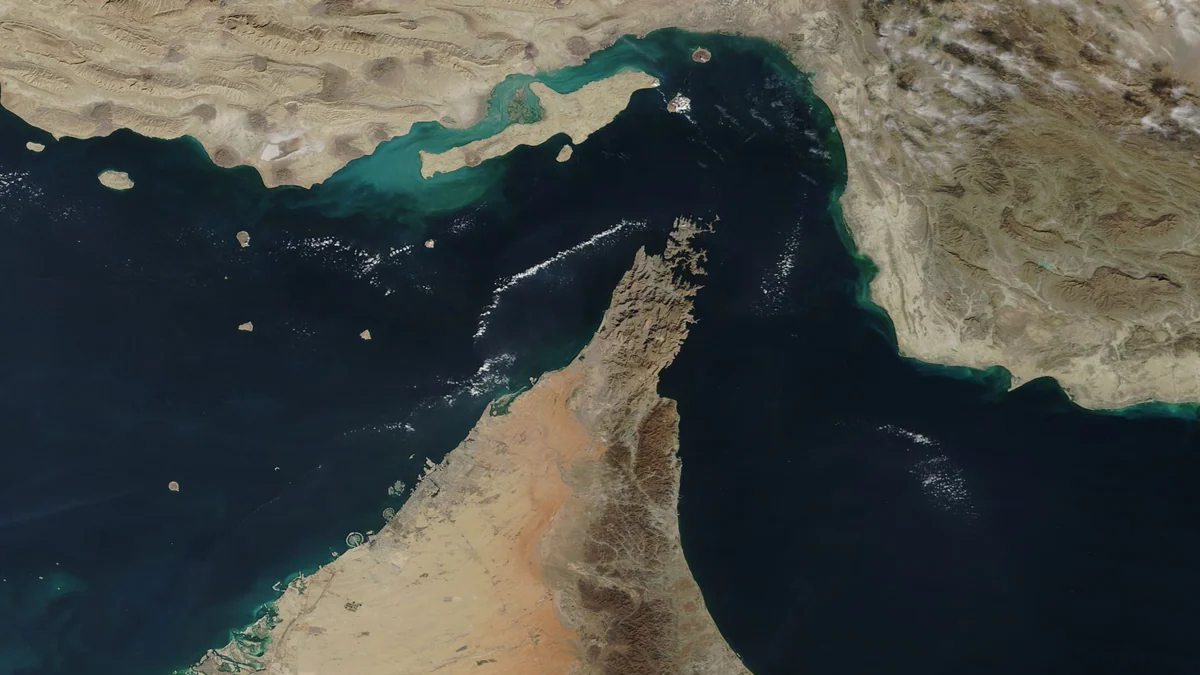
The Foundation for Defense of Democracies calculates the maritime blockade of the Strait of Hormuz costs Iran $435 million per day. That is not a sanction in the traditional sense, the kind that moves through banking channels and compliance departments and lawyer letters. It is a physical siege, with ships and coordinates and a daily bill that compounds against an economy already running a budget deficit approaching 50 percent.
The result shows in the export figures. Before the strikes, Iranian oil exports fluctuated between 65,000 and 1.5 million barrels per day, depending on how successfully Tehran routed crude through shadow fleets and intermediary buyers. The lower number is now the ceiling, not the floor. In July 2026, the US Treasury designated 10 entities and 8 tankers for what the department called attempts to "monetize the Strait" — the official language for the network of front companies and flag-of-convenience vessels that kept the oil moving when the banking system would not.
The designation is the practical mechanism here. Secondary sanctions do not require a ship to be stopped at sea. They require the next port, the next insurer, the next correspondent bank to calculate whether Iranian crude is worth the exposure. Usually it is not. The Strait remains technically open. The market closes it instead — which is tidier, and harder to appeal.
The Cost Beneath the Cable
Before the blockade and before the strikes, Iran was already losing. The Iranian Ministry of Cooperatives, Labour, and Social Welfare recorded that 57% of the population suffered from malnutrition in 2024 — a figure from the year of relative stability, before Operation Epic Fury reduced the petrochemical sector to rubble. A Majlis report placed unemployment among men aged 25 to 40 at 50%. These are not the numbers of a country under siege; they are the baseline from which the siege began.
The distinction matters more than the headline writers tend to allow. When Bessent speaks of severing every economic lifeline, the financial mechanism he describes is real — the rial, the blocked correspondent accounts, the tankers turned away. But the arithmetic of that mechanism lands not on a ledger but on a household. Between 22% and 50% of the Iranian population was already below the poverty line as of March 2025. The blockade did not create scarcity; it locked the door of a room that was already burning.
The blockade did not create scarcity; it locked the door of a room that was already burning.
Sanctions policy is built to be announced. The human cost is built to be absorbed quietly, in depreciated currency and empty shelves, and attributed to the regime rather than the instrument. The cable carries Bessent's phrase. The malnutrition figure travels more slowly, and often not at all.
The Last Buyer
China bought what everyone else refused. Iranian crude moves east at a steep price: eleven dollars per barrel below market — the toll Beijing extracts for absorbing the risk and the stigma. That discount is not charity — it is the structural price of monopoly, and Tehran has no counter-offer.
The comparison that matters is not to any prior sanctions regime. In 2012, Iran still had European buyers. In 2018, it still had ambiguity in the secondary sanctions architecture. Today it has one customer, and that customer sets the terms. The "Economic D-Day" measures are designed to close that channel too — to confront Beijing with a choice between discounted Iranian barrels and access to the US financial system, and to do so precisely while a US-China trade detente remains fragile enough to crack under additional weight.
The reach of secondary sanctions shows up in places that have no quarrel with anyone. Statistics Estonia recorded a 79.1 percent fall in Estonian exports to Iran in 2025. Estonia trades almost nothing with Tehran under ordinary conditions; that collapse is not a bilateral story. It is the mechanism demonstrating that secondary sanctions sever indirect links well beyond Iran's borders — a small-nation canary for how thoroughly European exposure has been cut. The European firm that once sold Estonia's goods onward to an Iranian intermediary made a quiet calculation, and the ledger in Tallinn registered the result.
Whether Beijing absorbs the new pressure, quietly reduces its intake, or uses the detente as cover to keep buying — that arithmetic determines whether the isolation holds.
The Marker to Watch
Unconfirmed reports that Ali Khamenei died during the February strikes have circulated for six months without official acknowledgment from Tehran. That silence is itself a data point. A state whose supreme leader is alive and functional does not typically leave the question open.
The structural question this raises is not about succession ritual but about load-bearing authority. The IRGC and the civilian government under Masoud Pezeshkian are fighting over a diminishing fiscal floor. Pezeshkian's administration holds the formal apparatus; the IRGC holds the guns and the remaining hard-currency channels. Which structure survives a sustained revenue collapse is not yet determined, and anyone who tells you otherwise is working from hope rather than evidence.
Here the analyst's standing error deserves naming directly. Economic collapse and regime transition are not the same event, and conflating them has burned confident readers before. The Soviet Union's economy was a ruin for years before the flag came down; the IRGC does not need a functioning welfare state to maintain coercive control.
Watch Chinese oil purchase volumes in Q4 2026. If volumes fall sharply, the fiscal floor collapses on a timeline measured in months, not years — and the IRGC-versus-Pezeshkian question resolves itself under pressure. If Beijing absorbs Iranian crude at or above current levels, the sanctions architecture has a structural gap that no press conference will close. That single number, reported quarterly, carries more analytical weight than everything said at the podium on August 24 — and will determine whether Iran's economic collapse ends in managed transition or uncontrolled fracture.