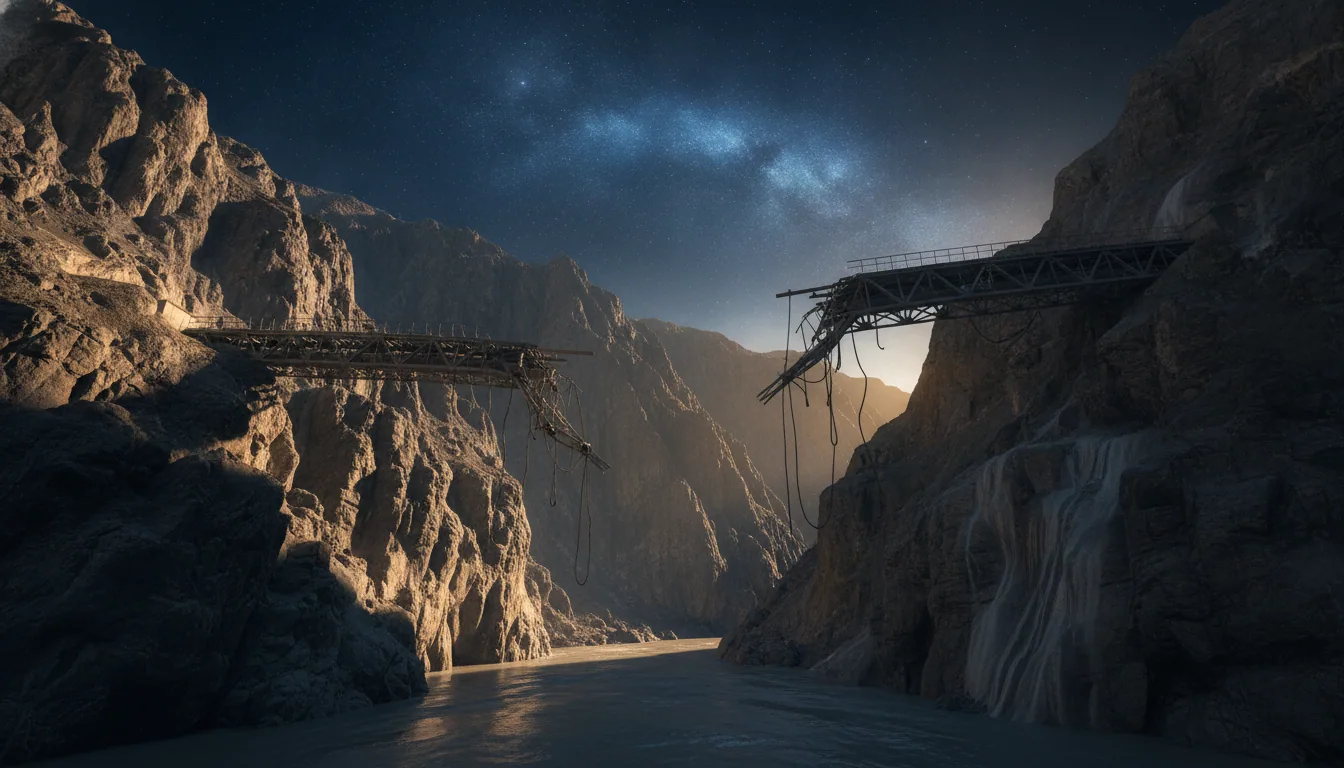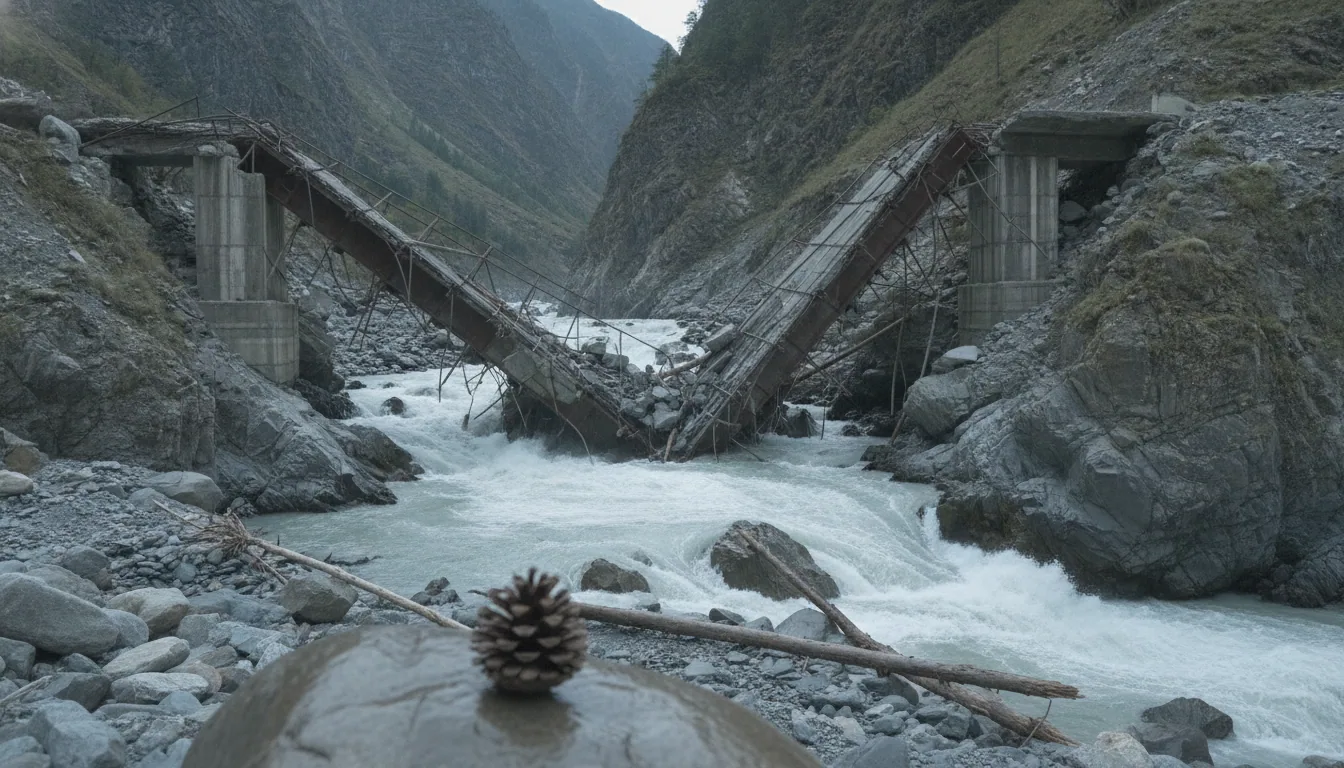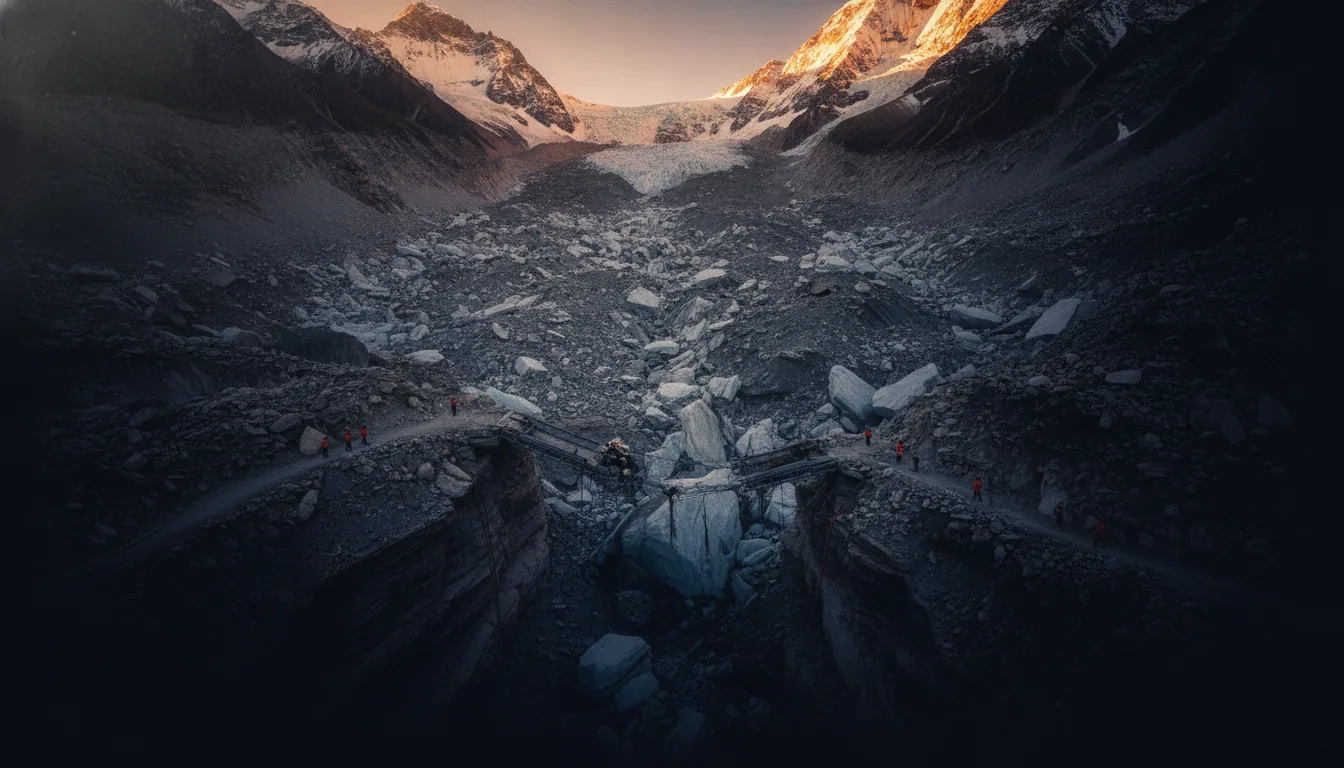
Unpredictable glacier collapses — once treated as anomalies — are now the defining hazard of high-altitude mountain ranges under accelerating climate change. The Langtang Lirung disaster of August 2026 is the clearest evidence yet of how fast that baseline has shifted.
A Mountain That Moved Like an Earthquake
The seismographs in Kathmandu started screaming at 6:47 in the morning on August 26, 2026. The needle traced the signature of a 5.2 magnitude earthquake — clear, unmistakable, violent. But when seismologists ran the checklist, nothing added up. No fault had slipped. No tectonic plates had shifted. The ground had not moved. The mountain had.
What moved instead was Langtang Lirung, a peak on the Nepal-Tibet border, shedding 200 million cubic meters of ice and rock in a single catastrophic release. That number needs a body-sized translation to mean anything: picture the entire city of Tartu buried under sixty meters of rubble, and you are in the right order of magnitude. It did not fall slowly. It did not give warning. It simply let go.
By the end of that first day, more than 1,300 people were confirmed dead in the villages and valleys below. The rivers had turned to moving concrete. Roads had ceased to exist. And in the remote high-altitude terrain where the debris had scattered, another 4,500 people were simply missing, a number that in the weeks following refused to get smaller in any meaningful way.
Here is the strange part. The physics that produced this event was not mysterious. The forces involved had been building for years, following rules that geologists understand well. The surprise was not in the mountain. The surprise was in our models, which were built for a slower world and had not caught up to the one we now inhabit. That gap, between what the physics was always going to do and what our instruments failed to predict, is what this story is about.
The Ice Was Already Undermined From Within
The catastrophe on Langtang Lirung did not begin at 6:47 in the morning. It began years earlier, in the dark interior of the glacier, where three separate mechanisms were quietly doing their work.
The first is hydraulic pressure. As surface ice melts, the water doesn't simply run off — it seeps into existing cracks and pushes downward. Under enough depth, that water column builds pressure against the bedrock below, reducing the friction that has held the glacier in place. Think of it as a hydraulic jack slipped under the ice: the glacier doesn't just sit on the mountain anymore, it effectively floats off it. This is not a metaphor. It is the physics identified in studies published in Nature Communications, describing exactly how meltwater becomes a mechanical force rather than merely a product of warming.
The second mechanism is permafrost loss. Frozen ground acts as the structural skeleton inside steep mountain faces, binding shattered rock into something that behaves, provisionally, like a solid wall. Once that frozen matrix thaws, there is no skeleton left. The cliff face holds its shape for a while, out of habit almost, and then it doesn't.
The third is the buttressing effect. For centuries, the lower tongue of a glacier presses against the slope below it, acting as a brace for the heavier ice mass above. When that lower section retreats, the brace disappears — like pulling a doorstop from under a leaning door. The upper ice, which was never as stable as it appeared, suddenly has nothing to lean against.
What makes Langtang Lirung so instructive, and so grim, is that none of these three mechanisms operates alone. Meltwater weakens the base; permafrost loss removes the rock skeleton; buttress retreat takes away the last physical constraint. Each amplifies the others. The failure is never just one thing. It is the three of them, working in concert, reaching a threshold that no single warning sign announces.
Four Years Earlier, an Italian Glacier Said the Same Thing
On July 3, 2022, a chunk of the Marmolada glacier broke away from the highest summit in the Dolomites and swept eleven people off the mountain. The scale was smaller than Langtang Lirung by almost every measure. But the forensics were unusually clean, and that made Marmolada something rarer than a tragedy: a readable warning.
Researchers from the University of Padova documented what the summit thermometer had recorded the day before: 10.7°C. Hold that number for a moment. At that altitude, temperatures should hover near zero. Ten degrees above freezing is not a warm afternoon — it is a structural event. Meltwater was pouring into cracks, pressing against the ice from inside, acting as a hydraulic wedge that pried the glacier away from the rock beneath. The mountain did not simply melt. It was levered apart.
Marmolada was not an anomaly waiting to be explained. It was a data point in a trend that European researchers had already been tracking with increasing unease. Permafrost across Alpine and other European mountain zones is warming faster than 1°C per decade — a pace that sounds modest until you consider that this "glue" took centuries of stable cold to set. Remove the cold fast enough, and slopes that have held since the last ice age begin to negotiate their own geometry.
What Marmolada offered, and what makes it practically useful now, is a before-and-after record precise enough to study. Langtang Lirung is the same letter, written at ten times the volume. The alphabet, unfortunately, has not changed.
Why the Himalayas Are Running This Experiment Faster Than Anyone Else
Picture a pot of water on a stove that someone keeps nudging the dial up on, just a little, every week. The surface stays still for a long time. Then it doesn't. The Himalayas are that pot, and the dial has been moving faster here than almost anywhere else on Earth. According to ICIMOD, the region is warming roughly 50% faster than the global average — which sounds like a statistic until you translate it into what ice and rock actually feel. Every degree of extra warmth is not just a thermometer reading; it is a new load of meltwater finding new cracks, a new stretch of permafrost softening into mud, a new section of bedrock losing the frozen mortar that held it together for centuries.
Scientists are clear that the Langtang Lirung collapse was not caused by a single bad summer. Climate change had shifted the baseline. The mountain that fell in August 2026 was a different mountain structurally than the one that stood there two decades ago — weaker at its seams, wetter inside, closer to a threshold nobody had marked on any map.
And now the geometry of the water itself is changing in ways that catch us genuinely off guard. Pools of meltwater — supraglacial lakes, in the field's vocabulary — are forming on glacier surfaces, persisting for a few weeks, and then bursting. The resulting Glacial Lake Outburst Floods, GLOFs, can send walls of water down a valley with almost no warning. Some of these lakes are so small and so short-lived that standard lake-mapping satellites simply miss them. The Himalayas are not just losing ice — they are rearranging how water moves through their bodies, and the new routes are ones we have no historical record of.
We Can Map the Slow Melt — But Not the Sudden Ice Failure
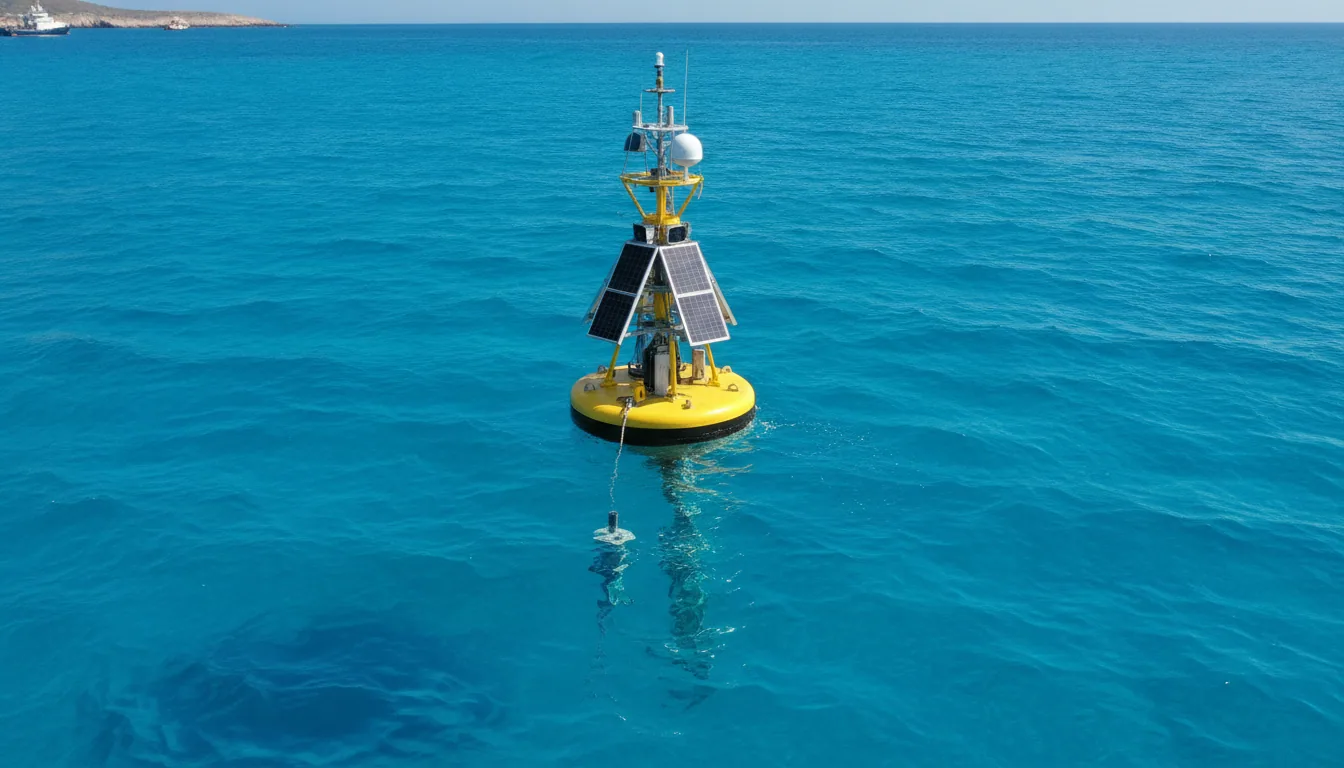
There are two kinds of knowing, and mountains only ask for one of them. Satellites orbiting at 500 kilometers can trace the retreat of a glacier's edge over years, drawing its slow withdrawal in precise centimeters per season. What they cannot do is hear the groan of rock separating from ice in the dark hours before a collapse.
That gap is not a budget problem. ETH Zurich glaciologists are plain about it: monitoring systems were designed for decadal melt patterns, not for failures that unfold over hours. The instruments are excellent at the wrong timescale. A glacier can shed its outline predictably for thirty years, then break in a single Tuesday morning, and no sensor in orbit would have seen the difference between Monday and the end.
The seismic record is now quietly telling a related story. USGS analysts, reviewing historical data, have begun reclassifying events that were logged as minor earthquakes, finding that some were actually climate-driven glacier collapses that nobody witnessed. The historical record is being rewritten from the bottom up. Events we called "unexplained tremors" turn out to have been mountains rearranging themselves.
Technology cannot move fast enough to prevent loss.
That sentence appeared without softening in a Guardian report, and it deserves to sit exactly as it was said. Not every problem is a solvable engineering problem in the time available. Some gaps between what we can measure and what we need to know are, for now, real.
What Remains After the Ice: The Question We Cannot Yet Answer
By 2100, global glaciers are projected to lose somewhere between 25 and 50 percent of their remaining mass. That range is not a rounding error — it is the honest width of our uncertainty, and it matters enormously, because the difference between the low end and the high end is the difference between manageable retreat and the near-total loss of systems that have taken tens of thousands of years to build.
The consequences are already forcing a reclassification. Mountain regions that hydropower planners, tourism boards, and highland communities once treated as predictable, if demanding, environments are being recategorized as high-risk zones. Infrastructure built for the glacier that existed in 1990 is increasingly misaligned with the glacier that exists today, and catastrophically misaligned with the one arriving in 2060.
What we genuinely do not know fills a longer list than what we do. The exact location and volume of thousands of small, temporary supraglacial lakes forming across the Himalayas right now is uncharted. The precise temperature threshold that tips a stressed glacier from slow retreat into sudden, mechanical failure remains unknown. And the fate of the 4,500 people still missing after August along the Nepal-Tibet border is, for now, simply open.
Mountains have always been indifferent to our timelines and our categories. What has changed is that our warming has written a new variable into their physics — and unpredictable glacier collapses are the clearest expression of equations we are only beginning to read. The next chapter is being written in ice, and we do not yet know how it ends.