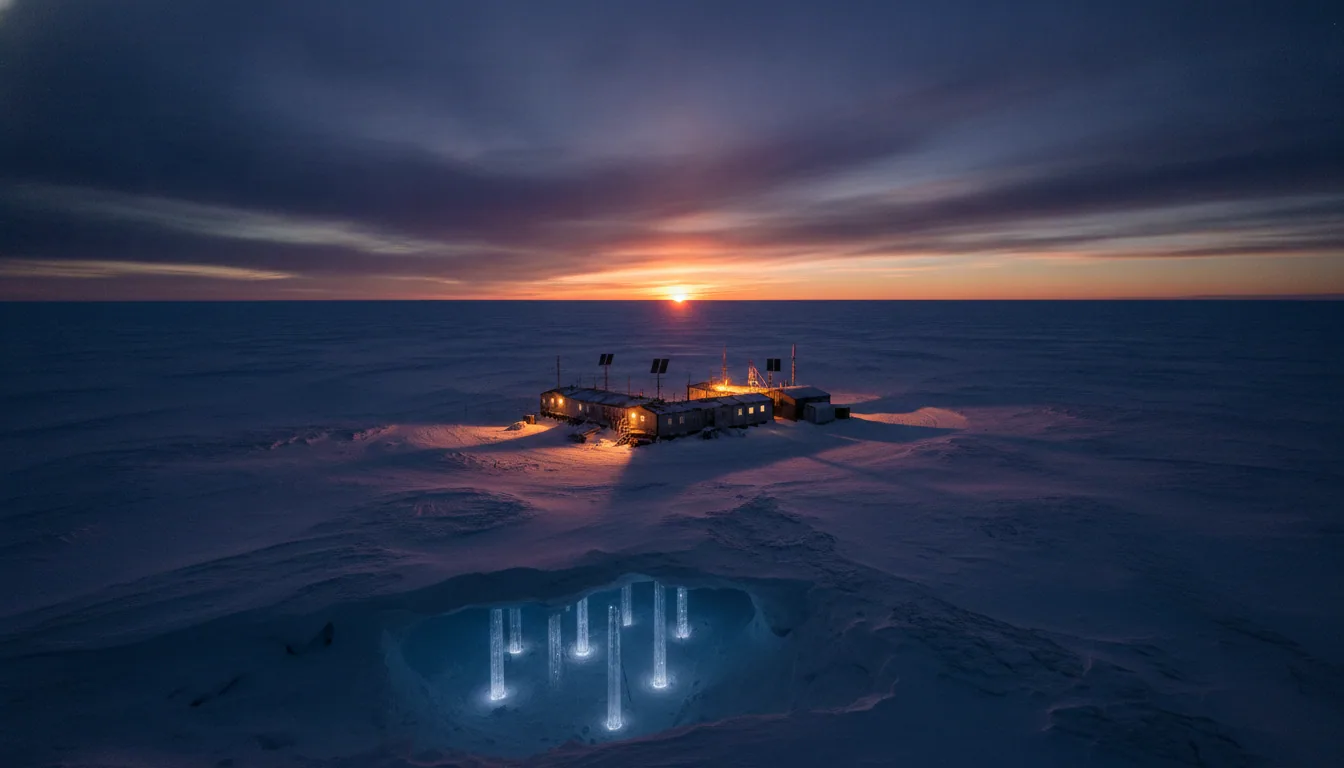
A Particle That Passes Through You Without Asking Permission
Right now, as you read this sentence, roughly 65 billion neutrinos from the Sun are streaming through every square centimetre of your body. Not around you. Through you. They are passing through the chair you sit on, through the floor beneath it, through the entire planet, and out the other side - without slowing down, without scattering, without the faintest acknowledgment that matter exists at all.
This is not a metaphor. It is a measured fact, and it remains strange no matter how many times you hear it.
Neutrinos carry no electric charge and almost no mass. Those two absences are the key to everything. Charged particles get grabbed and deflected by magnetic fields; massive particles get slowed and absorbed by dense matter. Neutrinos are neither, so the ordinary universe - gas clouds, galaxy clusters, everything between a violent source and your retina - simply cannot stop them. Where light from a distant catastrophe might be scattered, blocked, or bent into incoherence on its billion-year journey, a neutrino arrives pointing exactly back at whatever made it.
Here is the strange part. They are not perfectly ghost-like. In the 1990s, physicists discovered that neutrinos oscillate - they change "flavour" during flight, cycling between three distinct types called electron, muon, and tau. That oscillation matters enormously, because a particle can only change type if it has some mass, however tiny. The ghost particle, it turns out, has a little weight after all. The nickname is accurate and, as nicknames usually are, slightly misleading.
This is the particle Francis Halzen spent nearly four decades learning to catch.
The 1988 Napkin: One Physicist's Unreasonable Proposal
Francis Halzen was 44 years old and already established as a particle theorist at the University of Wisconsin-Madison when he wrote down an idea that his colleagues considered, charitably, premature. The year was 1988. The proposal: build a neutrino detector one cubic kilometre in volume. Not a room. Not a building. A cubic kilometre of instrumented material, enough to swallow a small mountain.
The logic behind it was ruthless in its simplicity. A neutrino barely interacts with anything, which makes it precious as a cosmic messenger and maddening as a detection target. To catch even a handful of the high-energy ones arriving from distant galaxies, you need a target of almost absurd size. Physics gives you no other option. More material means more chances, and there is no shortcut around that arithmetic.
Antarctica solved the engineering problem in a way no laboratory could. The glacial ice at the South Pole is among the clearest natural materials on Earth, built up over hundreds of thousands of years into a transparent, geologically stable medium stretching kilometres deep. Sink a light sensor into it at 1.5 kilometres down, and the surrounding ice becomes your detector, your laboratory, and your shield from cosmic-ray noise all at once.
Halzen spent nearly four decades watching the idea survive skepticism, funding fights, and Antarctic winters before it graduated from proposal to instrument to Nobel-caliber result. He is 82 now, and still holds the Vilas Research Professorship at Wisconsin-Madison. Big-infrastructure science moves on timescales that demand a particular kind of stubbornness. Halzen appears to have had exactly the right amount.
A Cathedral in the Ice: How IceCube Actually Works
Picture the Amundsen-Scott South Pole Station in winter: minus sixty degrees, katabatic winds, and below your feet, one cubic kilometre of ancient glacial ice studded with more than 5,000 sensors. That is IceCube. Not a telescope you point at the sky, but a block of frozen continent roughly the volume of the Empire State Building squared - and then squared again.
The sensors, called digital optical modules, hang on 86 cables drilled into the ice at depths between 1.45 and 2.45 kilometres. Down there, the pressure has squeezed out almost every air bubble, leaving a medium of exceptional clarity. That clarity is the whole point.
Here is what the detector is actually waiting for. A neutrino, having crossed half the observable universe without bumping into anything, very occasionally strikes an atomic nucleus in the ice. The collision produces a charged particle - a muon, typically - that moves faster than light travels through ice. That sentence is not a typo. Light in ice is slower than light in a vacuum, and the muon briefly outruns it, generating a faint cone of blue light called Cherenkov radiation. It is the optical equivalent of a sonic boom.
The digital optical modules catch that blue flash. From its shape and timing, physicists reconstruct the direction the muon was travelling - which is almost exactly the direction the neutrino came from. The detector does not see the neutrino. It sees the ghost of the ghost.
Reading those flashes is the work of more than 350 scientists from 58 institutions worldwide. Every event is a collaboration of drilling engineers, software architects, glaciologists, and particle physicists scattered across a dozen countries, all decoding a single blue wink from a kilometre underground. The universe writes in very faint ink. IceCube learned to read it.
The universe writes in very faint ink. IceCube learned to read it.
Stockholm, October 6: The 2026 Nobel Prize and Neutrino Astronomy's Coming of Age
At 11:45 in the morning, Stockholm time, Mark Pearce, Chair of the Nobel Committee for Physics, stood before cameras and announced the 2026 Nobel Prize in Physics. The name was Francis Halzen. The citation was precise, as Nobel citations always are: "for decisive contributions to the IceCube Neutrino Observatory and the discovery of high-energy neutrinos of astrophysical origin."
Twelve words to summarise thirty-eight years of work.
The prize carries 12 million Swedish kronor, roughly 1.2 million US dollars. What no one quite answered that morning is how that sum is shared among the more than 350 scientists who built, maintained, and operated IceCube over decades. The Nobel rules allow at most three individual laureates; the collaboration that earned the result contains an entire small city of physicists. The arithmetic is left, quietly, as an exercise for the institution.
Halzen, 82 years old and a Vilas Research Professor at the University of Wisconsin-Madison, responded with two sentences that are, depending on your temperament, either disarmingly modest or deeply precise. "I was lucky," he said. And then: "Neutrino astronomy is still to come."
The second sentence is the more interesting one. The award does not celebrate a finished project. It marks a graduation: neutrino detection has moved from an experimental physics challenge, something you attempt because the physics is thrilling, into a standard observational tool, something astronomers can rely on the way they rely on a radio telescope. That is what prizes often quietly recognise: not a discovery, but a new instrument handed to science for keeps.
What IceCube Has Already Seen: Blazars, Galaxies, and a 220-PeV Monster
Traditional telescopes read the universe in light. That is their great strength and their fundamental limit: anything that does not shine brightly, or whose light is swallowed by dust and gas between here and there, stays invisible. Neutrinos do not play by those rules.
Consider what happened in June 2026. A paper in Nature Astronomy traced a single neutrino, catalogued as IC 210922A, back to a source 11 billion light-years away. The source has been nicknamed Shadow Blaster, a star-forming galaxy that produces almost no light by the standards of the classical sky surveys. By the classical standards, it was nearly invisible. By neutrino standards, it was shouting.
That is the essential contrast. Where optical astronomy sees a dim smudge or nothing at all, a neutrino arrival points a straight finger at violent physics happening inside. No magnetic field bends the neutrino in flight; no gas cloud absorbs it on the way. The particle travels eleven billion light-years and arrives with its direction intact, a message from a cosmic accelerator that would otherwise go unread.
Then, in May 2026, the KM3NeT/ARCA detector in the Mediterranean recorded something even more striking: a neutrino carrying 220 petaelectronvolts of energy. That is 220 million gigaelectronvolts. For comparison, the protons smashed together at the Large Hadron Collider carry a few teraelectronvolts each. This single particle carried roughly twenty million times more. It is the highest energy particle ever recorded from a cosmic source. Nobody yet knows exactly where it came from.
This is the frontier of multi-messenger astronomy: combining neutrino detections with light and gravitational-wave observations to see the same violent event from multiple angles simultaneously, the way doctors read a patient with different instruments at once. The map of the high-energy universe is being drawn for the first time. Many of its most interesting features are still blank.
The Race Beneath the Earth and Under the Sea
IceCube does not work alone. As the Nobel Committee read Halzen's citation in Stockholm, two major competitors were hitting their own strides, and the global picture of neutrino infrastructure had quietly shifted.
In the Mediterranean, KM3NeT uses seawater the way IceCube uses ice: as a vast transparent medium, threaded with optical sensors waiting for that faint blue Cherenkov flash. Different ocean, same physics. The collaboration delivered its highest-energy detection ever in May 2026 at 220 PeV, a result that no single nation funded and no single institution can claim. That is now the shape of this science.
Meanwhile, 700 metres underground in Guangdong province, China's Jiangmen Underground Neutrino Observatory released its first precision results on neutrino mass ordering in June 2026. JUNO is not hunting the high-energy astrophysical particles that won Halzen his prize; it is probing the subtler question of how the three neutrino types rank by mass. The two programs are asking different questions of the same ghost particle, and the answers are converging.
The National Science Foundation and its international partner agencies built IceCube over a decade; sustaining momentum at that scale is never guaranteed. IceCube-Gen2, a proposed expansion that would increase the detector volume by roughly a factor of eight, remains under discussion. Funding is not yet committed. Nobel recognition has a way of loosening budgets, but it has never been a substitute for one. Fifty-eight institutions spread across 58 countries can build extraordinary science together; keeping it funded requires a different kind of collaboration, one measured not in gigaelectronvolts but in political will.
What We Still Cannot See — and Why That Is the Interesting Part
Halzen himself has said it plainly: "neutrino astronomy is still to come." That is not false modesty from an 82-year-old man holding a Nobel citation. It is the honest shape of where the field actually stands.
Consider Shadow Blaster, the star-forming galaxy 11 billion light-years away that a June 2026 study linked to neutrino IC 210922A. The nickname is vivid, the detection is real, and the full scientific classification of what exactly it is remains uncertain. One data point does not yet make a portrait. Neutrino astronomy can identify individual sources only rarely, and each identification arrives more like a single word than a sentence.
But this is precisely how every new messenger has worked. Radio astronomy revealed pulsars; X-rays found neutron stars; gravitational waves caught black holes mid-collision. Each time humanity opened a new sensory channel to the universe, it found objects and events that the old channels had been blind to. Neutrinos are the latest channel, and the catalogue of what they will eventually show us is, by definition, a list we cannot yet write.
Somewhere across 13 billion years of cosmic history, violent processes are running right now, silent to every telescope we have. The ice is listening. We just need a bigger ear.