Something Arrived from 63 Light-Years Away
On the morning of September 22, 2026, a small group of astronomers announced something that had never been done before: they had heard a planet. Not a star. Not a galaxy, not a pulsar, not a smear of diffuse gas. A planet, orbiting another sun, 63.4 light-years from the one that warms your face.
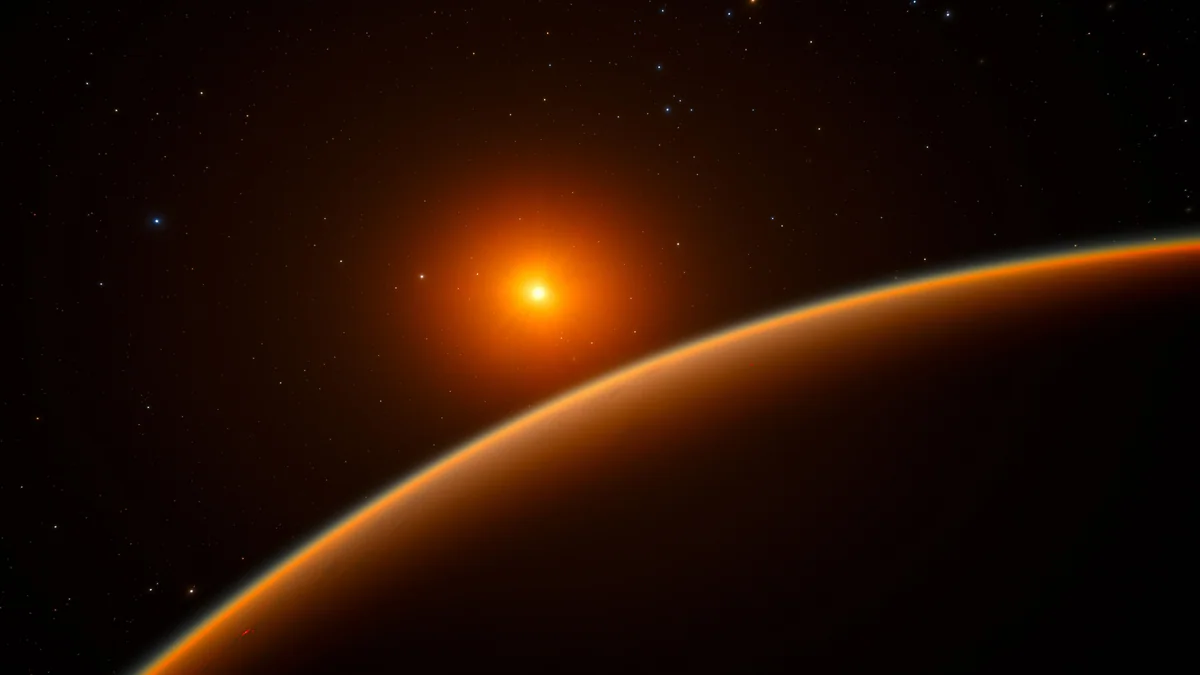
The planet is Beta Pictoris b, a young gas giant roughly ten times the mass of Jupiter, circling the bright star Beta Pictoris in the southern constellation of the Painter's Easel. Using the MeerKAT radio telescope array in South Africa, a team led by researchers at the Harvard and Smithsonian Center for Astrophysics and the University of Oregon localized recurring bursts of radio emission directly to the planet itself. Not to its star. To the planet.
Here is the strange part. Radio waves have a source. Every transmitter, natural or otherwise, sits in a precise location. Pinpointing an exoplanet radio signal to a specific world 63.4 light-years away, rather than the much brighter star sitting right next to it in the sky, is an act of precision that was simply impossible until now. As the team wrote, no radio detection had previously been unambiguously localized to an extrasolar planet rather than its host star. That sentence, quiet and technical, closes a door on a very long wait.
The Planet That Sent It: Young, Massive, Spinning Fast
Beta Pictoris b is not a hypothetical. It is a planet we have actually seen.
In 2008, astronomers captured a direct image of it — a bright dot crawling slowly around its host star, one of the first exoplanets ever photographed rather than inferred. That alone made it famous. What the 2026 detection adds is something the photograph could never show: evidence of what is happening deep inside.
The planet is a gas giant, but "giant" undersells it. Beta Pictoris b carries roughly ten times the mass of Jupiter, which already holds more mass than all the other planets in our solar system combined. Imagine compressing that thought. Then multiply it by ten.
Mass alone, though, does not explain the radio signal. The critical detail is age and spin. Beta Pictoris b is young — its system is around 20 million years old, a toddler by stellar standards — and it rotates once every 8 to 9 hours. Earth takes 24 hours. Even Jupiter, a fast rotator, takes about 10. A planet this massive, spinning this furiously, is doing enormous work in its interior: conducting fluid, building pressure, generating electrical currents. This is exactly the recipe for a planetary dynamo, the same internal engine that gives Earth its magnetic field, only running far hotter and faster.
The physics, in short, predicted that something like this should exist. Finding it was the hard part.
How You Listen to a Planet: MeerKAT and the Art of Ruling Things Out
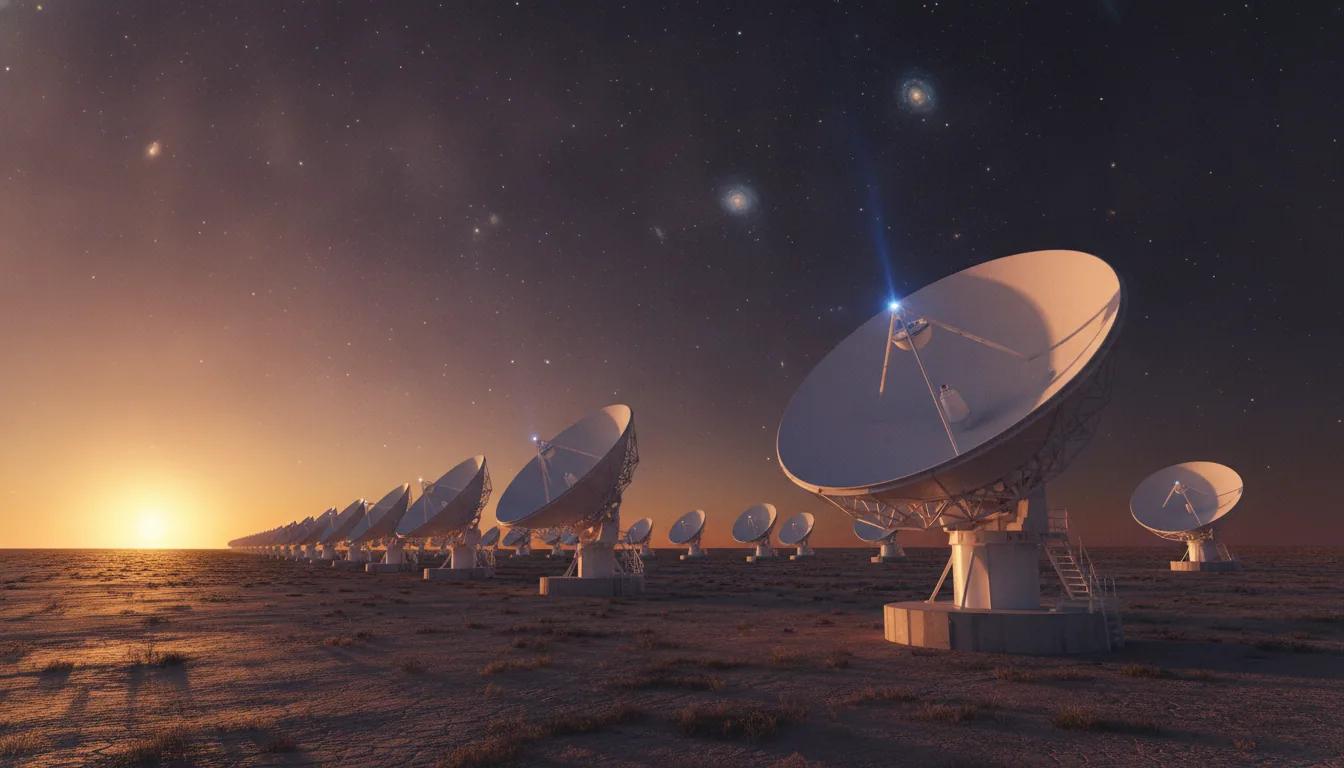
Sixty-four dishes are arranged across the Karoo desert in South Africa, each one a white bowl roughly 13 meters wide, all of them listening together as a single instrument. This is MeerKAT. It does not look at light. It listens to radio waves, and its combined sensitivity is good enough to pick up a signal that, by the time it arrives from 63 light-years away, carries less energy than a snowflake landing on a table.
The team watched Beta Pictoris b across four separate observation periods in 2025 and 2026, tuning across a frequency range of 0.85 to 3.5 GHz — roughly the band your home Wi-Fi occupies, which tells you something about why ruling out interference is half the work. What they found was not a steady hum. The signal came as rapid, recurring bursts, tightly circularly polarized, which means the radio waves were spinning in a consistent direction rather than vibrating randomly. That spin is a fingerprint. It is the calling card of a process called Electron Cyclotron Maser Instability, ECMI, the same mechanism that powers Jupiter's auroral radio roar.
But a fingerprint only matters if you can prove whose hand left it. The critical move was using quasars — ancient, unmoving galaxies billions of light-years away — as fixed reference points, like surveyor's stakes in the radio sky. By measuring the signal's position against those anchors across multiple epochs, the team localized the emission to the planet, not the star. That matters enormously because Beta Pictoris itself, an early-type star burning hot and bright, has no known physical mechanism that could produce this kind of emission. There is simply nothing in stellar physics at that stellar type to explain what MeerKAT heard. The signal has nowhere else to live.
The Long List of Almost: False Alarms and Near-Misses
In December 2020, a radio telescope picked up a narrow-band signal drifting in frequency, the exact behavior you would expect from a transmitter on a moving planet. The signal appeared to come from Proxima Centauri, our nearest stellar neighbor. Astronomers held their breath for three years. Then, in 2024, researcher Sofia Sheikh and her team traced it back to a terrestrial radio antenna on Earth. BLC1, as it had been named, was radio frequency interference wearing a very convincing costume.
That was not the only stumble. A candidate detection of radio emissions from Tau Boötis b, announced in 2020, looked promising enough to publish. Four years later, in May 2024, a reanalysis ruled it a non-detection. The signal had dissolved under scrutiny. Then there is YZ Ceti b, whose radio waves are real and reproducible, but the emissions originate from the interaction between the planet and its star, a kind of magnetic handshake rather than a broadcast from the planet itself. Close, but a categorically different thing.
Most recently, in July 2026, astronomers estimated the magnetic field of GJ 436 b by watching how it tugs on its star's corona, a clever indirect method that produces a result ranging anywhere from 6 to 110 Gauss. That is not a measurement so much as a suggestion.
Each near-miss did something useful, though: it forced the community to sharpen its standards, to demand not just a signal but a signal that could be localized, verified against a fixed reference, and ruled out as contamination. The skepticism bar rose with every false start. Which is exactly why what happened with Beta Pictoris b, on the other side of that long accumulation of almost, carries the weight it does.
What 1,200 Gauss Tells You About a World
Earth's magnetic field runs at roughly half a Gauss. Jupiter's, the strongest in our solar system's planetary roster, peaks around 4 to 14 Gauss at the cloud tops. Beta Pictoris b's field is estimated at greater than 1,200 Gauss. That number is not a typo. It is, as far as we can measure, the first direct magnetic field strength ever obtained for a planet outside our solar system.
The mechanism that produces it is the same one that paints auroras across our own polar skies. Charged particles, streaming outward from Beta Pictoris, spiral along magnetic field lines and funnel into the planet's upper atmosphere. There, Electron Cyclotron Maser Instability converts their kinetic energy into tightly beamed, circularly polarized radio waves. The aurora is not just light. It is a broadcast.
What generates a field that powerful? The answer lives inside the planet. Beta Pictoris b spins once every eight to nine hours, a pace roughly twice Jupiter's rotation rate, and its interior is almost certainly a churning mix of conducting fluid. Spin a conductor fast enough, and the physics of a planetary dynamo kicks in: circulating currents generate a magnetic field, which organizes more current, which strengthens the field. Bigger, faster, more fluid interior means more field. Beta Pictoris b has all three.
The comparison to Jupiter is instructive, but the analogy has limits. Jupiter is 4.6 billion years old and has had time to settle. Beta Pictoris b is perhaps 20 million years old, still radiating heat, still contracting. Its enormous field may partly reflect youth rather than ultimate steady-state character. What we know is the field exists, and it is formidable.
It is, as far as we can measure, the first direct magnetic field strength ever obtained for a planet outside our solar system.
The Hidden Variable in the Habitability Equation
A planet without a magnetic field is, over geological time, a planet losing its air. Stellar winds, the constant outflow of charged particles from a host star, erode unprotected atmospheres at rates that depend on the star's activity and the planet's distance. Mars lost most of its atmosphere this way after its internal dynamo shut down roughly 4 billion years ago. Earth kept its air because a liquid iron core, spinning fast enough, generates the roughly half-Gauss field that deflects those winds before they can do lasting damage.
This is why "magnetically protected" deserves a place alongside "liquid water" in the checklist of conditions astrobiologists use. Liquid water is the classic criterion, and rightly so. But liquid water on the surface of a planet whose atmosphere has been scoured away by a young, hyperactive star is a short chapter in a short story. The magnetic field is the condition that lets the other conditions persist.
Beta Pictoris b is not a candidate for life — but the method that measured its planetary magnetic field emission at above 1,200 Gauss does not care what kind of planet it is applied to. A rockier world, orbiting in a habitable zone, with the same auroral radio signature, would yield the same kind of number. The measurement technique now exists. The question is only whether our instruments are sensitive enough to hear the quieter planets.
Exoplanet Radio Detection: What the Telescopes Will Listen For Next
One confirmed signal changes the question. It no longer asks whether we can hear an exoplanet at all. It asks how many we can eventually hear, and how soon.
The immediate answer is more telescopes, and more targets at once. Early 2026 brought the unveiling of Multiplexed Interferometric Radio Spectroscopy, RIMS, a technique that lets observatories monitor hundreds of stars simultaneously rather than staring at one system per campaign. That is not a small upgrade. It shifts the search from archaeology, digging carefully in one spot, to something closer to a survey, walking the whole field.
The larger answer arrives later. The Square Kilometre Array, currently taking shape across South Africa and Australia, will deliver sensitivity five to seven times beyond what MeerKAT can offer. That margin matters because the outstanding problem is size. Beta Pictoris b is ten times Jupiter's mass, a giant with a giant's magnetic roar. Rocky planets, Earth-sized worlds, whisper at frequencies the current generation can barely resolve. Whether any instrument will ever hear them clearly remains genuinely open.
Three questions now sit at the frontier of exoplanet radio astronomy: Does Beta Pictoris b's signal hold steady, or does it flare and fade over years? What chemistry drifts through the aurora's glow? And can a rocky world — the kind where life as we know it actually lives — ever announce its magnetic field to a telescope 63 light-years away? We built the ladder to reach this rung. The next one is still being welded into place.