A Six-Hour Itinerary
Netanyahu's UN isolation is legible in the calendar before the speech: a head of state who arrives at the United Nations for six hours is not attending a forum. He is using it. The itinerary is the document; read it before the speech transcript.
Benjamin Netanyahu addressed the 81st session of the General Assembly on September 24, 2026, and was back on his plane before the building had fully absorbed what had happened. Six hours is enough time to land at JFK, clear a security cordon, walk to the rostrum, speak, and leave. It is not enough time for the bilateral meetings, the corridor consultations, the quiet amendments to draft language that constitute the actual work of multilateral diplomacy.
That is not an accident of scheduling. When a sitting prime minister treats the General Assembly as a transit stop, the abbreviated calendar tells you something the speech does not: the normal levers of UN business, the committee rooms where things are negotiated rather than performed, are no longer available to him in any useful way.
He came to New York to speak at the world, not with it. The distinction is the story. A podium you can always rent; a room that listens is earned, and the six-hour clock said plainly what the applause lines tried to obscure.
Seventy-Seven Empty Chairs
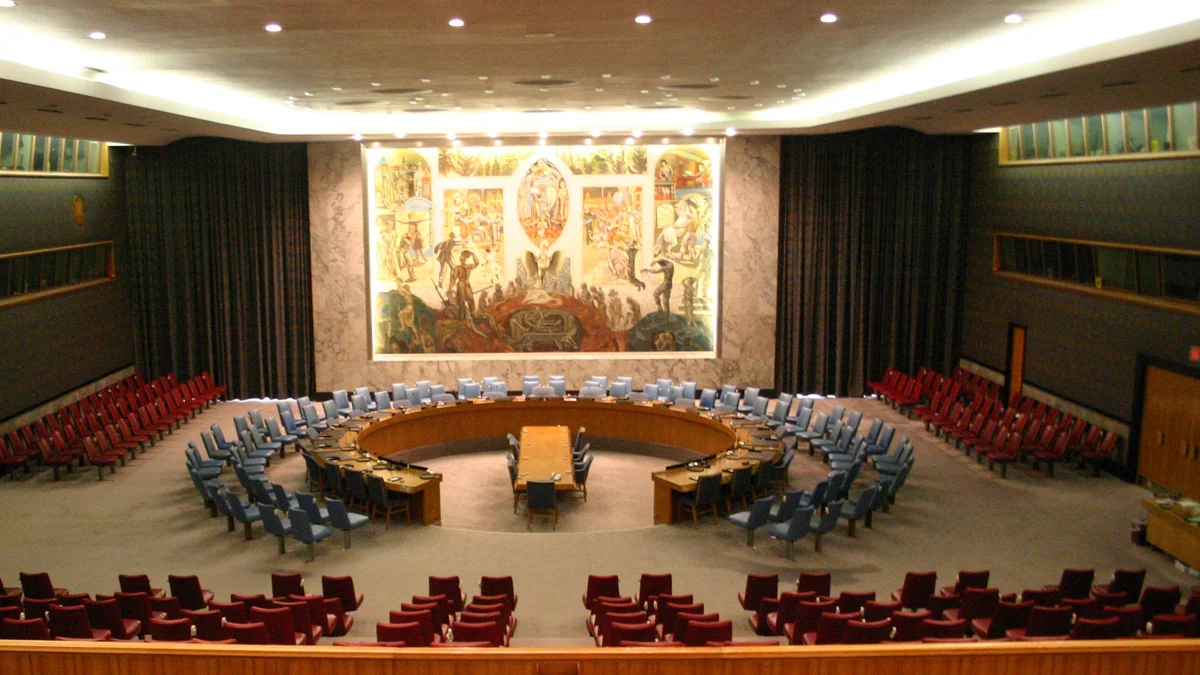
Approximately 77 delegations rose and left as Netanyahu approached the rostrum. Not a symbolic few, not a cluster of the usual suspects. Seventy-seven is a working majority of the General Assembly floor in motion, and the hall registers that differently than any vote.
Netanyahu's response was swift and diagnostic. He called the departing diplomats "moral cowards" and "antisemitic mobs." The label choice matters: it converts a political verdict into a character defect, relocating the problem from Israeli conduct to the psychology of the accusers, which is precisely what a politician running for reelection in five weeks needs it to do.
The Iranian delegation added one precise detail before leaving. Representatives placed a photograph of Qassem Soleimani in the chamber and walked out. The gesture was theatrical, but the theatrics were not theirs alone that afternoon, and a photograph of a man killed in a U.S. drone strike, left on a seat at the United Nations, tells a particular story about who is making common cause with whom.
The procedural backdrop sharpens the picture. In September 2024, the General Assembly passed resolution A/RES/ES-10/24 by 124 votes to 14, demanding Israel end its unlawful presence in Occupied Palestinian Territory within twelve months. That deadline has passed. The 77 walkouts are not a spontaneous eruption of sentiment — they are the diplomatic expression of a recorded institutional position that Israel's principal patron chose not to enforce. Read point by point, the resolution is the load-bearing wall. The walkout is the building settling around it.
"Moral cowards" is a phrase that travels well on Israeli campaign material. Whether it survives contact with 124 archived votes is a different question.
Two Clocks Running
Behind every podium appearance Netanyahu makes stands a fact the hall does not need to announce: since 2024, he has been subject to an International Criminal Court arrest warrant. It does not expire. It travels with him. The six-hour visit to New York was shaped, at least in part, by the geography of that warrant — a careful triangulation between states that might act on it and states that will not.
The second clock is the UN's own. Resolution A/RES/ES-10/24, passed in September 2024 with 124 votes in favour and 14 against, gave Israel 12 months to end its unlawful presence in Occupied Palestinian Territory. That deadline has now passed. The word in the resolution is 'shall' — not 'should', not 'urges', but 'shall'. Read that distinction carefully: it is the difference between a resolution with teeth and one with a photograph of teeth.
Here is what is load-bearing for Israeli strategy: the gap between the deadline and enforcement. No mechanism in the UN Charter compels a Security Council veto holder's ally to comply with a General Assembly resolution.
Netanyahu knows this. His legal team knows this. The six-hour schedule was not carelessness — it was a precise read of which clocks run and which merely tick.
The ICC warrant has not been acted upon by any state with the jurisdiction and the means to do so. That non-action is itself a policy, and every allied capital that has declined to enforce it has quietly underwritten the lesson: formal deadlines and formal warrants are real, but the enforcement gap between them and consequence is where Israeli strategy lives. Watch whether any treaty-state changes that calculation before October 27.
A podium you can always rent; a room that listens is earned, and the six-hour clock said plainly what the applause lines tried to obscure.
The Rostrum as Polling Station
Thirty-three days after the speech, Israel votes. October 27, 2026, is the load-bearing date behind everything Netanyahu carried to that rostrum, and it organises his material with a precision no UN speechwriter managed. The hall in New York was secondary. The screen at home was the room that counted.
He held up a Starlink satellite dish. The image was built for a domestic audience that reads isolation as persecution and persecution as proof of righteousness. It was a prop from a different theatre — the kind a campaign manager approves, not a diplomat. In that context it worked exactly as designed.
He claimed Israel had supplied two million tons of food to the Gaza Strip. No distribution record was offered, no UN agency corroborated the figure, and UNRWA — whose own supply documentation is publicly contested — was not cited in support. The number was large enough to fill a headline and opaque enough to survive only until someone requests the manifest.
He predicted the Iranian regime would be overthrown by its own people — "the power of the people will overcome the people in power." The line was aimed past the General Assembly's moulded ceiling at two audiences simultaneously: Iranian dissidents who might clip it, and Israeli voters for whom a collapsing Tehran is a promised dawn. It was not analysis. It was a campaign promise about another country's future.
Visible rejection, in the political calculus Netanyahu has refined over three decades, does not weaken him before his base. It certifies him. Seventy-seven empty chairs become seventy-seven endorsements of the narrative that the world is organised against the Jewish state and only one man will say so plainly. Watch the October 27 result. If his bloc holds or grows, the rostrum delivered.
The Hostile City
Outside the Secretariat building, the NYPD arrested more than a hundred protesters before the speech was finished. The demonstrations were organised by the Palestinian Youth Movement and the NYC Democratic Socialists of America — a coalition that would not have filled a precinct blotter a decade ago. Susan Sarandon was detained for blocking a roadway; somewhere, a press officer filed that detail under gift.
The comparison Netanyahu reached for was telling. He did not address the arrests or the scale of the protests. He addressed the mayor. Zohran Mamdani, he declared, had made the city unsafe for Jews — a charge that reframes municipal politics as a civilisational affront and transforms a socialist mayor into an international actor. The move is familiar: when the street becomes inconvenient, name the official, and the street disappears from the frame.
Mamdani is not the first New York mayor to govern a city where Israeli policy is contested. He is the first to govern it when 62 percent of Americans hold a negative view of Netanyahu's government, according to a Pew Research poll from July 2026. That number is not a protest headline — it is a structural shift.
New York in 2026 is not New York in 2002, and Netanyahu's rhetoric about the city's hostility confirms the change more reliably than any poll does. The street and the poll say the same thing. The speech treated one as a security problem and ignored the other entirely.
When the Allies Start Counting: Netanyahu's UN Isolation Goes West
Sánchez called it genocide. Macron asked why the world had gone quiet. These were not speeches from Caracas or Pretoria — they came from Madrid and Paris, two NATO capitals, two governments that still coordinate arms policy with Washington. That is the structural shift worth registering: the western flank has broken formation.
The distinction that matters now is between rebuke and consequence. Rhetorical condemnation is cheap; sanctions on West Bank settlement goods, suspension of arms transfers, formal recognition of Palestinian statehood — those are load-bearing. Spain and France have gestured toward the first and third. Neither has moved decisively on the second. A Pew Research poll from July 2026 found 62 percent of Americans view Netanyahu's government negatively. Numbers like that move procurement committees, eventually.
Watch October 27. The shape of Netanyahu's UN isolation — whether it deepens or finds some new equilibrium — depends on which result the ballot delivers. If he wins a mandate wide enough to govern without his most extreme coalition partners, allied capitals gain a negotiating surface. If he wins only by tightening that dependency, the exits narrow for everyone — and the rebuke from the western flank becomes something colder than a speech.