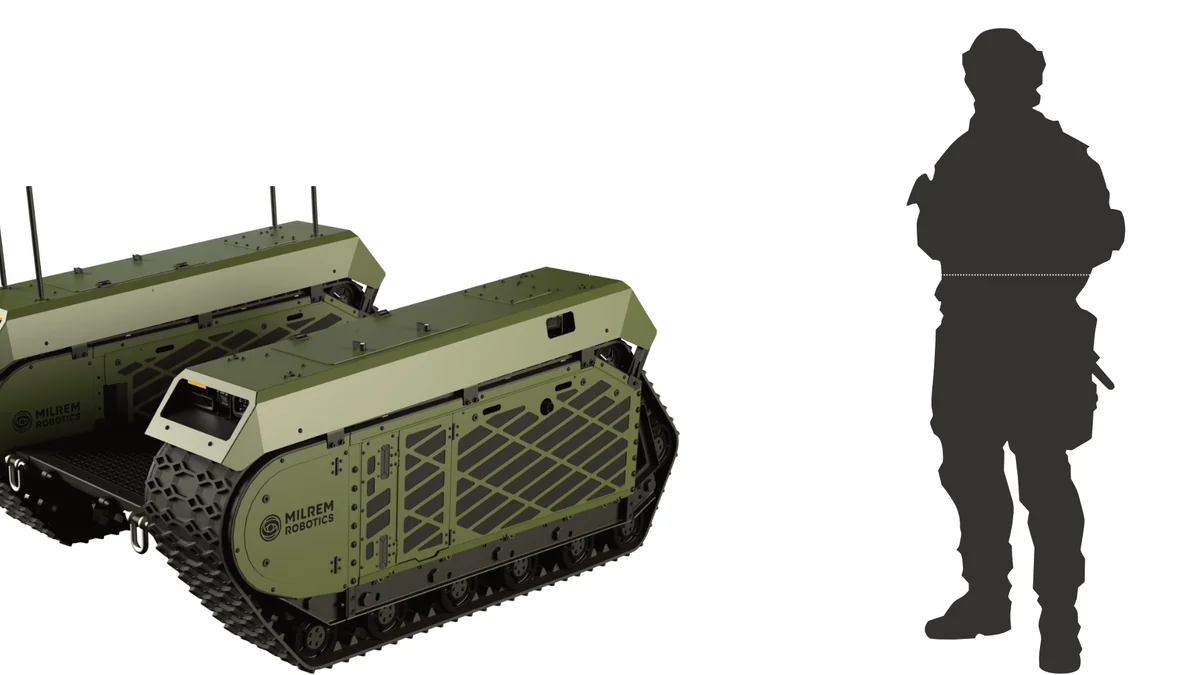
Milrem Robotics has introduced a tactical shift in border defense, proposing to secure NATO's 2,150-mile eastern flank through autonomous robotic units. By integrating hardware like the THeMIS platform with ARCOS command software and real-world combat experience from Ukraine, the concept transforms border security from a static, manpower-heavy system into a dynamic, coordinated security zone.
Imagine you are handed a map and a single, daunting task: you must watch the line. This isn't a suburban fence or a small-town perimeter. It is 2,150 miles of continuous border stretching through forests, marshes, and plains. For a human patrol, attempting to monitor this distance with eyes and boots on the ground is more than just difficult. It is an arithmetic impossibility.
The tactical breakthrough: 2,150 miles humans cannot guard
This specific number—2,150 miles—was what the Estonian company Milrem Robotics brought to Paris in June 2026. The Eurosatory exhibition is the world's largest international defense event for land forces, a place where the buyers for national armies listen and the manufacturers talk. Milrem didn't arrive with just a new piece of equipment; they arrived with an architecture for a new reality: the protection of NATO's eastern flank using autonomous robotic units.
There is a crucial distinction here. Trade show advertisements always promise the world, but Milrem's proposal was anchored in a dimension that no NATO ally has been able to ignore. It is simply not possible to cover a 2,150-mile border with enough manpower to make it secure without the costs and the risks becoming utterly intolerable. Here is the strange part: a robot does not experience fatigue. It does not require rest, it does not sleep, and it never takes a vacation.
Instead of offering individual vehicles at a catalog price, the concept focuses on roboticized zones. These are connected through a unified command system where machines are coordinated much like a traditional military unit. According to this vision, the eastern flank would become the world's first land border guarded by autonomous systems.
THeMIS finds its teeth: The Ukrainian weapon on an Estonian robot
For a long time, the THeMIS—a tracked, unmanned ground vehicle—was understood as a platform rather than a weapon. It was built to move silently, to observe, and to carry logistics. That changed when the Ukrainian company Frontline Robotics mounted its BURIA weapon module onto the frame.
BURIA is a remote-controlled system centered around a 40 mm automatic grenade launcher. These grenades are designed to dismantle unshielded vehicles, intercept drone swarms, and engage light infantry. In this configuration, the THeMIS gained more than just sensors; it gained teeth.
What matters most, however, is where this combination was proven. The testing didn't happen on a sterile laboratory range; it took place in near-combat conditions in Ukraine. Between 2024 and 2026, the Ukrainian front line became the most grueling testing ground for armored robots in the world. The integration of these systems had to survive the reality of modern warfare, not just the theory of it.
The accelerator here is the logic of war itself. A standard development cycle for a weapon system can take years of bureaucratic deliberation, but the pressure of the conflict in Ukraine has compressed that cycle into months. For Milrem, the partnership with Frontline represents access to an extraordinary and brutally honest testing environment.
On June 19, 2026, at Eurosatory, the parties signed a memorandum to expand their cooperation. This document marks the intersection of two different realities of war: Estonian engineers who understand the UGV platform and Ukrainian experts who know what actually functions in a modern battle. The result is a system that has passed both the code audit and the trial by fire.
ARCOS: How one operator leads a robotic pack
We have discussed the hardware—the tracks and the guns—but we need to ask what holds these machines together. What prevents two robots in a field from simply being two isolated machines?
The answer is ARCOS, or the Autonomous & Robotic Control Suite. This is the software layer that transforms a collection of individual devices into a coordinated unit. It allows a single operator to manage multiple vehicles, maintaining a single, coherent picture of the situation. Think of it this way: a conductor doesn't play every instrument in the orchestra himself; he keeps the entire ensemble in a shared rhythm.
A company like Milrem doesn't just gain revenue from this; they gain the right to define the standard. Now, hold that thought, because the real challenge is whether the software can talk to other systems. A vacuum doesn't exist on the battlefield, and armies already rely on established command-and-control (C2) and Battle Management Systems (BMS). ARCOS is designed specifically to interface with these systems, making the robot a natural extension of the headquarters' command picture.
The company is no longer selling a solitary robot. They are selling a modular command layer. It is an architecture that allows an army to add and update its robots without having to rebuild the entire system from scratch. Think of it as an operating system where specific "apps" can be downloaded to handle different combat missions.
The French General and the drone that changed everything
Something has happened on the fields of Ukraine that tank commanders have long feared: massive armored columns have become easy prey for drones. When an enemy can see you from above, and your armor is designed primarily to protect your sides, the old tactics suddenly feel wrong. In the modern era, a large, concentrated unit is often just a very clear target.
In response, the 7th Armored Brigade of France has begun testing a new model. Traditional squads are being replaced by more flexible, smaller-footprint combat groups. A dispersed group represents ten different targets, requiring ten times more drones and significantly more coordination to destroy.
Further evidence of this shift appeared at Eurosatory from the Turkish company ROKETSAN, whose KARAOK anti-tank system successfully struck an aerial target for the first time. The line between land and air is becoming transparent. Drones are attacking tanks, and the weapons designed for tanks are now attacking drones.
In a modern engagement, you aren't just looking for the enemy on the horizon; you are looking in the sky. The chain of "see-identify-decide" must happen at high speed. Robotic units allow this chain to be stretched further away from the human operator, keeping them in a zone of relative safety.
Selling the architecture of defense, not just iron
If we compare two images, the shift becomes clear. The first is a column of armored vehicles and thousands of soldiers supported by a massive logistics train. The second is a sensor, a set of tracks, a software suite, and a maintenance container positioned at the border. Milrem is now selling that second, more efficient image.
This is a significant transition for a defense supplier. They aren't just delivering metal; they are providing the hardware, the ARCOS software, and the integration into NATO systems. The buyer receives a completed solution rather than a mere component.
While robotic units reduce the need for humans in high-threat zones, they are not maintenance-free. A border guarded by machines requires charging stations, communication infrastructure, and constant software updates. While a soldier needs food, a robot requires the attention of an electrician and an engineer.
If Milrem's solution becomes the first functional model for the eastern flank, they will no longer be competing against other UGVs. Instead, the competition will be measured against the standards the Estonian company has already written. A system tested in actual combat is something a NATO planner trusts far more than results from a laboratory.
The questions that remain
Three major questions still hang over this concept. First, there is the limit of autonomy. How much decision-making power will a machine be given when it comes to using weapons without a human confirmation? Currently, NATO lacks a unified standard in this area.
Second is the reality of electronic warfare. An adversary capable of jamming communication systems could potentially turn the entire architecture blind in an instant. How this threat is mitigated has not yet been detailed publicly.
Finally, there is the matter of cost and schedule. There is a long road between a concept and its implementation, and no member state has yet confirmed final funding for the project. These gaps mean that the tactical breakthrough of Milrem's robotic unit is still at the beginning of its journey, where the answers are only just starting to take shape.