The Load-Bearing Wall: What the Strait Actually Carries
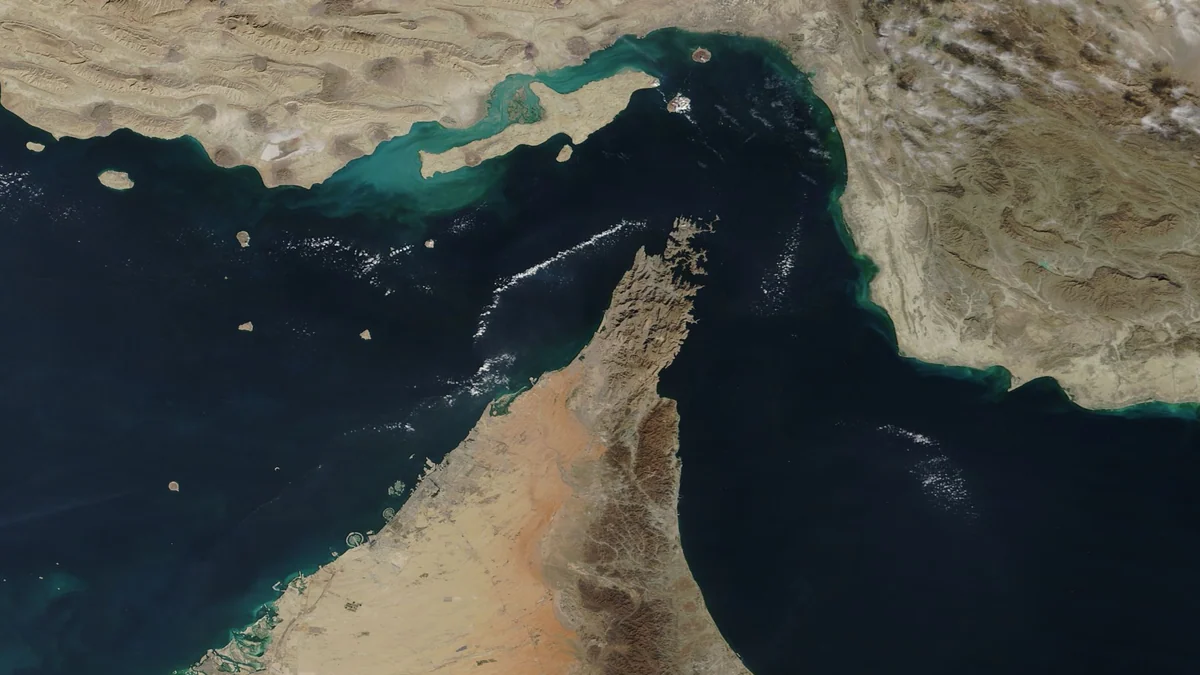
The battle for the Strait of Hormuz is, at its core, a battle over a geographic fact — and geographic facts do not negotiate. Thirty-four kilometres at its narrowest point. Through that corridor, before February 28, 2026, passed twenty-five percent of all seaborne oil on earth and twenty percent of global liquefied natural gas. No abstraction about energy security comes close to the weight of those two numbers. They do not describe a vulnerability — they describe a load-bearing wall.
In the autumn of 1973, the Arab oil embargo lasted five months and moved through pipelines that could, in theory, be rerouted. Analysts at the time called it a temporary disruption. They were right, barely, and only because the chokepoint was political rather than physical. The Hormuz chokepoint is different.
Ask the small question first: who is the borderland here, and who is the empire? The answer is not obvious, because the strait has no single buffer state caught between two giants. It has dozens of them — every Asian economy that cannot price its industrial output without knowing what transits that corridor in the next thirty days.
The alternatives are not alternatives at all. The East-West Pipeline across Saudi Arabia carries a fraction of the volume; Oman's overland route does not exist at scale; the economics of rerouting supertankers around the Cape of Good Hope collapse against the calendar. That is the load-bearing wall. Everything else is moulding — pull it and nothing falls.
Nine Hundred Strikes Before Breakfast: The Opening and What It Left Behind
Nine hundred strikes in the first hours. The word "surgical" does not survive that arithmetic. Operation Epic Fury, launched on February 28, 2026, was designed to be decisive, and on one count it was: Ali Khamenei, Supreme Leader for thirty-five years, was killed before the first full day of the campaign had closed. That is not a tactical result. It is a structural one, and structures, once broken, do not simply reassemble under a successor.
The death of a supreme leader under bombardment is without precedent in the Islamic Republic's history. Those who argue that decapitation moderates a regime are arguing against the record. The pattern, from Belgrade to Baghdad, is the opposite: a successor who takes power while the bombs are still falling does not open a channel — he closes one.
What followed was predictable from the structure, not from the personality. Iran shifted to an explicitly offensive military doctrine under IRGC command — mines, drone swarms, fast-attack interdictions. I have heard this promise before: that the elimination of the hard-liner clears space for the pragmatist. It failed in the 1989 Khomeini-succession speculation, and it has failed here for the same reason. Watch not what Mojtaba Khamenei says about negotiations, but which IRGC commanders he has retained and promoted since March — that is the load-bearing signal, not the communiqué.
The Dual Blockade: Wall of Steel, Sea Mines, and Twenty Thousand People Who Are Not Leaving
On August 12, Donald Trump announced total control over the Strait of Hormuz and gave the arrangement a name: Wall of Steel. By then, US Central Command had redirected 59 commercial vessels and disabled three. The Vela Nova, a Panama-flagged freighter interdicted the day before, offered the clearest illustration of what that name means in practice.
Iran's answer is not a counter-blockade in any conventional sense. It is a cost-imposition strategy — sea mines laid across transit lanes, drone strikes timed to make underwriters reach for their calculators. The Guardian framed the result as a dual blockade, which is accurate in the structural sense: the US Navy prevents exit from Iranian ports, and Iran makes the rest of the strait expensive enough to achieve much the same effect on neutrals. Ask the small question first: who is the borderland here? The Indian tanker captain is the borderland.
The human ledger has been settled in two columns. One holds the macro numbers — 25 percent of global seaborne oil, 95 percent of Gulf LNG now absent from world markets. The other holds the smaller count that the wire tends to leave in the final paragraph: as of April 2026, approximately 20,000 mariners and 2,000 vessels remained stranded inside the Persian Gulf, their operators caught between two blockades and instructed by insurers to stay put.
Hossein Taeb, commanding the Basij forces, stated that the waterway remains under Iranian management and control. Trump said the opposite. Both statements are true in the only sense that matters to the man on the stranded vessel: neither side controls enough of the strait to let him leave, and neither has found it convenient to count him yet.
A paper agreement between a naval perimeter and a minefield is not a ceasefire; it is a photograph of two men not currently shooting each other.
The Ledger: From $126 a Barrel to $4.04 a Gallon
In March 2026, Brent crude touched $126 a barrel. That is the number the summit communiqués never mention, because it is the number that connects the strait to a kitchen table in Ohio or Łódź or Busan. The mechanism is not complicated: close the channel, reduce the supply, watch the price move.
The movement was not slow. When the gap closed, the market did not wait for diplomats. Somewhere a spreadsheet was quietly updated, and then another, and then fuel contracts began repricing across three continents before the smoke from the first night's strikes had cleared.
Gulf LNG exports fell by an estimated 95 percent — not disrupted, but eliminated for practical purposes. The LNG spot market, which runs on marginal supply, does not absorb a 95 percent drop the way a reservoir absorbs a drought; it reprices violently and permanently, and the infrastructure investment that follows moves to North American and African suppliers and does not come back. China, which routes approximately one-third of its oil through the strait, absorbed this quietly and said little about the reserve levels no one outside Beijing can verify.
The consumer farthest from the decision paid most directly. By August 13, 2026, the US national average for gasoline stood at $4.04 a gallon. Gulf exporters recorded a 21 percent drop in export value. The mariners stranded inside the Gulf did not appear in the price data at all.
Ask the small question first: who is the borderland here, and who is the empire? The ledger answers plainly, if you read the right column.
The MOU That Lasted Three Weeks: Pakistan, Pezeshkian, and the Price Iran Named
On June 17, 2026, Pakistan announced a Memorandum of Understanding between Washington and Tehran. The fighting paused. Somewhere a spreadsheet was quietly updated.
The text committed both sides to a temporary halt in offensive operations and opened a channel for humanitarian corridors. What it did not do was touch the mines. The IRGC had laid them, and the MOU gave them no reason to lift them. A paper agreement between a naval perimeter and a minefield is not a ceasefire; it is a photograph of two men not currently shooting each other.
By July it was over. The structural reason is not complicated: one party controlled the mines and the other controlled the naval perimeter, and neither concession was in the document. The comparison to the 1988 Tanker War ceasefire is instructive only up to the point where it breaks — in 1988, Iran had exhausted its capacity and accepted terms. In 2026, Tehran under Mojtaba Khamenei had absorbed the decapitation strike and hardened. Pezeshkian signed the MOU; the IRGC managed the water.
Iran's stated condition for reopening the Persian Gulf corridor is full US compensation for war damages. I have heard this formulation before: it is not a negotiating position but a closing one, a demand calibrated to be refused so that the refusal becomes the justification for the next step.
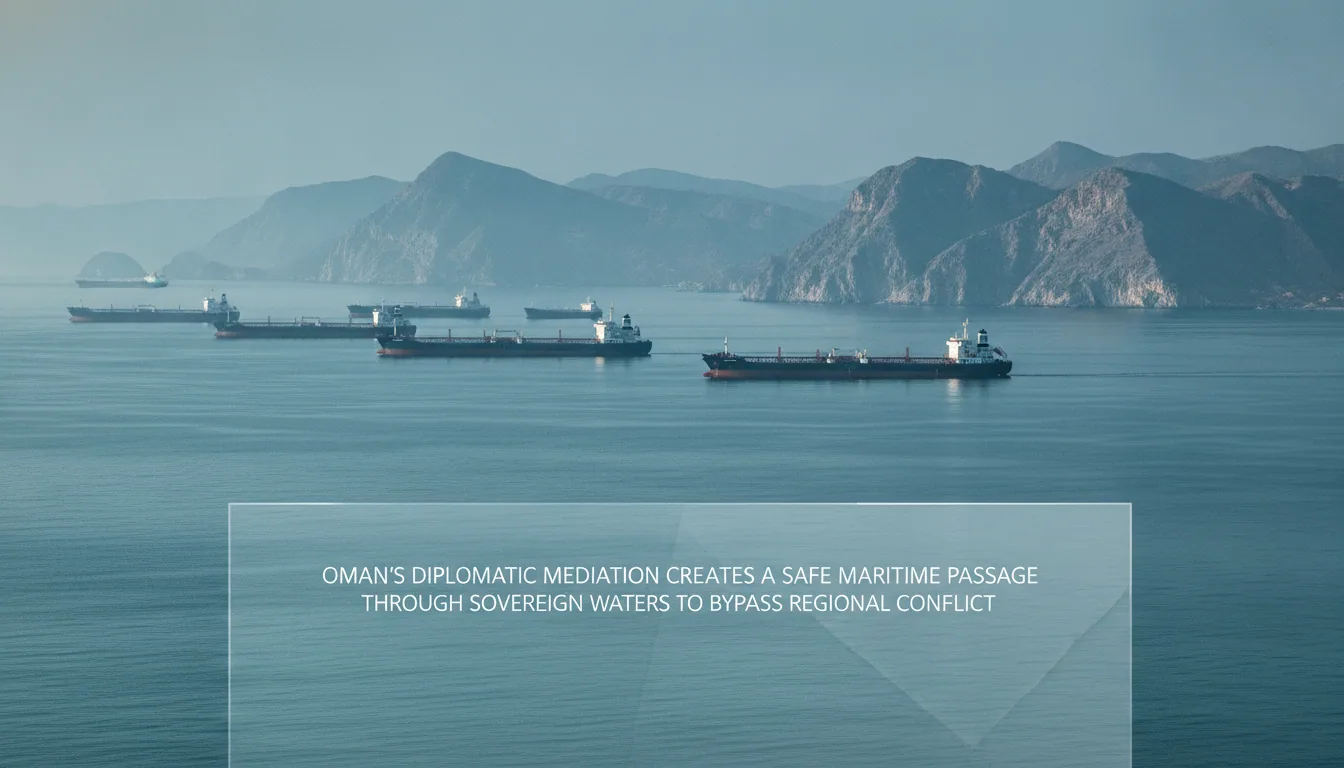
Meanwhile, mediators are reportedly discussing a 60-day transit corridor along the Omani coast, under IMO and JMIC supervision. The soft fact here is the corridor; the hard geography is the mine density between that corridor and the lanes ships actually need. Watch whether any party produces a mine-clearance protocol. If the corridor document appears without one, read it as moulding.
Taxing the Hormuz Passage: The Tariff UNCLOS Does Not Recognise, and the Marker Worth Watching
Trump's proposed 20% tariff on all goods transiting the Strait of Hormuz is not, in the legal sense, a blockade measure. It is a claim to sovereignty over an international strait — a claim the international system has never granted any state, and that UNCLOS was constructed precisely to foreclose. The distinction matters: a blockade is an act of war, recognised as such, with defined legal consequences; a transit tariff is something older and more corrosive.
The wire calls this a fee. The original doctrine calls it something colder: a toll on the high seas, which no treaty permits. Twenty-five percent of global seaborne oil moved through that 34-kilometre neck before February 28. Somewhere, a spreadsheet is calculating what 20% of that flow yields annually.
The battle for the Strait of Hormuz will not be settled by the tariff rate. It will be settled — or not — by the language of whatever Oman corridor text the mediators eventually produce. Read one line: if the final text says the parties shall restore freedom of navigation, someone conceded something real. If it says should, everyone is lying, and this contest over the world's most consequential 34 kilometres will be back on your screen before the year ends.