The Strike, the Silos, and the Child
The Black Sea grain war reached a definitive turning point on the night of August 12-13, 2026, when Ukraine struck Novorossiysk in a single coordinated operation. The July 1993 Sukhumi shelling destroyed the grain warehouse on the waterfront first - before the hospital, before the parliament building. Whoever planned that sequence understood something elementary: you do not need to starve a population immediately if you can demonstrate that you will.
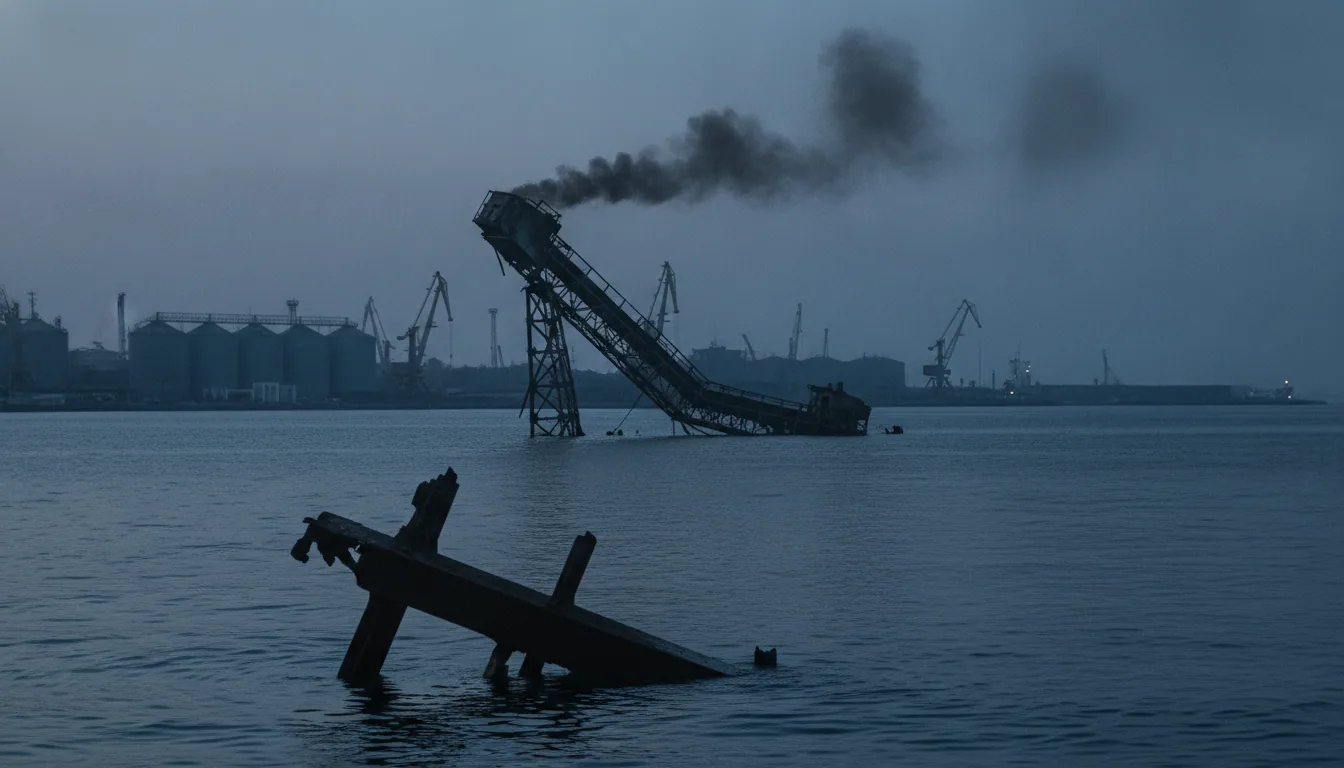
Palianytsia jet-powered drones, Neptune missiles, and unmanned naval systems converged on the port. The Novorossiysk Grain Plant and the Demetra terminal took direct hits. Loading galleries collapsed, silos were damaged, and both terminals suspended operations indefinitely - no timeline offered for restoration, because there is none yet to offer.
Three people were killed. One of them was eight years old. That entry does not appear in any communiqué, but it belongs in the ledger first.
Zelenskyy claimed responsibility without qualification. The occupying fleet and all the infrastructure that supports it, he said, will not be safe as long as Russian aggression continues. The logic is symmetrical and therefore dangerous: Russia spent July conducting 67 strikes on Ukrainian port facilities and 35 attacks on vessels in port at Odesa. Ukraine has now answered by removing Novorossiysk from the functional map of the global wheat trade, at least for this season. Russia holds a 28 percent share of the global wheat export market. Chicago wheat futures moved 3 percent upward on August 12 before the rubble had cooled.
Ask the small question first: who is the borderland here, and who is the empire? The answer, as of this week, is that there is no borderland anymore - only two powers methodically destroying each other's capacity to feed the rest of the world. Somewhere, a spreadsheet tracking Egyptian import costs was quietly updated.
How the Escalation Was Built, One Strike at a Time
The wire presents the Novorossiysk attack as a sudden rupture. The ledger tells a different story. In July 2026 alone, Russia conducted 67 strikes on Ukrainian port facilities and 35 attacks on vessels sitting in port - a sustained campaign of attrition that never made the front page because no single strike was spectacular enough to demand it. That is how blockades are built now: not by a declaration, but by arithmetic.
Ukraine's response to the original Black Sea Grain Initiative collapse in July 2023 was to establish a unilateral humanitarian corridor, hugging NATO coastlines to stay beyond easy Russian reach. It worked, partially, for a time. By 2026, Russian pressure had cut that corridor's capacity by roughly one-third - not through a single dramatic interdiction but through accumulated harassment, mining, and the quiet withdrawal of insurers who stopped covering the risk.
The corridor did not close. It shrank until it barely mattered.
Ukrainian grain shipments fell 76 percent in the first two weeks of August 2026 against the same period in 2025. That figure arrived in the same week the Novorossiysk Grain Plant and the Demetra terminal went dark. The sequence matters: Ukraine did not strike first into a stable equilibrium. It struck into a supply chain already strangled by three years of Russian targeting.
The geography shifted too. After repeated Ukrainian strikes on Crimea forced the Black Sea Fleet to relocate from Sevastopol, Novorossiysk absorbed both the naval function and the grain export burden. One city became the load-bearing wall. That is the detail the communiqué does not name.
Russia Exports a Quarter of the World's Wheat — and Cairo Is Watching
Russia holds a 28 percent share of global wheat exports. That is not a statistic from a trade brief - it is the load-bearing wall. When the Novorossiysk Grain Plant suspended operations indefinitely on August 12, Chicago wheat futures moved 3 percent within hours. A futures market does not mourn; it calculates. Somewhere a spreadsheet was quietly updated, and in Cairo the number that changed was the import line.
Egypt, Algeria, and Indonesia are not peripheral to this story. They are the story. These are the economies that absorbed the original Black Sea Grain Initiative's 32.9 million tonnes and that have no comfortable alternative when the terminal gates close. The WFP has begun issuing food-insecurity warnings - language, from an agency trained in understatement, that deserves to be read at face value.
Ukraine's own position in this equation is worth holding alongside Russia's. In January and February 2026 alone, Ukraine exported 9.95 million tonnes of agricultural products worth four billion dollars - a figure that measures both its importance to global supply and its own acute exposure. Ukrainian grain shipments fell 76 percent in the first two weeks of August 2026. The Solidarity Lanes through Romania and Poland absorb a fraction of what the Black Sea once moved.
Ask the small question first: who is the borderland here? It is not Brussels or Washington watching prices tick on a screen. It is Algiers, Jakarta, Cairo - governments caught between a disrupted Russian exporter and a besieged Ukrainian one, with no third option on the map.
The Shadow Fleet, the Insurance Policy, and the Pacific Signal
The underwriters moved first. Insurance companies began refusing coverage for Russian vessels operating in the Sea of Azov and the Black Sea - achieving through actuarial calculation what two years of Western sanctions had not. No gunboat required. A desk in London, a risk model, a policy not renewed. The Russian shadow fleet, assembled precisely to circumvent Western financial pressure, found itself facing a wall that sanctions lawyers had spent years trying to build.
Putin's response arrived in the register he favours when cornered. He threatened to seize European merchant vessels in retaliation for European sanctions against the shadow fleet. "Attempts to seize Russian vessels and sell off our property are outright piracy," he said. "If such plans are implemented, Russia will respond in kind." Maria Zakharova, reading from the same script at her podium, accused Ukraine of weaponizing the global food market - a phrase worth pausing on, coming from the country that collapsed the Black Sea Grain Initiative in July 2023.
Then Moscow sent a different kind of message. Concurrent with the strikes on Novorossiysk, Russian forces staged naval exercises in the Pacific: 13,000 personnel, 60 ships. The Pacific is not the story. The simultaneity is the story - a reminder, addressed to Washington and Tokyo, that Russia can distribute its naval theatre faster than NATO can track the signals.
One detail in the wreckage deserves its own sentence. The Caspian Pipeline Consortium infrastructure in Novorossiysk - Chevron, ExxonMobil, the quiet load-bearing architecture of Western commercial interest - was reportedly not hit. Somewhere a spreadsheet was quietly updated. That line carries more weight than anything in the communiqué.
The grain war is manageable, if barely. The oil war is a different architecture entirely, and someone in Kyiv knows exactly where the load-bearing wall is.
The Danube Completes What the Navy Could Not
There is a standing joke among logistics planners that nature is the most reliable ally of any blockade. This summer, the joke stopped being funny. Heatwaves have dropped the Danube to levels that restrict barge traffic, reducing alternative Ukrainian export capacity through Romania's Constanta port at precisely the moment every tonne that cannot move through the Black Sea needs somewhere else to go.
The EU-backed Solidarity Lanes - land and river corridors assembled after the BSGI collapsed in July 2023 - were already strained before the river dropped. Rail crossings into Poland and Slovakia had been running near capacity since 2024. The Danube constriction narrows the corridor from both ends simultaneously: the sea route is burning, and the river route is drying.
Russia's answer, according to BBC reporting, is to redirect cargo flows toward Baltic and Caspian Sea ports and overland routes. The logistics arithmetic is punishing. Caspian access requires transshipment through Kazakhstan or Iran; Baltic routing adds roughly two thousand kilometres to the journey and depends on rail gauge compatibility that exists only partially. Watch Constanta's weekly throughput figures - if they recover before autumn harvest pressure peaks, someone has found a workaround. If they do not, the corridor is effectively closed, and the climate did the final work that the navy began.
Read the CPC Line: Where the Black Sea Grain Conflict Meets the Oil War
One fact from the August 12-13 operation deserves more attention than it has received: the Caspian Pipeline Consortium infrastructure in Novorossiysk was not struck. The CPC terminal moves Kazakh crude to market through a pipeline in which Chevron and ExxonMobil hold significant equity stakes. Whether that restraint reflects a deliberate Ukrainian calculation or operational limits, nobody outside Kyiv's planning rooms has confirmed. It is, for now, a held line.
The number that will concentrate minds before any summit does is 53 - a projected fall in Ukrainian wheat exports of 53 percent for 2026-27, if disruptions at the current tempo continue. That is not a European food-security problem. It lands in Cairo, Jakarta, and Algiers, where governments do not have the fiscal room to absorb a second consecutive shock year. Chicago wheat futures moved 3 percent on a single day's reporting from Novorossiysk. That is a tremor. The 53 percent figure, if it materialises, is the earthquake.
Watch the CPC line. If Ukrainian strikes extend to that infrastructure, the principals at the table change overnight - Chevron's lawyers are not Zelenskyy's problem until they are everyone's problem. That is the one marker worth tracking above all others this autumn in the Black Sea grain war. The grain conflict is manageable, if barely. The oil war is a different architecture entirely, and someone in Kyiv knows exactly where the load-bearing wall is.