On August 24, 2026, the transition from financial pressure to maritime interdiction signaled a US-Iran direct escalation. Operation Economic Outcast shifted American strategy from sanctions to the physical destruction of Iranian oil tankers, aiming to dismantle the regime's economic reach through kinetic military action in the Persian Gulf.
The current shift toward kinetic strikes marks a final departure from managed diplomacy into a state of active conflict. In 1987, the "Earnest Will" convoys sought to protect oil flows by reflagging Kuwaiti tankers as a defensive reflex of a superpower. The 2026 maritime order has moved from protection to active erasure.
In early September, U.S. Central Command destroyed five Iranian tankers near Kharg Island and Jask. The hulls of the M/T Downy and M/T Stark 1 now sit on the seabed as the deliberate execution of a new strategic doctrine. This is a physical blockade designed to starve a regime in real time.
Global oil prices approached $100 per barrel as the market reacted to what it can no longer ignore. The USS Abraham Lincoln (CVN-72) remains a silent observer to these new kinetic rules under constant surveillance. Power is no longer measured in accounts; it is measured in sinking steel.
A Ledger of US-Iran Direct Escalation
In October 2024, the Iranian military launched 180 ballistic missiles toward Israel following the deaths of Hezbollah and Hamas leaders. This volley was a performance of regional reach that served as a rehearsal for total structural demolition. Operation Epic Fury finally broke the cycle of symbolic exchanges on February 28, 2026.
Within a twelve-hour window, nearly 900 U.S. and Israeli strikes targeted the foundational military infrastructure of the Iranian state. This was a systematic reduction of the regime's capacity to hold its own maritime borders. The ceasefire established on April 8, 2026, failed while the ink was still wet.
By September 9, 2026, the official ledger recorded 120 separate violations of the agreement, proving that the pause was a fiction. For neighbors in Kuwait and Bahrain, these gaps are merely intervals when empires recalibrate their sights. The move from the 2024 volleys to the 2026 demolition represents a final exit from managed diplomacy.
Power is no longer measured in accounts; it is measured in sinking steel.
The Empty Chair in Tehran
The reported death of Ayatollah Ali Khamenei in February 2026 has left the revolutionary ideology without its final arbiter. While the wire debates succession, the reality is a house without a roof. Silence from the Office of the Supreme Leader is now more descriptive than any official communique.
Power now rests in the load-bearing walls of the Islamic Revolutionary Guard Corps (IRGC). Mojtaba Khamenei assumes a hardline posture without the weight to steady a structure deforming under pressure. In Tehran, the only thing more dangerous than a dictator with a plan is a committee with a missile silo.
Lacking a fleet, the regime has moved the front line from the Gulf to the utility grid through cyber operations. These attacks on United States water systems represent the last tool of the weak when they can no longer hold the sea. The chain of command has frayed, increasing the risk of accidental catastrophe.
The View from the Small-Nation Floor
In the desert night of Jordan, forty ballistic missiles landed as the kingdom became an unwilling stage for a drama scripted elsewhere. When the IRGC retaliated for the five destroyed tankers, they used a Jordanian base as their impact zone. This is the cost of sovereignty becoming the friction between colliding empires.
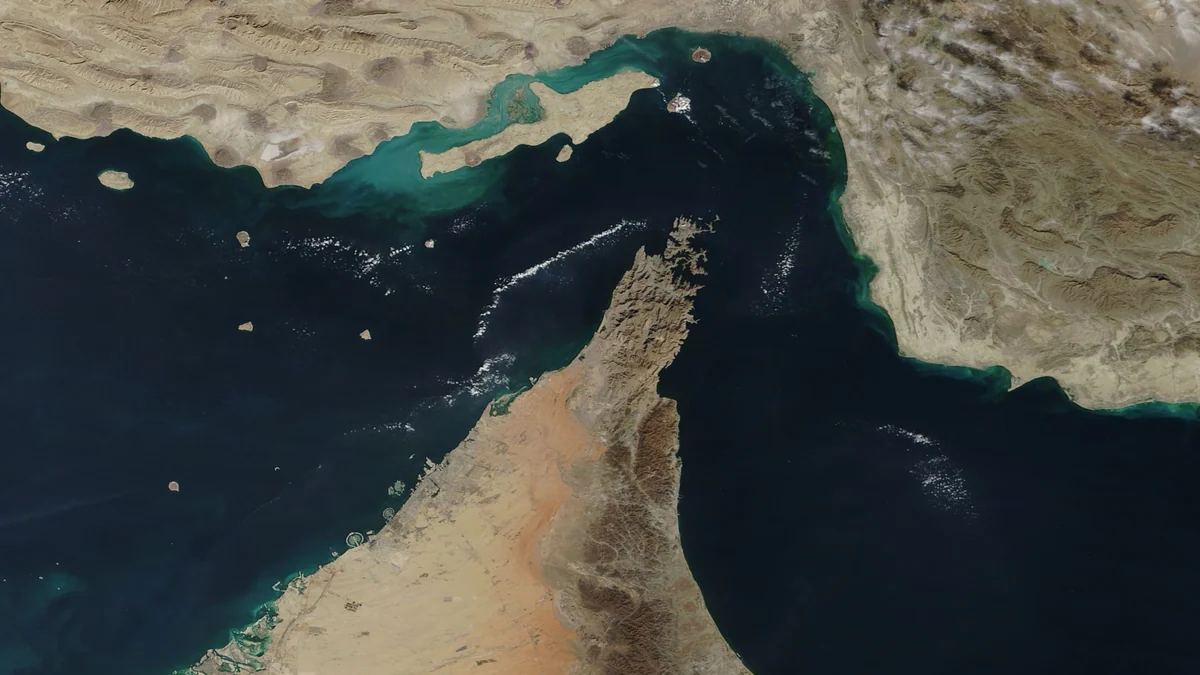
Further east, in Kuwait and Bahrain, the IRGC has ordered tankers to evacuate or face immediate strikes. For these Gulf states, maritime safety is no longer a matter of international law, but of Iranian tactical patience. The Strait of Hormuz carries one-fifth of the world's daily oil supply.
A strike on a ship like the M/T Stark 1 is felt in every counting house in Manama. Small states have become the load-bearing walls for a structural escalation they did not choose. They remain the geography that connects two enemies who no longer wish to talk.
Economic D-Day and the Chokepoint
Operation Economic Outcast discards the optimism of containment for the logic of the siege. The U.S. Treasury recently designated 36 logistical entities, including Ava Airlines and Chabahar Airlines, to dismantle the infrastructure of Iranian influence. Washington is now treating the private sector as a combatant.
The Strait of Hormuz remains the ultimate geography of global vulnerability and the jugular of the energy market. In previous decades, the threat of closing the Strait was a diplomatic card held by Tehran. Today, that card is gone, replaced by the kinetic reality of sunken hulls.
The destruction of tankers near Kharg Island confirms that "Economic D-Day" is a physical reality. This strategy treats the Iranian state as a structure to be cleared rather than a partner for a deal. Talk of a ceasefire has become nothing more than decorative molding on a collapsing house.
The Marker at Kharg Island
Defense Secretary Pete Hegseth has stripped the euphemisms from the American position, specifically targeting the infrastructure at Kharg Island. If 900 strikes in 12 hours were the prelude, this terminal is the finale. The borderlands continue to pay for the miscalculations of the center.
In the longue durée, the small nation remains the expendable currency of empires settling a score. Watch the daily loading logs for the Kharg Island terminal for the next sign of collapse. If the export volume drops below 500,000 barrels per day, the blockade has achieved physical primacy.
If the terminal itself goes dark on the satellite feed, the evidence forces us to conclude that this US-Iran direct escalation has reached its ceiling. One specific date is the pivot: if the insurance rates for the Gulf of Oman do not reset by November, the regional order has finally broken.