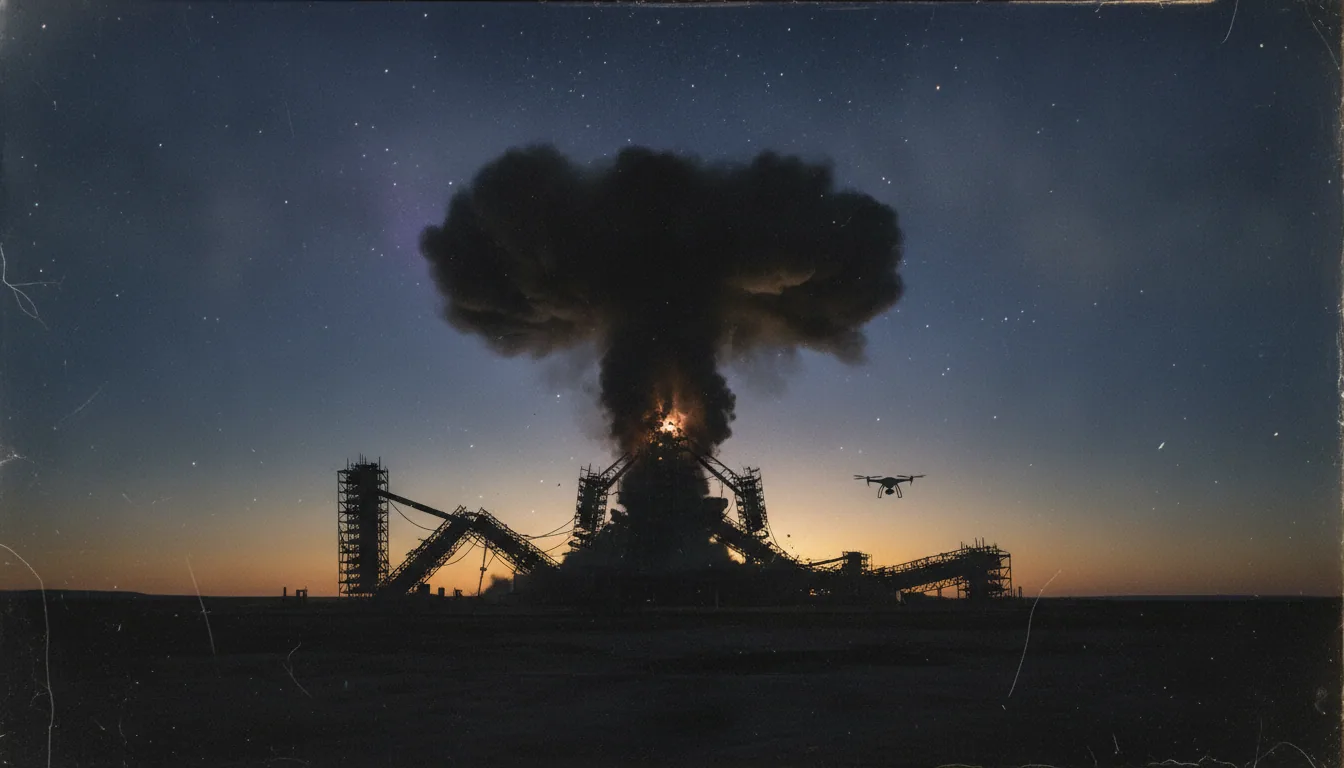

Ukraine is undergoing a fundamental military shift, transitioning from traditional attrition to an autonomous, drone-centric defense model. This transition, marked by the creation of the Unmanned Systems Forces and large-scale domestic production, represents a decisive technological turning point for Ukraine’s armed forces in their struggle for long-term survival.
The technological turning point for Ukraine’s armed forces arrived in July 2026, when the dismissal of traditional military leadership signaled a permanent shift toward algorithmic warfare and autonomous systems. This change is not merely a personnel update but a structural survival strategy.
The July Dismissals: When the Decorative Molding Cracks
I remember the hollow sound of stamps hitting desks in Moscow during the August 1991 coup. It is the sound of an institutional structure choosing between its past and its survival. The July 2026 reshuffle in Kyiv carries that same clinical chill.
President Volodymyr Zelenskyy dismissed Defense Minister Mykhailo Fedorov in mid-July, followed by Army Chief Oleksandr Syrskyi on July 21. Protesters filled the streets on July 18 to demand Syrskyi’s resignation and denounce the removal of Fedorov. This was the first time a crowd rallied specifically to protect a digital technocrat over the traditional military brass.
Fedorov served as the architect of Ukraine’s drone-first doctrine. His departure was a "forced silence" on the deep-seated friction between civilian reformers and the professional officer corps. He later cited conflicts over the pace of army reforms as the primary reason for his exit.
Ask the small question first: who is the borderland here, and who is the empire? Ukraine is attempting to replace human blood with autonomous systems to survive a numerical mismatch against a neighbor that treats men as expendable ballast. That is the load-bearing wall making the July dismissals more than a cabinet reshuffle.
Everything else is molding—pull it and nothing falls. The wire says these dismissals were a response to public anger. An institutional purge has removed the reformers who outpaced the bureaucracy they were meant to serve.
With Mykhailo Drapatyi identified as the leading candidate to succeed Syrskyi, the presidency is betting that the machine can now run without its primary evangelist. Ukraine is moving from the era of individual genius to the era of the institutionalized algorithm.
Ukraine is moving from the era of individual genius to the era of the institutionalized algorithm.
The Succession of the Mind: From Attrition to Algorithms
The distance between Kyiv and London is 2,100 kilometers. Valerii Zaluzhnyi, the former Commander-in-Chief, now watches the war from an ambassadorial desk in the United Kingdom. His departure removed the military’s last bridge to the pre-robotic era.
The names now surfacing in Kyiv suggest a different architecture. Mykhailo Drapatyi inherits a doctrine that prioritizes silicon over the bayonet. This is a necessity in a war where the human cost has become unsustainable.
The wire calls the new drone branch a technical auxiliary. The original motto says something colder: Our strength is the mind. This funding supports a new foundation for the state, with the defense budget growing from $1 billion in 2022 to $10 billion by 2024.
The Brave1 defense cluster now coordinates over 1,500 companies and 3,500 projects. It is the organized resistance of the small-nation floor. It was built to ensure that no future deal is made without its own consent.
Drapatyi must manage a technocratic front that operates at a scale the old guard never mastered. Ninety-five percent of these systems are produced domestically, no longer waiting for the great powers to deliver the tools of survival. This shift reflects the hard-won realization that technology is the only way to avoid being traded away.
Algorithmic Sovereignty: A Technological Turning Point for Ukraine’s Armed Forces
In February 2024, Kyiv did something no other capital had dared. Kyiv established the Unmanned Systems Forces (USF) as a distinct military branch. This was the world’s first institutional recognition that the era of the human-centric frontline was ending.
The wire copy often describes this transition as "asymmetric warfare." I have heard this euphemism before: 1995, Grozny. It usually means a smaller force is dying more creatively than its occupier.
In Ukraine, the term has been de-euphemized into a matter of industrial output. Ask the small question first: who is the borderland here, and who is the empire? Ukraine produced approximately two million drones in 2024.
That is a sixfold increase that occurred while Western capitals debated delivery schedules. The statistics reveal the true shift. Ninety-five percent of the drones used by the Armed Forces of Ukraine are now domestically produced.
This is the load-bearing wall of the current defense architecture. Everything else, from the summit photographs to the diplomatic communiqués, is decorative molding.
Ukraine’s defense industry budget grew from $1 billion in 2022 to $10 billion in 2024.
Somewhere a spreadsheet was quietly updated, and the math of the borderland changed. The Brave1 tech cluster now coordinates over 1,500 companies working on 3,500 projects. By moving manufacturing inside its borders, Kyiv has decoupled its survival from the whims of foreign legislatures.
This is algorithmic sovereignty. It is the strategy of a people who have learned that when empires negotiate, the small nation is usually the currency. It is the 95 percent solution to a 1939 problem.
The Digital Wall: Bypassing the Electronic Siege
I remember the crackle of radio jamming in the ruins of Grozny in 1995. The static signaled the arrival of a blind, brutal, and heavily coordinated assault. The Unmanned Systems Forces have turned to a calculated combination of the physical tether and the autonomous, algorithmic eye.
Consider the thin glass thread of the modern fiber-optic drone. This physical cable unspools twenty kilometers behind a quadcopter as it flies deep into the Russian rear to bypass heavy electronic jamming. The pilot sees a crystal-clear image while the enemy electronic warfare units scream uselessly into a silent sky.
When the physical tether breaks, the ZIRKA AI system takes over. The ZIRKA AI system uses autonomous terminal guidance to recognize and strike a tank without any further human hand. These digital brains feed into Delta, a battle management platform that turns every sensor into a singular map.
The wire says technology makes the soldier obsolete. These machines merely attempt to compensate for the heavy blood-cost of small-nation sovereignty in a long and grinding war. In the map room, the load-bearing wall of defense is shifting from the human body to the cold, domestic, and proprietary algorithm.
Sinking the Shadow: Economic Warfare at 1,800 Kilometers
In 1916, the British Grand Fleet maintained a blockade of Germany with iron and coal. Today, the mechanism has been digitized and shrunk. Between July 1 and July 20, 2026, Ukraine’s Unmanned Systems Forces struck 183 Russian shadow fleet vessels.
This was not a naval battle in the traditional sense. It was the systematic auditing of a criminal enterprise by way of high explosives. Roughly 20 percent of that fleet has been damaged or destroyed by sea drones like the Magura V5.
The warships are the decorative molding of the empire, meant to look imposing on a map. The load-bearing wall of Russian power is the revenue from its shadow fleet. On July 17, 2026, a single drone operation targeted 12 Russian vessels in the Black Sea.
Ukrainian long-range drones now reach targets 1,500 to 1,800 kilometers away. This is the strategic shift from tactical lines to economic attrition. They are striking the wallet of the empire directly.
These strikes do not require a massive navy or a permission slip from a great power. They require algorithmic precision and the reach to touch the source of the coin. Somewhere in Moscow, a spreadsheet was quietly updated.
The Small-Nation Verdict: A Spreadsheet in Dnipro
The true accounting of this pivot is not found in Kyiv but in the Mechnikov Regional Clinical Hospital in Dnipro. Surgeons here manage the human residue of a war that moves faster than the flesh can endure. The hospital remains the final judge of the cost.
By June 2025, the Unmanned Systems Forces reported 350,000 targets destroyed. This volume reveals the scale of the machine-led battlefield and the exhaustion of traditional tactics. It is math as a survival strategy for a nation that cannot trade lives for land indefinitely.
I have watched orders that looked eternal fall over in a single weekend. From the blunt artillery of 1995 Grozny to the silent algorithms of 2026, the technology changes but the borderland’s dilemma of survival remains constant.
Ignore the summit photographs. Watch instead for Mykhailo Drapatyi's first signature on a procurement order for autonomous systems. If the document favors precision over legacy hardware, the doctrine survives and the evidence forces us to conclude the shift is permanent. This final commitment marks the definitive technological turning point for Ukraine’s armed forces.