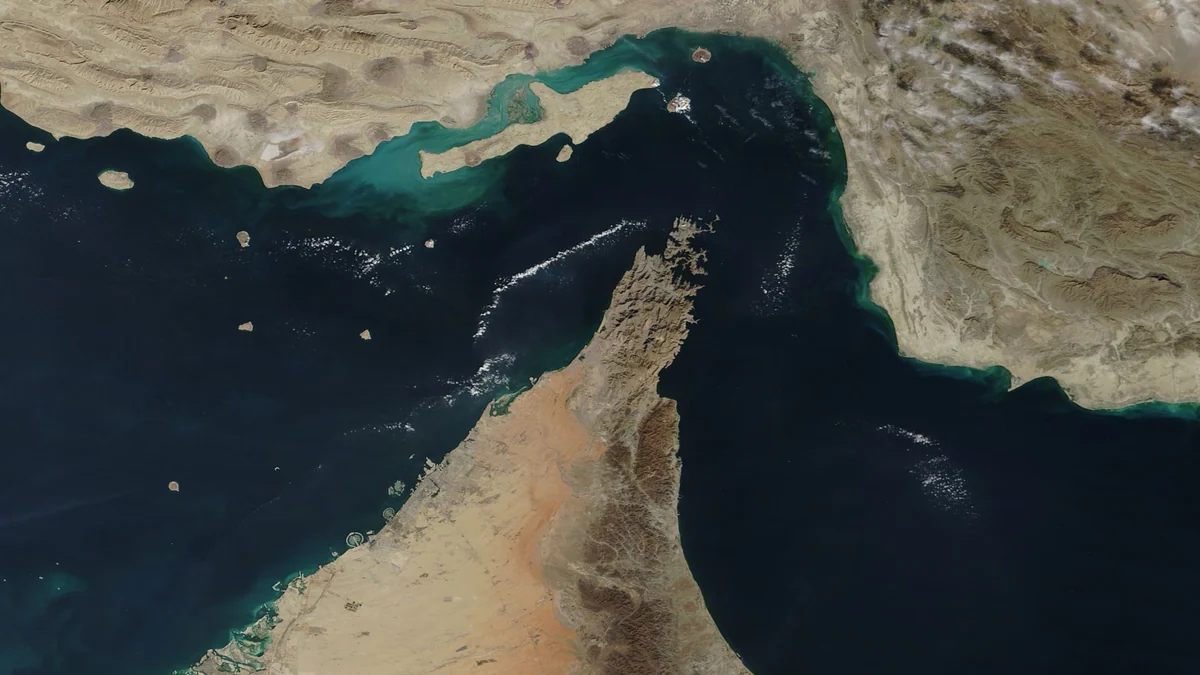
The U.S.-Iran maritime conflict escalation centers on the collapse of the June 2026 ceasefire after Iranian forces struck three commercial vessels in the Strait of Hormuz. This rupture triggered immediate American retaliatory strikes and the revocation of vital oil sanctions waivers, fundamentally destabilizing global energy markets.
From the February Strikes to the June Memorandum: A Ceasefire Built on Sand
The Dayton Accords ran to 150 pages and still required a NATO-led implementation force to keep the parties from each other's throats. The June 2026 Memorandum of Understanding between Washington and Tehran ran to rather fewer obligations and came with no implementation force at all. That asymmetry is the whole story.
The war opened on February 28, 2026, when U.S. and Israeli aircraft struck Iranian territory, killing Supreme Leader Ali Khamenei. The stated American objective was preventing Iran from crossing the nuclear threshold. These strikes removed the one figure whose personal authority served as the load-bearing wall of the Islamic Republic's foreign policy.
By June, both sides had bled enough to want a pause. The MOU agreed to halt hostilities and reopen the Strait of Hormuz, where one-fifth of the world's traded oil moves. The agreement lacked any verification protocol, arbitrator, or timeline with consequences attached.
I have heard this promise before: 1994, Minsk. It failed then for the reason it will fail now. A ceasefire without architecture is not an agreement; it is a shared decision to stop shooting until one side finds a reason to start again.
The July 7 Trigger: How U.S.-Iran Maritime Conflict Escalation Resumed
Three merchant ships transiting a waterway that carries 20 percent of global oil were struck on July 7, 2026. This occurred while the ceremonies for Ayatollah Khamenei were still under way in Tehran. The timing suggests a state where leadership had not yet consolidated around a single command.
The Revolutionary Guard moved while the funeral procession moved. Who held the trigger in Tehran that morning, and did anyone above them know? The Strait of Hormuz is a global economic event, not just a bilateral grievance.
A ceasefire without architecture is not an agreement, it is a shared decision to stop shooting until one side finds a reason to start again.
Closure is transmitted instantly into oil prices and insurance rates for countries without a vote in this war. The IRGC was not just signaling Washington; it was holding the rest of the world. The 20 percent oil flow figure remains the conflict's structural load-bearing wall.
The Exchange: Eighty Iranian Targets, Eighty-Five American Sites Claimed
U.S. Central Command struck more than 80 Iranian military targets on July 7, including air defense and command networks. More than 60 IRGC small boats were destroyed to degrade Iran's capacity to interdict commercial shipping. CENTCOM called the attacks a clear violation of the ceasefire.
Iran's Revolutionary Guard claimed retaliatory strikes on 85 U.S. military sites across Bahrain and Kuwait. Kuwait's army confirmed it was confronting hostile missile and drone attacks. The symmetry of the claimed numbers serves as an arithmetic proof of proportionality.
Whether 85 sites were actually hit is not yet knowable. What matters is that by nightfall, the Strait of Hormuz remained a contested waterway. Both sides absorbed a serious military blow and immediately captured the global news cycle.
The Borderland Problem: Kuwait and Bahrain, Hosting Someone Else's War
Kuwait's army announced it was actively confronting Iranian attacks, describing its airspace as a combat zone in a war it did not declare. Bahrain's interior ministry directed civilians to move to the nearest safe place. The ministry effectively acknowledged it did not know which places were actually safe.
Who decided these cities were acceptable collateral for a great-power argument? Both states host significant U.S. military infrastructure, including the Fifth Fleet in Bahrain. Once you become a platform for power projection, the other side's targeting calculus does not spare you.
No one in Kuwait City or Manama voted on the June memorandum of understanding. Above their heads, the ceasefire was already failing. The structural trap of hosting foreign bases ensures involvement in the fallout.
The Ceasefire Declared Over: Trump at Ankara and Ghalibaf's Counter-Charge
At a NATO summit in Ankara, the last diplomatic framework for the war was publicly buried. Trump declared the June MOU "over," accusing Iranian leaders of lying about terms. The speed of this collapse—a press conference rather than a negotiated exit—is the message.
Mark Rutte called the U.S. strikes absolutely necessary, providing NATO political cover that costs nothing. Iran's parliament speaker, Ghalibaf, countered by accusing Washington of major MOU violations. Both sides now occupy the position of the wronged party, leaving no room for an off-ramp.
Iran rejected a U.S.-backed draft resolution at the UN Security Council, closing the multilateral channel. JD Vance declined to rule out renewed full conflict. No one in Washington has prepared a diplomatic landing zone for the coming weeks.
Watch the Sanctions Waiver, Not the Summit Photograph
On July 7, the United States revoked the Iranian oil sanctions waiver as CENTCOM's strikes landed. Military and economic pressure were applied in a single motion. This coordination is the load-bearing fact of the current crisis.
Oil prices rose sharply as markets priced in a potential closure of the Strait. The waiver's status is the one concrete marker of future intent. Its permanent cancellation means the June MOU is not returning in any form.
Ignore the communiqué from Ankara and watch for intermediaries like Oman or Qatar. They know that a closed Hormuz eventually draws parties back to a table. The question is always the same: who picks up the phone first, and what price of oil forces their hand in this U.S.-Iran maritime conflict escalation.