A Safety Order That Built the Pyre
In 1973, a fire spread through the Summerland leisure complex on the Isle of Man because the builders had clad it in Oroglas and Emabond, two materials whose flammability was noted in the trade literature and ignored in the contract. One hundred and fifty people died. The comparison to Hong Kong's renovation tragedy in 2025 is not lazy; it is, however, insufficient — because Summerland was negligence, and Wang Fuk Court was something more deliberate.
Wang Fuk Court was built in 1983 as part of Hong Kong's subsidised Home Ownership Scheme. After a government inspection in 2016, the complex was placed under a mandatory repair order — the state's instrument for forcing ageing high-rises into compliance with modern safety standards. The legal obligation was real. What followed was not.
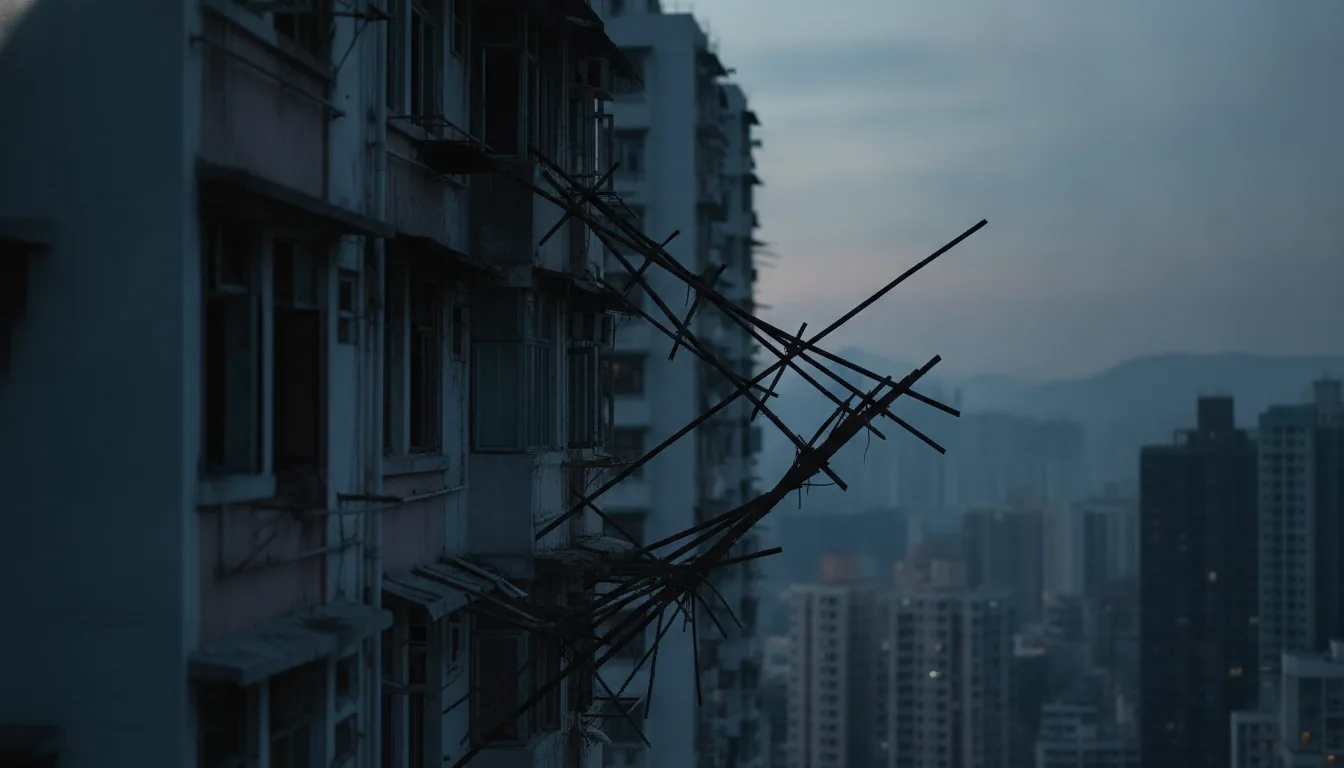
Of 57 bids submitted for the renovation contract, the one awarded was the most expensive: HK$336 million, to Prestige Construction and Engineering. The selection logic, if there was any, has not survived scrutiny. What the contract delivered onto the facades of seven 31-storey residential blocks was bamboo scaffolding wound with non-fire-resistant safety netting, and polystyrene boards packed into window frames as temporary seals.
Polystyrene — Styrofoam, the material of disposable coffee cups — burns readily and melts into accelerant. Somewhere a spreadsheet was quietly updated, and the safety mandate became the entry point.
Investigation reports would later mention triad involvement in the bidding process over forty times. The mandatory maintenance law, designed to protect residents of ageing public housing, had been converted into a recruitment mechanism for criminal inflation of costs. The state ordered the repair. The repair built the pyre.
Forty-Four Hours: What the Fire Record Shows
The fire began at 14:00 HKT on 26 November 2025. A discarded cigarette butt ignited debris on a first-floor roof of Wang Cheong House, Block F. What followed was not a building fire in any ordinary sense.
Flames climbed at speeds of up to 10 metres per second, channelled upward through bamboo scaffolding and non-fire-resistant plastic safety netting wrapped around the 31-storey structure. The vertical geometry did the rest. A chimney does not care what it burns, only that the draw is good, and the draw here was excellent.
Seven of the eight residential blocks were consumed. The fire ran for 44 hours and 18 minutes before it was declared extinguished. One hundred and sixty-eight people died, among them one firefighter — the deadliest toll in Hong Kong since the Wing On warehouse fire of 1948 killed 176.
The 4,600 residents displaced by the disaster were not a random cross-section of the city. Approximately 40 percent were aged 65 or older. Wang Fuk Court was built in 1983; its population had aged inside it.
Evacuation protocols designed for a younger, more mobile population met, in the event, a population that was neither. The physical record is therefore precise on two counts: how the fire moved, and who it found when it arrived. The scaffolding and netting are the mechanism; the demographic profile is the exposure — and the two facts belong together in any honest account, because the building's material condition and its residents' condition were both, by November 2025, the product of the same prolonged institutional failure to look squarely at what was actually there.
The Architecture of the Bid
The investigation report into the Wang Fuk Court renovation named triad involvement in the tender process more than forty times. Not in passing. Forty times is a finding, not a footnote, and the ICAC — Hong Kong's Independent Commission Against Corruption, the institution that has carried the city's anti-graft reputation since 1974 — became the primary investigator of what that number implied.
What it implied was structural. Prestige Construction and Engineering had submitted the highest bid among fifty-seven proposals and won the HK$336 million contract anyway. Will Power Architects Company Limited, the structural consultancy assigned to oversee it, saw its directors arrested on suspicion of corruption.
PC&E was subsequently wound up over debt. The consultancy's name, in retrospect, reads less like a company and more like a communiqué verb chosen by someone with a sense of irony. By June 2026, over 160 people had been arrested in connection with corruption at Wang Fuk Court and related projects.
Seven individuals and two companies faced charges of manslaughter, fraud, and money laundering — the manslaughter count alone a signal that prosecutors believed the fire was not merely an accident waiting to happen but a consequence waiting to be assigned. The legal architecture was catching up to the physical one.
Then, in November 2026, Operation UNITEDEDGE dismantled a HK$130 million bid-rigging syndicate connected to related renovation projects. The operation confirmed what the forty references in the investigation report had already suggested: Wang Fuk Court was not an isolated failure of one contractor. It was a node in a network. The practical question for any resident of ageing Home Ownership Scheme housing across Hong Kong is not whether this happened here, but whether the same load-bearing arrangement exists in the scaffolding going up outside their own window.
The mandatory maintenance law, designed to protect residents of ageing public housing, had been converted into a recruitment mechanism for criminal inflation of costs.
Partial Blame: Hong Kong's Renovation Tragedy on the Record
The investigation report found the Hong Kong government partially to blame for the Wang Fuk Court disaster. Chief Executive John Lee announced the findings publicly; the Housing Secretary resigned. Those two facts are on the record, clean and verifiable.
What the official record does not say is what, specifically, went wrong inside the bureaus that approved the renovation framework. The specific internal failures that produced partial culpability remain, in the language of the report, vague. A government admits enough to demonstrate seriousness, and withholds enough to protect the architecture of accountability — which is to say, the people still inside it.
The gap runs deeper than any single resignation. Hong Kong's building safety codes set material classifications: fire-resistant, non-fire-resistant, prohibited. The polystyrene boards used to seal windows at Wang Fuk Court, and the green netting draped across the bamboo scaffolding, did not arrive from outside the classification system — they arrived because the system permitted them, or because no one on-site was required to verify that what was ordered and what was installed were the same thing.
Researchers examining the disaster noted what the codes had long assumed but never tested at scale: material class alone is no longer a reliable indicator of performance. Classification tells you what a material is rated to do in a laboratory. It tells you nothing about what it does when a discarded cigarette ignites scaffolding debris on a first-floor roof and flame travels upward at ten metres per second through seven thirty-one-storey towers.
The Housing Secretary's desk is now empty. The standard that enabled the material choices is not.
The Relief Ledger and the Legislative Repair
The government allocated HK$630 million for resident support and area restoration in late 2026. The number is not trivial. Measured against the HK$336 million renovation contract that produced the disaster, it is almost exactly double — a rough invoice for what the savings-chasing tender process eventually cost the public.
New legislation proposes criminalising bid-rigging with penalties of up to ten years' imprisonment. Eric Chan, the Chief Secretary, is leading the reform effort. The proposal is structurally sounder than the relief fund — money compensates, law deters, and the question has always been whether deterrence arrives before or after the next Wang Fuk Court.
The honest comparison is with jurisdictions that criminalised construction fraud only after a mass-casualty event: the South Korean response to the Sampoong department store collapse in 1995, the British response to the Grenfell inquiry. In both cases the legislation passed. In both cases enforcement lagged years behind the statute. A law on paper is load-bearing moulding until the first conviction.
The unresolved question is permanent return. Whether all 4,600 displaced residents — forty percent of them elderly — will be permitted back to the damaged blocks remains open. Whether the Owners' Corporation model that made the original bid-rigging possible will be structurally reformed, or merely audited, is also open. Eric Chan has the mandate. The model has not changed yet.
The One Line Worth Reading in the New Law
One hundred and sixty-eight dead. The deadliest fire in Hong Kong since 1948, when the Wing On warehouse burned and 176 people died in a city that had no Independent Commission Against Corruption, no mandatory maintenance regime, and no paper trail pointing at coordinated criminal networks. That 1948 comparison is not entirely lazy, but it breaks on exactly one point: this time the state had the tools.
The ICAC exists. The paper trail runs to over 160 arrests. The names recur across projects.
The accountability test is narrower now. Seven individuals and two companies were charged with manslaughter, fraud, and money laundering in June 2026. Their trials have not concluded.
That gap, between charge and conviction, is where institutional credibility lives or quietly expires. New legislation proposes criminalising bid-rigging with penalties reaching ten years in prison. Read one word when the final text lands: if it says shall prosecute, the mechanism has teeth; if it says may, the law is decorative and the architects of the next Wang Fuk Court already know it.
Residents of subsidised housing under "one country, two systems" had no sovereign backstop when the institution meant to protect them was the institution that failed them. Hong Kong's renovation tragedy will not close as a chapter until the verb in that clause is shall, and enforced. The verb in that clause is the only number that matters now.