Joshua Wong's Sentence and What It Is Built to Do
On November 5, 2026, Joshua Wong was sentenced to ten years in Hong Kong's High Court — conspiracy to collude with foreign forces under the National Security Law, his second conviction under the same statute. Judge William Tam described it as a serious violation. The paperwork was orderly.
Wong pleaded guilty. That detail is worth holding for a moment — not because it implies contrition, but because it tells you something about the terrain. This is his second conviction under the NSL.
A previous sentence of four years and eight months for subversion in the Hong Kong 47 case already had him in custody; legal observers now project he will not leave prison before late 2036. He will be forty. The cumulative structure is the point.
The charge itself names a specific act: lobbying for international sanctions against Chinese and Hong Kong officials, alongside exiled activists including Nathan Law. What it describes, structurally, is not a conspiracy in the operational sense but a political generation being foreclosed. Charge-stacking — stacking convictions until the arithmetic removes a person from the board entirely — is not punishment for what was done. It is prevention of what might be done.
Chief Superintendent Steve Li of the National Security Department provided the official load-bearing narrative promptly: the verdict proves that seeking foreign intervention is a dead end, and those who pursue it will face the full force of the law. That framing is not incidental. It is the law doing its second job, the one the sentence itself cannot perform alone — speaking past Wong to everyone still calculating the odds.
Charge-Stacking as Legal Architecture
The structure was visible before Wong's name appeared on the docket. The Hong Kong 47 case — forty-seven activists charged in 2021 for organising unofficial primary elections — had already established the template.
Wong's earlier conviction in that proceeding drew four years and eight months for subversion. The November 2026 sentence adds ten more, on a separate charge. The arithmetic is not accidental.
The collusion charge names Nathan Law as co-conspirator. Law is in exile. He cannot be touched, but his naming matters: it establishes that the law's jurisdiction does not stop at the airport gate.
The official record now treats the diaspora as an extension of the offence — which is a different kind of geography than Hong Kong has ever operated under.
Benny Tai, the legal scholar who organised those same 2021 primaries, also received ten years. Two defendants, same sentence length, different charges. That symmetry signals a decision above the courtroom level.
Judge William Tam described the offence as a serious violation of a law that had already been in effect when Wong continued his lobbying. The framing is precise: knowledge of the prohibition is itself aggravating.
Elaine Pearson of Human Rights Watch named the mechanism directly: the Hong Kong government is using charge-stacking to ensure that the city's most effective activists remain behind bars for the foreseeable future. Each conviction runs against a fresh charge, the sentences accumulate, and the common law norm of proportionality — designed to prevent exactly this outcome — has been displaced by a national security judiciary that answers to a different logic. What looks like a succession of trials is a single architectural decision, expressed across several courtrooms.
What looks like a succession of trials is a single architectural decision, expressed across several courtrooms.
The Man and the Clock
Hong Kong's most visible pro-democracy organiser has been in custody since November 2020. That is six years before this sentence was handed down — six years already spent inside, before the decade-long clock began.
He is 30 years old. The arithmetic is not complicated: he will be 40 when the full term runs, assuming it runs in full.
What the prosecution argued was not that he organised street protests. The allegation was narrower and, in some ways, more instructive. After the National Security Law took effect in June 2020, the defendant allegedly continued lobbying for US sanctions against Chinese and Hong Kong officials, working alongside exiled activists including Nathan Law.
The law was new; the conduct, in the prosecution's framing, was not. That is the point of the charge — the NSL reached back into the diaspora networks and forward into acts already under way, and it found him still moving.
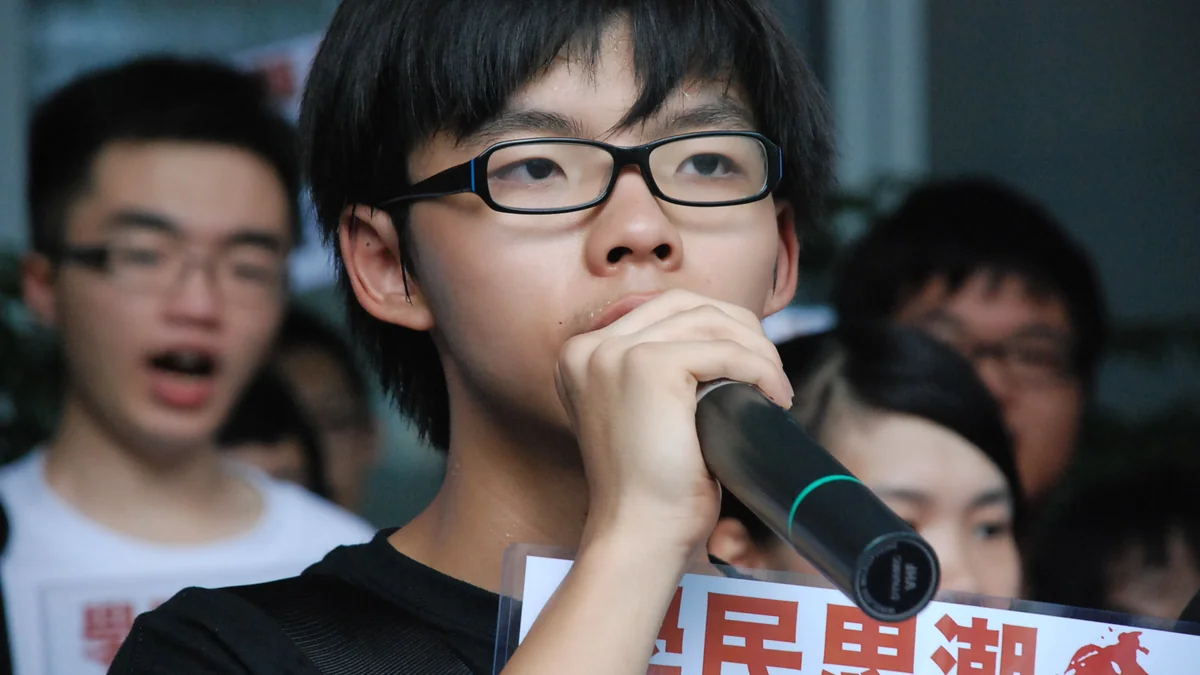
He first came to public attention in 2014, as a teenager leading the Umbrella Movement. That is the arc: from student organiser at seventeen to convicted conspirator at thirty, with no long intervals of private life in between. The compression is the story.
What remains opaque matters too. Early release eligibility under the NSL's strict regime is unconfirmed. The precise evidentiary record behind the collusion charge — beyond documented public lobbying and social media activity — has not been fully disclosed.
Whether the decade runs clean or accrues credits is not yet settled, and the courts have not said. The number 2036 is legal experts' estimate, not a court-ordered date. Watch whether that distinction survives appeal.
The Landscape Already Cleared
Apple Daily's presses stopped in June 2021. Stand News went dark in December of the same year. Both closures came not through market failure but through police raids, frozen assets, and arrested editors — the National Security Law had found its second use, beyond the courtroom.
Jimmy Lai sits in a separate cell. The newsrooms are empty. Somewhere a spreadsheet was quietly updated.
The Hong Kong 47 case established the template: 47 activists prosecuted for organising unofficial primary elections in 2020, an act that in most constitutional systems would qualify as civic participation. Benny Tai, the legal scholar who helped design those primaries, received ten years. The majority of Hong Kong's pro-democracy leadership is now in prison, in exile, or has withdrawn entirely from public life.
Sarah Brooks of Amnesty International called it plainly: the National Security Law is hollowing out Hong Kong's once-vibrant political landscape.
Then came Article 23. Passed in early 2024, this domestic security ordinance expanded local police and judicial powers beyond the original NSL framework — which had already been expansive enough.
Beijing had outsourced the architecture; Hong Kong's own legislature supplied the interior fittings. Taiwan's government condemned the sentencing as political persecution, a statement that carries moral weight and no enforcement mechanism.
One Country, Two Systems was always a constitutional formula with load-bearing walls and decorative moulding. The moulding — the independent press, the organised opposition, the unofficial primaries — has been stripped away methodically since 2020. What remains standing is the legal structure itself, now fully integrated with the mainland's national security logic.
The question is not whether the formula survives. The question is what the formula was ever holding up.
The International Frame and Its Limits
Taiwan condemned the sentence as political persecution. The statement was noted, filed, and changed nothing. This is the structural condition of the international response: symbolically sincere, load-bearing nowhere.
The charge of "collusion with foreign forces" is not incidental legal language. It is the frame's load-bearing wall. By criminalising the act of lobbying Washington for sanctions, Beijing converted the international human rights architecture itself into the offence.
The United Nations conventions, the foreign legislatures, the NGO networks — contact with any of them becomes, under this reading, the crime. The defendant did not sneak secrets to a foreign power. He testified before foreign governments about conditions in his own city.
That is what the prosecution called collusion.
Washington imposed targeted sanctions and visa restrictions on Hong Kong and mainland officials after 2020. The defendant allegedly lobbied for precisely this. The concrete result: the officials sanctioned retained their positions, Beijing accelerated Article 23's passage in 2024, and a second ten-year sentence accumulated for his efforts.
Steve Li's verdict on that outcome — that seeking foreign interference is a dead end — is, on the evidence, difficult to dispute on purely tactical grounds, however contemptible the conclusion he draws from it.
The small-nation question applies here without irony. Hong Kong is the borderland. The terms were set in 1997 by two powers, and the international community that now issues statements was not in that room as a party.
It was not designed to be.
What 2036 Means for the Question Beijing Has Already Answered
The National Security Law is not punitive in its primary logic. It is constitutional: it closes a political possibility space, and it does not reopen. By 2036, the generation that built the 2014 Umbrella Movement and the 2019 street infrastructure will have spent its formative decades either in custody or in exile.
That is not incidental. It is the point.
What remains operates under total foreclosure. Nathan Law and the overseas networks sustain a diaspora frame, and digital organising continues in fragments, but e-resistance without a domestic anchor is cartography without territory. Human Rights Watch's Elaine Pearson called this charge-stacking; the accurate description is generational removal.
One figure changes this read. The court has yet to publish whether Joshua Wong's two sentences run concurrent or consecutive.
Concurrent, and release remains plausible in the mid-2030s. Consecutive, and the number exceeds a decade by a margin that forecloses almost everything. Watch the sentencing determination notice when it appears in the Hong Kong Gazette.
If the word is "consecutive," the question of what comes next has already been answered, and this article is simply its record.