What the Beijing Triad Covers
In 1826, the Scottish missionary William Milne reached for a word to describe what would become the Beijing Triad: a Chinese secret society whose cosmology rested on the union of heaven, earth, and humanity. He chose triad. The word was tidy, translatable, and durable. It was also, from the beginning, a foreign label pressed onto a thing it only partially fit.
The Heaven and Earth Society, which Milne was attempting to name, had its origins in 18th-century resistance to Qing rule. Its founding slogan was not a criminal manifesto but a dynastic one: oppose the Qing and restore the Ming. Opposition to a ruling dynasty is not opposition to order itself — a distinction that would prove, in later centuries, remarkably convenient for certain ruling dynasties.
By November 2026, Beijing Triad simultaneously labels three distinct phenomena: fictional cinema, pro-government street gangs deployed for political violence, and specific criminal networks operating inside the capital. Three phenomena, one borrowed name, and no great effort by anyone to separate them. That compression is not laziness. When a single word can point in three directions at once, the parties who benefit from the blur tend to leave the disambiguation to others. The summit convening in Shenzhen on November 18 carries the same compressed vocabulary, and the same structural incentive to leave it unexamined.
The Summit and the Void Beneath It
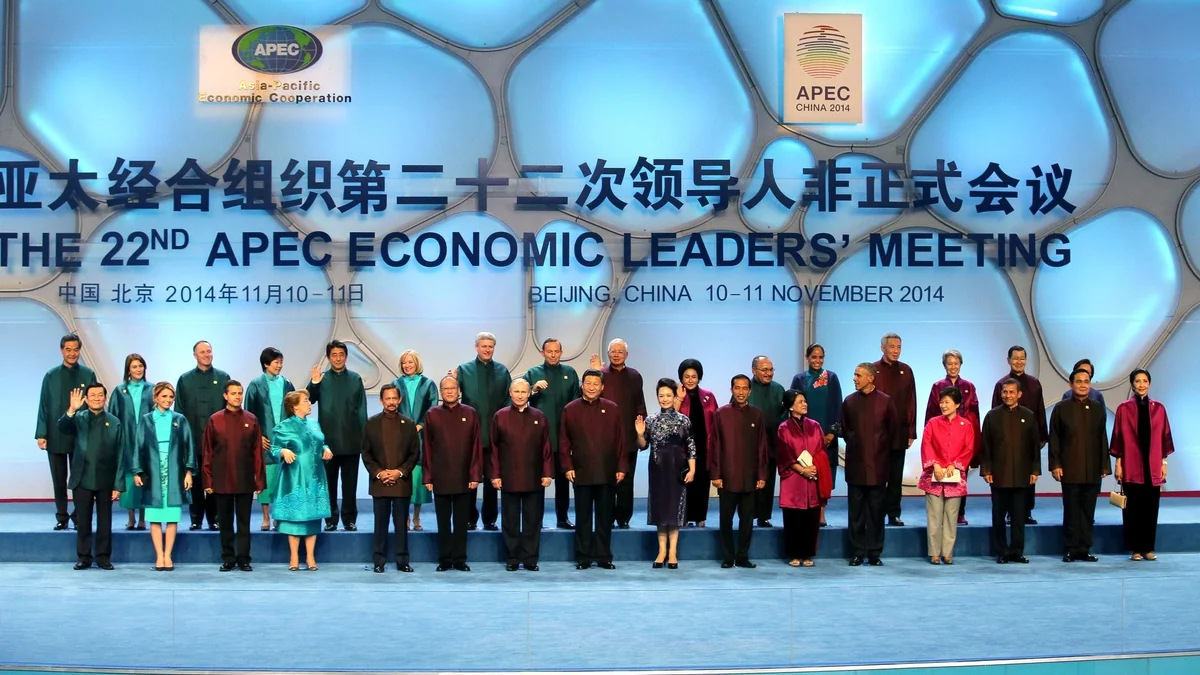
New START expired in February 2026. That single fact is the floor beneath everything happening in Shenzhen on November 18 and 19, because it means Trump, Xi, and Putin are convening without a single operative nuclear-arms-control treaty between Washington and Moscow for the first time since the Kennedy administration. The void is not rhetorical. It is structural.
APEC is the forum chosen to fill it. The Asia-Pacific Economic Cooperation bloc accounts for 62 percent of global GDP and roughly half of world trade, numbers that look load-bearing until you read the governing documents: every decision is non-binding, running on voluntary consensus alone. That is the moulding, not the wall. A forum that cannot compel its members to lower a tariff cannot compel them to cap a warhead.
Into this architecture China arrives expanding. New submarine-launched missile tests documented through 2025 and into 2026 signal that Beijing is building its nuclear triad, not freezing it. The negotiating posture is active accumulation, not mutual restraint. A power that has not yet reached numerical parity with the United States or Russia has a rational interest in agreeing to limits only after it no longer needs to.
The official framing from Washington is reduction. The structural question the framing avoids is sequencing: will Beijing accept verifiable caps before it reaches the numbers that make caps feel safe to accept? That question has no answer in the communiqué language so far released, because the communiqué language so far released has been careful to avoid it.
Ask the small question first: who is the borderland here, and who is the empire? The Baltic states, watching a potential US-Russia-China arrangement take shape outside any NATO consultative framework, already know which side of that ledger they occupy.
The Patriot and the Racketeer
Tao Siju, China's Public Security Minister through the mid-1990s, offered a proposition that at the time read as pragmatism and now reads as doctrine: triad members who love their country and support Hong Kong's prosperity deserve to be welcomed. The remark was not disavowed. It was filed.
The 14K and Sun Yee On are the two societies most consistently cited for operational alignment with Beijing's political objectives. What that alignment looked like in practice became visible on 21 July 2019, at Yuen Long MTR station, when men in white T-shirts beat commuters and protesters indiscriminately with rattan canes. Police response was slow in ways that require a word stronger than coincidence. The photographic record is extensive; the prosecutions were not.
Wan Kuok Koi, known as Broken Tooth and 14K's most visible international face, was sanctioned by the US Treasury in 2020. The Treasury's designation named his vehicle: the World Hongmen History and Culture Association, a front organisation that dressed triad networking in the vocabulary of diaspora heritage. The name alone is a small lesson in how the communiqué works — Hongmen being the very lineage of those 18th-century anti-Qing brotherhoods, patriotism retrofitted as cover.
The practical architecture, then, is a layered one. Beijing maintains formal deniability, the kind that survives a press conference. The societies supply the operational reach — the capacity to mobilise bodies in a train station, to extend a political network across jurisdictions that Chinese law enforcement cannot enter. Tao's welcoming words were not a slip. They were a load-bearing statement, and the structure built on top of them is now old enough to have a sanctions record.
The Export Trade in Soft Violence
Two categories of harm, one supply chain. Triad networks linked to the 14K and Sun Yee On are, according to British and American law enforcement reporting, moving synthetic opioids into the United Kingdom through the same logistics chains that carry outboard engines — the kind bolted to inflatable migrant boats on the Channel crossing. The opioids and the engines do not share a manifest. They share a network.
The second product line is quieter and harder to seize. Triad operators, the reporting suggests, have directed romance-fraud operations against British targets — patient, long-cycle social engineering that corrodes trust and extracts money without leaving shell casings on anyone's floor. No treaty covers it. No foreign ministry communiqué is obliged to name it. The harm accumulates in debt, in broken relationships, in a generalised suspicion of strangers that is itself a form of social damage.
This is gray-zone design, not accident. Violence that generates no attributable headline costs nothing diplomatically and answers to no arms-control clause.
The opioid shipment and the romance script are, in that sense, the same instrument — a projection of leverage that never announces itself as one.
Former Public Security Minister Tao Siju said, in a different era, that patriotic triad members should be welcomed. The architecture he was describing has simply been modernised. The product range has expanded. The deniability has improved.
Clean Hands at Home
Beijing courts convicted 803 individuals across 162 organised crime cases between 2018 and 2020. The Ministry of Public Security released that figure as evidence of resolve. It is both things at once: proof of will, and an accidental census of scale.
The domestic record since then has been consistent. Wang Haimin received fifteen years for running a forced towing and robbery scheme in the capital — the kind of conviction that proves the state's hand is clean and its reach is long. In July 2026, Beijing launched a one-year national crackdown on online predatory lending and cyber-fraud. The machinery of suppression, when turned inward, moves with genuine efficiency.
The comparison that matters is not between Beijing and some imagined lawless state. It is between Beijing's domestic posture and its reported tolerance for the same categories of criminal organisation operating at a convenient distance. A joint Sino-US drug taskforce raided the 125 group on May 16, 2026 — bilateral cooperation offered selectively, as useful, on terms Beijing chose. That selectivity is the structural fact.
The historical analogue is not obscure. The Soviet state ran exacting campaigns against domestic black markets while KGB-adjacent networks moved currency and contraband across the Warsaw Pact's outer rim. The internal and external hands belonged to the same body, and the distinction between them was administrative, not moral.
Beijing's dual-track record does not require conspiracy to explain; it requires only that the observer distinguish load-bearing architecture from decorative enforcement. The crackdown numbers are real. So is the selective geography of their application.
Who Is the Borderland at Shenzhen
APEC accounts for roughly 62 percent of global GDP and half of worldwide trade. Its decisions bind no one. That structural fact is not a footnote to the Shenzhen summit; it is the summit's load-bearing wall.
A trilateral nuclear arrangement reached inside an APEC forum operates entirely outside NATO's consultative architecture. The alliance's eastern members, the ones within range of the weapons under discussion, hold no seat at this table and carry no pen near this text. Their strategic exposure is the subject of the conversation; their consent is not a procedural requirement. Baltic security and European defence autonomy are the unnamed stakes in a negotiation framed as arms reduction between three nuclear powers who will split whatever bill gets written.
The question the small-nation floor forces is simple: when Washington, Moscow and Beijing redistribute strategic risk by voluntary consensus, who absorbs the unwritten portion?
That answer will be legible by the morning of November 19. Read one line of the final Shenzhen text. If the agreed language on nuclear limits says shall, someone conceded something measurable. If it says should, the three leaders held a press conference and called it diplomacy, and the eastern borderlands will be back on your screen before the year is out, carrying a risk that no Beijing triad arrangement — however consensual — was ever theirs to sign for.