What Starfish Prime Left in the Magnetic Field
The physics of orbital deterrence have been misread since 9 July 1962, when the United States detonated a 1.4-megaton warhead at 400 kilometres above the Pacific and discovered something the textbooks had understated. Electrons from the fission decay did not dissipate. They were captured by Earth's magnetic field and formed an artificial radiation belt that persisted for years, quietly killing satellites that had nothing to do with the test.
The Starfish Prime comparison to the present Russian threat is already circulating in Western commentary, and it is useful - precisely where it breaks. The mechanism is not in dispute: a nuclear detonation in Low Earth Orbit is not a targeted strike. It has no aim, no discrimination, no proportionality in the legal sense.
It damages whatever orbit it reaches, regardless of flag. That physics was true in 1962 and it remains true for the satellite named Sputnik-S, reportedly stored near Moscow and assessed by German intelligence as potentially launch-ready within sixty days.
What does not carry forward from 1962 is the scale. Starfish Prime fired into a neighbourhood of hundreds of satellites. The orbital environment today holds roughly 9,500.
Simulations of a comparable 1-megaton detonation near the South Atlantic Anomaly show 99.4 percent of LEO satellites disabled within fifteen days. The Starfish Prime analogy is not wrong; it is catastrophically insufficient.
The 1960s precedent describes a warning shot fired into a nearly empty room. The 2026 version fires into a crowd. That is the structural difference from which everything else in this story follows.
Sputnik-S: What the BND Filed and What Moscow Calls It
On 23 November 2026, Germany's Bundesnachrichtendienst placed on record a finding that Russian engineers have a nuclear-capable satellite, designated Sputnik-S, in storage near Moscow. The filing is precise on location and vague on payload classification - which is itself a form of precision. What the BND can verify from signals and imagery, it has verified; what lies inside the casing remains inference.
The satellite does not stand alone in the intelligence record. US Assistant Secretary of State for Arms Control Mallory Stewart had already identified Cosmos-2553 as a testbed for components associated with orbital nuclear weapons - a programme that predates the current storage report by years. Cosmos-2553 is the proof-of-concept; Sputnik-S, if the BND assessment holds, is closer to the product.
The 60-day launch window is a soft figure. NDR and WDR reporting, drawing on the same intelligence stream, placed a possible launch as early as December 2026.
Intelligence agencies do not publish confidence intervals alongside their filing dates, so the reader should treat sixty days as a planning horizon, not a countdown. That distinction matters: a soft deadline still moves policy.
Dmitri Peskov called the reports unfounded propaganda. The denial is on the record and belongs here. It neither confirms nor refutes payload classification, which is the one question the denial was designed to avoid answering.
Moscow has long understood that categorical denial of a capability costs nothing if the capability itself remains undisclosed - a lesson absorbed from the Soviet practice of denying the existence of programmes that later appeared in treaty schedules. The wire says Russia denied it. The original question - what is inside the satellite - remains open.
A Weapon That Cannot Tell Friend from Foe
The physics here are worth stating plainly, because they are the structural fact that everything else in this story rests on. A single nuclear detonation in Low Earth Orbit could disable up to one-third of all active satellites immediately. That is not a worst-case projection coaxed from a model - it is the floor.
The ceiling is worse. Simulations of a 1-megaton blast positioned near the South Atlantic Anomaly - the region where Earth's magnetic field runs thinnest - show 99.4 percent of LEO satellites disabled within fifteen days. The mechanism is not the initial pulse but what comes after: high-energy electrons from fission-product decay become trapped in Earth's magnetic field, forming an artificial radiation belt that keeps working long after the detonation itself.
The belt does not check registration papers.
That last point is the load-bearing wall. Everything else is moulding. An orbital nuclear weapon damages Russian satellites, Chinese satellites, Starlink terminals, NATO reconnaissance assets and the GPS receivers in commercial shipping at the same cumulative rate.
The user cannot quarantine the effect to its adversary's infrastructure. No terrestrial nuclear weapon has ever worked this way - a silo-launched warhead detonates where it is aimed. An orbital detonation seeds a radiation environment that is, by the physics of magnetic confinement, non-discriminatory and persistent.
This reframes the strategic logic entirely. Russia possesses satellites. Russia depends on them for the same battlefield awareness it seeks to deny the West.
The question that intelligence agencies are unlikely to answer publicly is whether Moscow has hardened its own constellation against an artificial radiation belt - and if it has, when that hardening was done, and what it implies about intent.
An orbital detonation seeds a radiation environment that is, by the physics of magnetic confinement, non-discriminatory and persistent.
Orbital Deterrence and the Fifth Domain: How NATO Rewrote Article 5 for Orbit
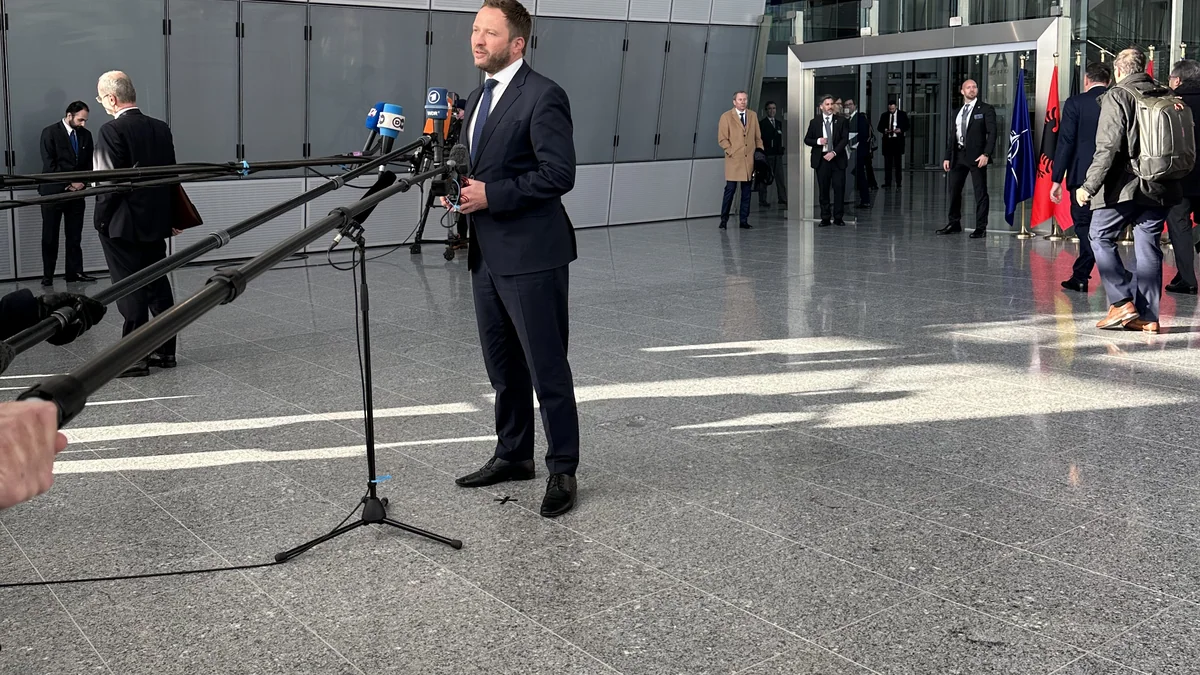
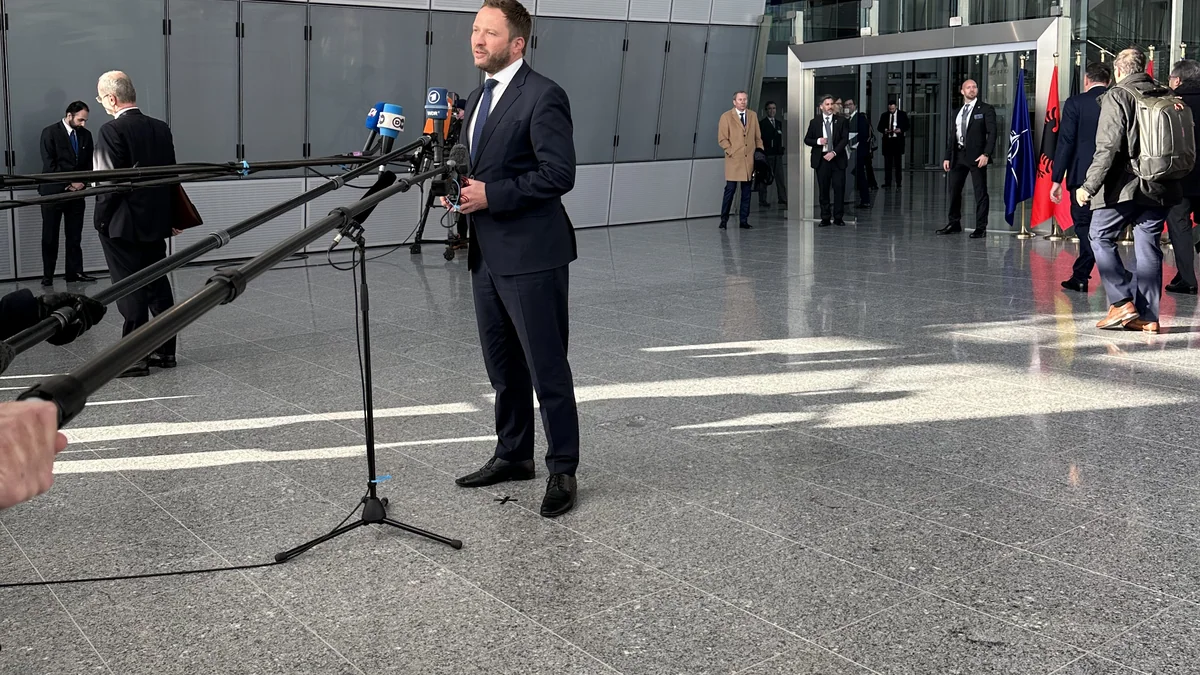
The word came from Brussels on a grey November morning. Mark Rutte, NATO's Secretary General, stood before cameras and stated it in plain declarative: the alliance would defend its assets in space. No hedging, no conditional clause, no diplomat's subjunctive.
The fifth operational domain - alongside land, air, sea, and cyber - had just acquired a collective-defence guarantee. The announcement carried the weight of institutional memory. NATO had walked this corridor once before, in 2016, when it designated cyberspace an operational domain and extended Article 5 to cover attacks against digital infrastructure.
The logic then was the same as it is now: a weapon does not need to leave a crater to constitute an act of war, and an alliance built on deterrence cannot afford ambiguity about which attacks it will answer. Space followed the same reasoning, applied at a higher altitude.
Article 5 now explicitly covers attacks against space-based systems. That is not a minor amendment to doctrine. It is an answer to a specific physics problem: if a single detonation in low-earth orbit can blind an alliance's military communications, navigation, and surveillance simultaneously, then the capacity to threaten such a detonation is itself a form of coercion.
Rutte's statement in November 2026 converted that vulnerability into a tripwire. The doctrinal shift is clean on paper.
The harder question - what a credible response to an orbital nuclear event actually looks like before the radiation belt forms - is not answered by any communiqué. That is the load-bearing wall. Everything else is moulding.
Space Control Weapons and the Ratchet That Follows
In September 2026, US Air Force Secretary Troy Meink acknowledged that the United States had already deployed on-orbit space control weapons. No specifics were offered. The capability exists; the architecture stays classified.
Compare that posture to the Cold War's declared restraint, and the distance is considerable. The 1967 Outer Space Treaty was built on the premise that orbit remained, if not neutral, at least ungarrisoned by offensive systems. That premise is now historical furniture.
The deterrence logic up here differs from the terrestrial nuclear balance in one structural way. On land, a second-strike capacity makes pre-emption irrational. In orbit, once a nuclear-armed satellite is on station and manoeuvring, the window for a clean intercept may be measured in minutes - or not exist at all.
Pre-emption of the launch, not the detonation, becomes the only viable option. That is a different calculus, and a less stable one.
The non-nuclear alternative is being sketched. German firm ATMOS Space is developing orbital-to-ground kinetic strike technology, conventional warheads delivered from orbit, as a deterrent rung below the nuclear threshold. The logic is to offer a response option that does not escalate immediately to the unacceptable.
Whether that rung holds, or simply licenses the next move up the ladder, is the question the architects have not answered. Each acknowledged capability on one side authorises a development programme on the other. The ratchet does not require a decision to turn. It only requires the previous click.
The Treaty That No Longer Holds and the Vote to Watch
The 1967 Outer Space Treaty prohibits placing nuclear weapons or any other weapons of mass destruction into orbit. That sentence is clean and unambiguous. What the treaty does not contain is a verification protocol - there is no mechanism to inspect a satellite's payload before launch, no mandatory declaration, no inspection right that any signatory can invoke.
The legal scaffolding looks solid from a distance. Up close, it has no bolts. Russia has now vetoed UN resolutions that would have reaffirmed the existing ban, twice blocking language in the Security Council that carried no new obligations beyond restating the 1967 text.
A veto against a restatement is itself a data point. It signals that Moscow is unwilling to be held even to the furniture of the old agreement, let alone its load-bearing walls.
The collapse, if that is what this becomes, will not arrive with a declaration. It is being vacated one procedural vote at a time, quietly, in rooms where the gallery is thin. That is how the architecture of arms control has always dissolved - not in a single dramatic breach but in a sequence of absences, each one attributed to procedure, each one narrowing what the next negotiation can recover.
Watch the next UN First Committee resolution on the prevention of an arms race in outer space. If it passes without a Russian veto, the intelligence picture may have shifted and the 60-day window deserves revision. If Moscow blocks again, the evidence forces a sober conclusion: the architecture of orbital deterrence now rests on a treaty that exists on paper, and that is precisely where it lives.