Since 2008, the promise of NATO membership has functioned as decorative moulding on a strategic structure with no load-bearing walls. As Washington floats a 'land for peace' trade involving 15% of Ukrainian territory, the small nations of the borderlands are left to calculate the price of a deal they did not sign.
A promise heard before: Bucharest 2008 and the subsequent silence
I have heard this promise before: 2008, Bucharest. Ukraine's path to NATO received its first official guarantee at that April summit, where the final communiqué included a single sentence that was written exactly as it was intended: Ukraine and Georgia will become members. No date was fixed. No mechanism was attached. The construction promised everything and committed to nothing—exactly what great powers require when they cannot agree, yet cannot afford to openly refuse.
Ukraine has been in official relations with NATO since 1992—longer than almost any current negotiator has held their post. Thirty-four years of cooperation programs, partnerships, and summits have produced a mountain of protocols, yet the absence of one thing is impossible to ignore: membership. In the intervening years, Russia has occupied approximately 15% of Ukraine's internationally recognized territory.
This figure is the metric against which all subsequent proposals must be measured, regardless of how they are packaged for the Western wire.
Currently, the 1955 West German precedent is being circulated as a handy solution: a state that joined NATO despite part of its territory being under the control of another superpower. The analogy is convenient, and it is being repeated with an eagerness that suggests a desire for a quick exit. It is also exactly where the brakes should be applied.
West Germany joined the Alliance at the opening of the Cold War, facing a Soviet Union that was a geopolitically fixed adversary within stable borders. In Ukraine's case, the front line is in motion, the conquest is ongoing, and the adversary is sitting across the negotiating table. This is a different geometry, not the same pattern in a new suit.
The Bucharest guarantee failed in 2008 for the same reason it threatens to fail now: a guarantee without a guarantor is merely a recorded wish.
The Washington proposal: Donbass for membership and those who carry the weight
In November 2026, U.S. negotiators raised the question that President Zelenskyy later described in literal terms: would Ukraine cede control of the Donbass in exchange for NATO membership. The proposal bore no official seal. The geographic boundaries—where exactly the line in the Donbass would be drawn—remained undisclosed. This is a significant void in a deal where territory is the primary object of exchange.
The trilateral U.S.-Russia-Ukraine meetings have seen the involvement of Jared Kushner. His institutional weight remains an open question; the role of a special representative without a confirmed mandate is not, in diplomatic terms, equivalent to the credentials of a Secretary of State. However, the act of sitting at the table creates a precedent of its own, regardless of the title on the door. Somewhere, a spreadsheet was quietly updated.
Pressure is not confined to the communiqué. SpaceX restricted the use of Ukraine's Starshield satellite communication; Zelenskyy publicly termed this a political decision rather than a technical failure. Starshield is the backbone of Ukrainian drone operations. To limit it in a state of war is a lever that cannot be read as anything other than coercion—a tool more strategically precise than the withholding of economic aid, though less frequently discussed.
The logic of the trade is transparent: the United States offers NATO membership as a security guarantee and asks in return for territory that Russia already controls. From the Ukrainian perspective, this means recognizing a factual occupation as a formal treaty—obligatory surrender of what was taken by the gun.
Zelenskyy has rejected this phrasing. He has expressed a willingness to put the territorial question to a referendum, but only under the condition of a comprehensive security package. Shifting the responsibility to the people is also a political shield. The true weight of this proposal is perhaps best judged by those it does not affect: Washington faces no front line with Russia; the thickness of the buffer is a spreadsheet calculation, not a survival one.
Zelenskyy's position: The referendum as a shield
Zelenskyy's response to the American overture was singular. Kyiv will not formally renounce its territories within internationally recognized borders. This is not a performance of a negotiating position; it is a duty written into the Ukrainian constitution that no president can unilaterally dissolve.
The first point of his "Victory Plan" is an immediate invitation to NATO. It is important to note what this document does not say: territorial integrity and Alliance membership are not presented as interchangeable goods, but as two sides of the same package. Ukraine has not offered land for security in this text; on the contrary, the document binds the two inseparably.
The referendum card is in Zelenskyy's hand, but the conditions are his own. He is prepared to put the territorial question to the people, but only if the West has first guaranteed a full security package—both guarantees and reconstruction aid. This structure is twice clever: it protects the president from the moral burden of the decision and places the onus on the West to give before Ukraine gives anything back.
The practical meaning for the reader is this: Zelenskyy has not said "never." He has said "not without a price." It is a transactional logic that inadvertently mirrors the language used by the negotiators in Washington. Ukraine is trapped in this logic—to answer in these terms is to adopt them.
One thing remains open. Zelenskyy is ready to ask the people, but not before the West makes its move. As of November 2026, the question of who steps first remains unanswered.
The architectural dilemma: Irreversibility and the Article 5 fault line
Mark Rutte stated it clearly: Ukraine's path to NATO is irreversible. The word was chosen with care. "Irreversible" is politically binding, yet it says nothing about when the journey ends or within which borders the nation joins the Alliance.
A solution has been quietly discussed for some time. Article 5 collective defense would initially extend only to the areas under Kyiv's actual control. Again, the 1955 model is cited: West Germany became a member while Berlin was divided and its eastern border was contested.
The analogy is deceptive. The German case was simpler in the sense that no one was simultaneously demanding that the Alliance dismantle its eastern flank.
Russia is demanding a return to 1997 positions—the withdrawal of NATO forces from every state that joined after that year. This is not a territorial question; it is an existential question for the Alliance. Such a demand would void the practical substance of membership for Poland, the Baltic states, and Romania.
The partial application of Article 5 is legally unprecedented. No precedent exists for it. No wording in the Article provides for a line within a country below which guarantees apply and above which they do not. It is a construction that has yet to be invented, and everyone involved understands that the invention will create as many questions as it resolves.
Consider for a moment what this means to a small nation that has lived under the shadow of the Russian 1997 demand since the day it joined. The question is not abstract.
The small-nation floor: Estonia and the definition of an unjust peace
Emmanuel Macron did not choose his words with his usual caution. Those who wish to dose the aid are, in effect, seeking to impose an "unjust peace." For the leader of a European power, this was a rare moment of clarity directed at the American transactional logic.
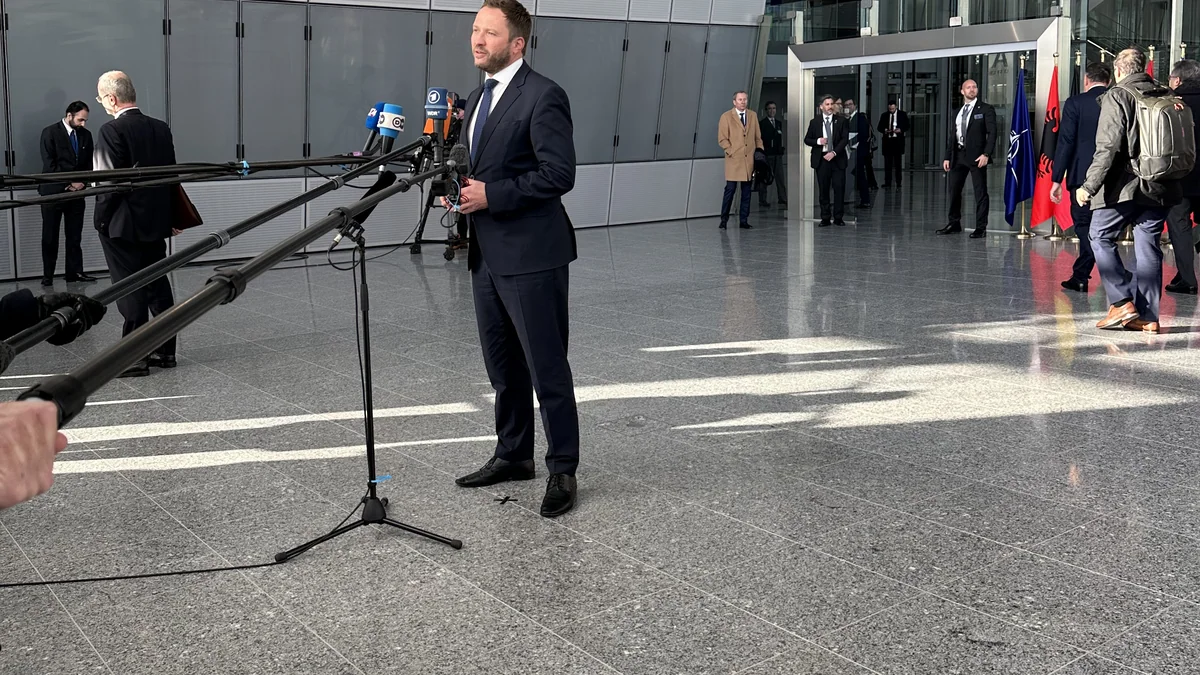
Estonia has chosen a different answer: 0.25% of GDP annually in support of Ukraine until 2027. For a small nation, this number is not an abstract percentage—it is a public act of political pricing. In Tallinn, they know the cost of being undefended.
Kalev Stoicescu suggested the 1940 Winter War scenario as a possible model: territorial loss without capitulation, survival, and later recovery. Finland lost Karelia but preserved its statehood. The question is whether the analogy holds—in 1940, no one was offering Finland collective defense in exchange for the ceding of land.
Then there is the report from Bild, which Moscow denied: that Russia had demanded Finland's withdrawal from NATO. A denied demand is still a demand. It speaks to the geometry of the bargaining table—what moves in tandem with what, and who is considered a tradeable asset.
Every small nation asks this question in silence: who is the buffer zone this time? If the trade-off works and a precedent is set, the question becomes very concrete in the next crisis. Not theoretical—concrete.
What to watch: The verb, the vote, and the volume
Mark Rutte called Ukraine's path to the Alliance irreversible. That is the word to watch. It will either be repeated in future texts or quietly replaced. If the term "irreversible" disappears from official NATO communiqués and is replaced by "ongoing process," someone has lost an argument.
In the final document, there is one line to read before all others: check whether the verb regarding the Donbass is 'shall withdraw' or 'should withdraw.' The difference is not grammatical. The first is an obligation; the second is a wish, and wishes do not activate Article 5.
The mechanism for the partial application of Article 5 has yet to be clearly drafted. How exactly it would function in a state where 15% of the territory is controlled by an opposing army remains an open question. Without that answer, Rutte's promise is decorative, not structural.
The figure from the Estonian Ministry of Defence is checkable: 0.25% of GDP annually until 2027. It is not a massive sum, but it is concrete and verifiable. If the negotiations become more "comfortable," watch whether this number holds.
One thing remains unanswered on Ukraine's path to NATO: whether Russia would accept membership even in the event of territorial concessions. Without that knowledge, all else is moulding. The answer will arrive only when Moscow specifically confirms or rejects it. Until then, history suggests that while speculation is free, it is the nations on the floor who eventually pay the bill.