
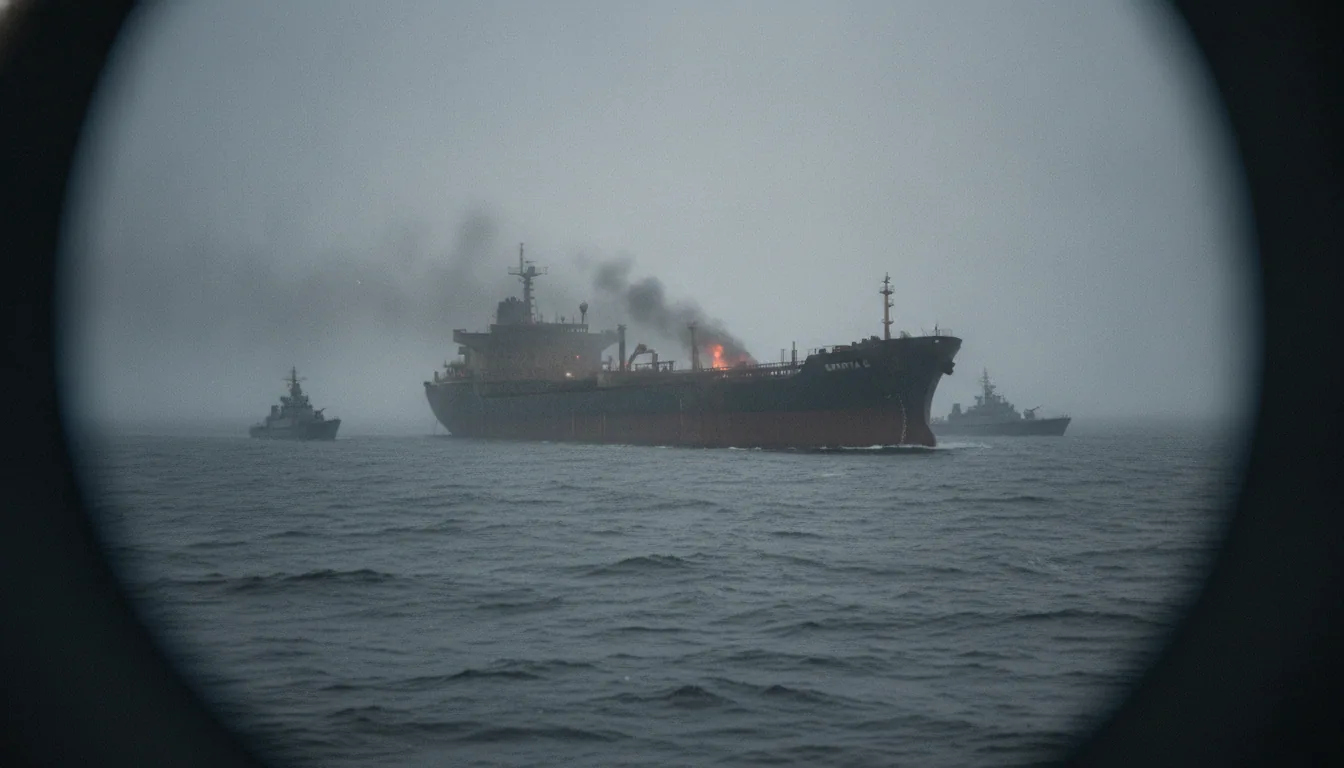
In November 2026, the fire aboard the Russian vessel Sparta II exposed a systemic fracture in the ability of coastal states to manage uninsured, militarily escorted vessels. The incident demonstrated that technical maritime rescue has been subsumed by a geopolitical chess match, where environmental risks are inseparable from the threat of direct military escalation. In the Gulf of Finland, the safety of the shoreline now depends on the calculations of a shadow fleet that exists outside the ledger of international law.
The Flame at Gogland: What November 21 Revealed
In the autumn of 1989, ships drifted for hundreds of kilometres along the Danube—vessels no insurance company would acknowledge and no port authority officially owned. As the Iron Curtain collapsed, a gap emerged in the maritime order: the system functioned only until something caught fire. For the Sparta II, the logic remains identical, though the water is now the Gulf of Finland and the year is 2026.
On 21 November 2026, the Sparta II caught fire near the island of Gogland. A drone strike struck the vessel, which sailed under the flag of Oboronlogistika—a company tied to the Russian Ministry of Defence—and occupied a prominent place on Western sanctions lists. By the morning of 22 November, the ship had lost steerage and was drifting toward Loviisa in Finnish territorial waters.
This was not an anomaly. It was a system performing exactly as designed until one of its hundreds of components became visible. The shadow fleet is a confluence of the world's oldest maritime precariousness: vessels 15 to 20 years old, operating without Western protection and indemnity insurance. The Sparta II is merely a symptom. The smoke over Gogland did not rise into a vacuum, but over a structure built on the collective will to ignore the fact that such an infrastructure exists. The question is not merely how to extinguish the fire, but who is handed the bill for what happens next.
Anatomy of a Shadow: Old Hulls, New Geopolitics
The Sparta II is no random merchantman. Owned by a military-linked entity, it operates in the grey zones where international jurisdiction becomes blurred. It is a military-commercial hybrid, a load-bearing wall in Russia's strategy to externalise risk while the coastal states internalise the cost.
The Vaindloo anchorage in Estonian waters has become the geographical pivot of this logic. By late 2026, the number of shadow vessels anchored there has tripled, reaching up to 40 hulls at any given time. Ukrainian drone pressure has rendered traditional Russian ports unstable; the open sea has replaced the quay, and Vaindloo has been converted into a transit warehouse.
The technical state of these ships follows a deliberate pattern. Western P&I insurance, which usually covers pollution damage, is absent from almost the entire fleet. In the event of a spill, there is no one from whom to demand compensation. Russia does not pay, and the insurance companies involved exist only on paper. Furthermore, the regular deactivation of Automatic Identification Systems (AIS) facilitates ship-to-ship (STS) transfers that erase the origin of the cargo from international documentation. Somewhere, a spreadsheet is quietly updated while the physical risk is left to the locals.
Three Layers of Failure: Water, Explosives, and Escorts
When the Sparta II lost control near Loviisa, the Director General of the Finnish Border Guard, Joni Sjöberg, faced a dilemma tree where every branch led to a new threat. Too little water and the fire continues; too much, and the ship loses stability and sinks. This is a situation for which no standard manual provides a solution.
The second layer is the cargo. The ship carries military equipment, creating a permanent risk of explosion within the containers. A rescue operation conducted under fire, where the exact contents of the hold are a state secret, is a tactical nightmare. This is the structural reality of the shadow fleet: it uses the protocols of civilian distress to shield military logistics.
The third layer is the military escort. Russia maintains a permanent patrol in the Gulf of Finland: two or three armed warships protecting the shadow fleet from interference. The Sparta II incident confirms a burgeoning pattern where any attempt at ship inspection can lead to direct kinetic contact between NATO units and Russian forces. The rescue operation is no longer a technical task; it is a test of sovereignty.
Patrushev and the Rhetoric of Piracy
Nikolai Patrushev chose his words with care. After Estonian authorities attempted to detain the vessel Jaguar, the Kremlin announced that the West was engaging in "piracy" in the Baltic. This is the load-bearing rhetoric; it creates a legal justification to meet civilian law enforcement with military force.
Patrushev pointed to new Estonian legislation that allows for fire to be opened on vessels manoeuvring dangerously. Tallinn reads this as a necessary legal framework; Moscow reads it as a provocation. Thus, a paragraph of maritime law becomes an argument for the use of weapons on the high seas. The installation of electronic warfare equipment at marine terminals in the Leningrad region is the next step. GPS interference in the Gulf of Finland is no longer an occasional glitch; it is a deliberate infrastructure project. The weaker party declares that the stronger party is the aggressor, transforming defensive measures into an excuse for escalation.
The Permanent Vessel and Asymmetric Costs
Estonian and Finnish ministers are now demanding that the European Maritime Safety Agency (EMSA) station at least one permanent pollution-control vessel in the Baltic capable of winter operations. The Sparta II case demonstrates that without such a resource, environmental protection is a strategic gamble, not a routine service.
North Sea states have decades of experience with EMSA standby vessels, but the Baltic was previously deemed a lower priority. The dominance of the uninsured shadow fleet has turned this deficiency into a critical risk for the coastal taxpayer. Environmental danger has been weaponised into political leverage. Estonia and Finland are left with two choices: remain passive spectators to potential pollution or intervene and risk a military flashpoint. Both scenarios serve Moscow's objective of maintaining managed chaos.
Ignore the summit photographs and the diplomatic communiqués. Watch the EMSA mandate during the next budget cycle. If the final text includes a binding commitment to station ships, the Baltic has gained a concrete defensive tool. If the decision remains "under review" or uses the conditional "should," the shadow fleet will remain the primary arbiter of security on our coastline. This crisis will be back on your screen by winter.