The Night the Safe City Stopped Being Safe
On October 18, 2026, Ukrainian drones struck St. Petersburg in the deepest sustained attack of the war, hitting an oil terminal, a logistics hub, a data center, and residential infrastructure across Russia's second city — forcing the closure of Pulkovo Airport and leaving 20,000 residents without power.
Governor Aleksandr Drozdenko reported 127 drones shot down over the Leningrad Oblast. One person was killed; ten were injured, according to the regional health committee. Those numbers sound like a defense ministry would prefer you read them as a victory — 127 intercepted, modest casualties — but the intercepted drone is still the drone that emptied the airspace over Pulkovo International Airport, forced its temporary closure on Governor Beglov's order, and left 20,000 residents without power when a strike hit the Vostochnaya substation.
The Tarasov bridge, part of the Western High-Speed Diameter highway, took a direct hit. Critical infrastructure in a city of five million does not need to be destroyed to be degraded; it needs only to burn long enough to change the calculus. Ask the small question first: who is the borderland here, and who is the empire?
The answer matters because of what the map now shows. Ukrainian drones reached targets between 850 and 1,250 kilometers from the Ukrainian border. That is not a tactical range. That is a strategic one — a distance that turns every industrial hub between Pskov and the Gulf of Finland into a planning problem for someone in Kyiv, and a sleepless problem for someone in St. Petersburg who had, until last night, assumed the war lived elsewhere.
What Ukraine Actually Struck: Infrastructure as a Balance Sheet
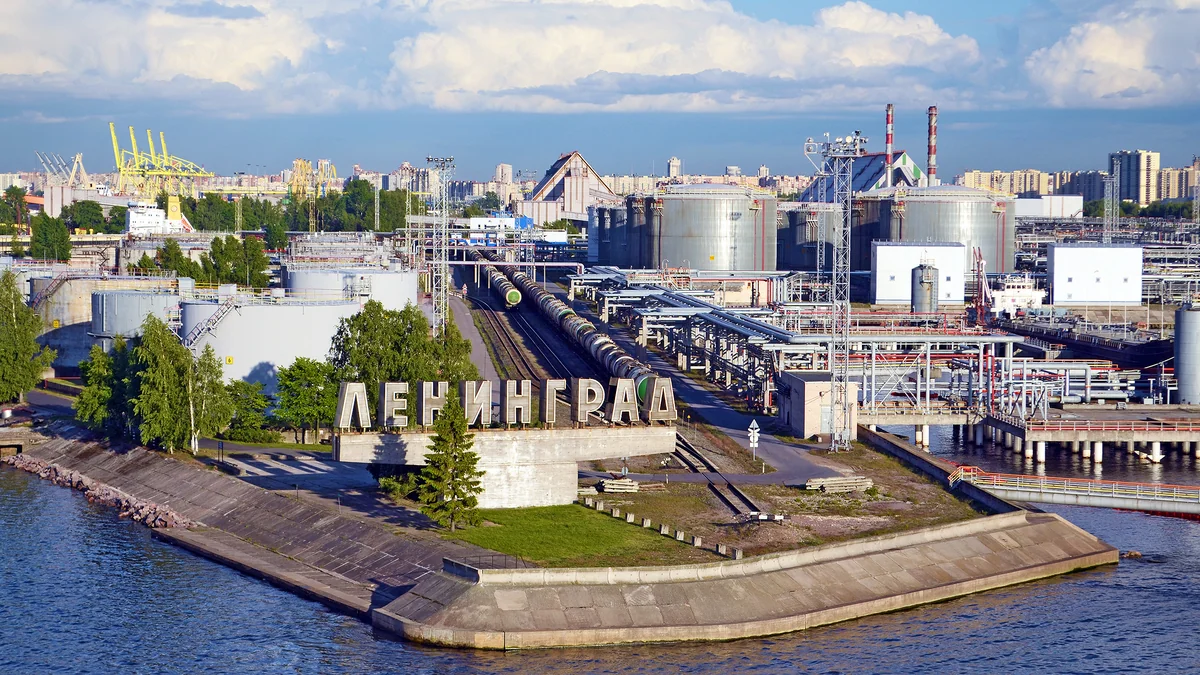
The St. Petersburg Oil Terminal processes 12.5 million tons of fuel annually, making it one of Russia's primary hard-currency engines on the Baltic. It caught fire on the night of October 18. Whether it retains any of that capacity is not yet known, but the Kyiv Independent described it plainly as "one of Russia's largest fuel storage and export facilities" — a description Dmitry Peskov declined to contest with specifics.
The Ozon logistics warehouse tells a different story about a different kind of damage. At 51,500 square meters, the destroyed facility is not a symbolic target. It is a node in the domestic supply chain whose loss compounds quietly, in delayed shipments and rerouted inventory, long after the fire is out. Economic attrition of this kind does not appear in a single headline; it accumulates on a ledger.
The VK data center hit added a third layer to the target profile. Russia's largest social media platform suffered regional service disruptions confirmed by Downdetector monitoring. Ukraine has been moving toward digital infrastructure as a target category since Zelensky authorized what his office termed "respond in kind" strikes — a phrase worth reading carefully, given that the Russian original presumably had a bureaucratic precision the English translation softens.
Then there is the civilian ledger, which Beglov's own figures supplied. Twelve apartment buildings and two houses sustained damage from debris or direct hits. One person was killed. Ten were injured. These numbers belong in any honest accounting of the night, not because they alter the strategic calculation, but because they are the part of the balance sheet that no communiqué buries without cost. Russia cannot easily conceal them, because Beglov reported them himself — a governor managing domestic optics, not a general managing battlefield information.
Four target categories, four different kinds of pressure. The night was not a single strike. It was a taxonomy.
Ukraine's Deep-Strike Drones: FP-1, Peklo, and the Architecture of the St. Petersburg Attack
The two instruments that reached St. Petersburg are worth naming precisely. The FP-1, manufactured by Fire Point, is a one-way attack drone built for the 1,250-kilometer bracket. The Peklo — a missile-drone hybrid — sits at the harder end of the capability spectrum, combining loiter endurance with terminal acceleration. Together they constitute not an improvised swarm but a layered strike architecture, and the distinction matters.
Russia had Pantsir systems, S-300 batteries, and S-400 coverage over the Leningrad Oblast. Governor Drozdenko reported 127 drones downed on the night of October 18 alone. That figure is simultaneously a testament to how much air defense Russia concentrated in the region and a record of how much got through anyway.
The June 6 precedent is the number that should have prompted the harder question. On that night, according to reporting by minusumin.ee, Russian defenses downed 376 drones over St. Petersburg — a figure almost three times larger. The reaction inside the Russian military apparatus was apparently to treat it as a successful defense. The correct reading was operational reconnaissance at scale: Ukraine was mapping the gaps.
Here is the structural consequence that flows from these two nights. When a country is forced to deploy S-400 assets — systems designed for front-line theater suppression — to protect a Baltic port city 1,250 kilometers from the contact line, that is not a redeployment. It is a choice between two vulnerabilities. Every battery that faces northwest is a battery not facing the Zaporizhzhia direction. Russia's air defense is finite. Ukraine appears to have understood that earlier than Moscow did.
Every battery that faces northwest is a battery not facing the Zaporizhzhia direction.
The Ceasefire That Wasn't: Trump, Zelensky, and the Energy Pause
The agreement, such as it was, had a simple premise: Washington would broker a halt to strikes on energy infrastructure, Moscow would honor it, and Kyiv would stand down. It did not survive contact with the calendar. Ukraine's position, stated plainly by Zelensky, was that Russia failed to honor the pause. His authorization to "respond in kind" followed.
The October 18 strikes arrived inside that wreckage. The US effort to engineer a unilateral energy ceasefire had given the war a brief rhetorical frame of de-escalation. Then the frame burned with the terminal. Trump's brokerage was the decorative part of the deal; Moscow's decision whether to comply was the load-bearing wall, and Moscow declined to hold it up.
Dmitry Peskov, asked about the strikes, said Ukrainian attacks on Russia were "incapable of changing the course of events." The language is worth a moment. Not a denial that the oil terminal burned. Not a promise of retaliation. A shrug, in bureaucratic passive — the kind of formulation designed to absorb a fact without conceding its weight.
Here is the small-nation question the ceasefire framing conceals. When Washington brokers and Moscow decides, the party bearing the operational risk is neither of them. Ukraine fires the drones and lives with the escalation calculus. The Baltic states watch a war move closer to their waters and wait for a phone call from an administration that is simultaneously negotiating with the party threatening them. The ceasefire was a Washington story. The burning terminal is a Kyiv story. The insurance premium on the next tanker bound through the Gulf of Finland is everyone else's story — and no one in the brokerage room was reading it.
The Baltic Flank Recalculates
St. Petersburg is not a frontline city. It is Russia's primary Baltic Sea export hub, the terminal through which 12.5 million tons of oil move annually toward European and Asian markets. That distinction mattered enormously until last night, and then it mattered less. The comparison to Odessa in 2022 is instructive but only up to a point: Odessa was always understood as contested; St. Petersburg was not.
Rainer Saks, the Estonian security analyst whose career spans the years when NATO's eastern flank was a theoretical abstraction, called the operation a new operational standard. The phrasing is precise. A standard implies repetition, not exception. What shifts the calculus for Northern Europe is not one burning oil terminal but the demonstrated capacity to reach it again, and again, until no insurer will cover a tanker taking on cargo at the Neva mouth.
The structural question underneath the night's events is the one Saks left implied: is this a campaign or a demonstration? The distinction carries weight. A demonstration is a signal, fired once to alter the negotiating table. A campaign is attrition, designed to compound. One oil terminal fire can be absorbed; six quarters of degraded throughput, rising insurance premiums, and rerouted tanker traffic cannot. The Baltic states have watched this question before, from the short end of the map.
The Load-Bearing Wall and the One Thing to Watch
The structural question is not whether Peskov's communiqué was truthful. It was not. The question is whether the St. Petersburg oil terminal fire degraded throughput capacity or ended it. The difference matters: degraded infrastructure recovers in weeks; destroyed infrastructure recovers in quarters, if at all.
The terminal's annual capacity stands at 12.5 million tons. Whether it can process a single ton of that today is, as of this writing, unknown. The economic value of what burned inside the Ozon warehouse — 51,500 square meters of inventory — remains equally unquantified. Where the drones were launched from is also unconfirmed, which tells us something about Russian air defense and rather more about Ukrainian operational security.
Peskov said the St. Petersburg drone strikes could not change the course of events. The verb "could" is doing the work there. Watch the next Baltic tanker insurance quotes. If underwriters add a St. Petersburg exclusion clause, the terminal's throughput figure becomes irrelevant, because the ships will not dock. That is the one number this story turns on.