
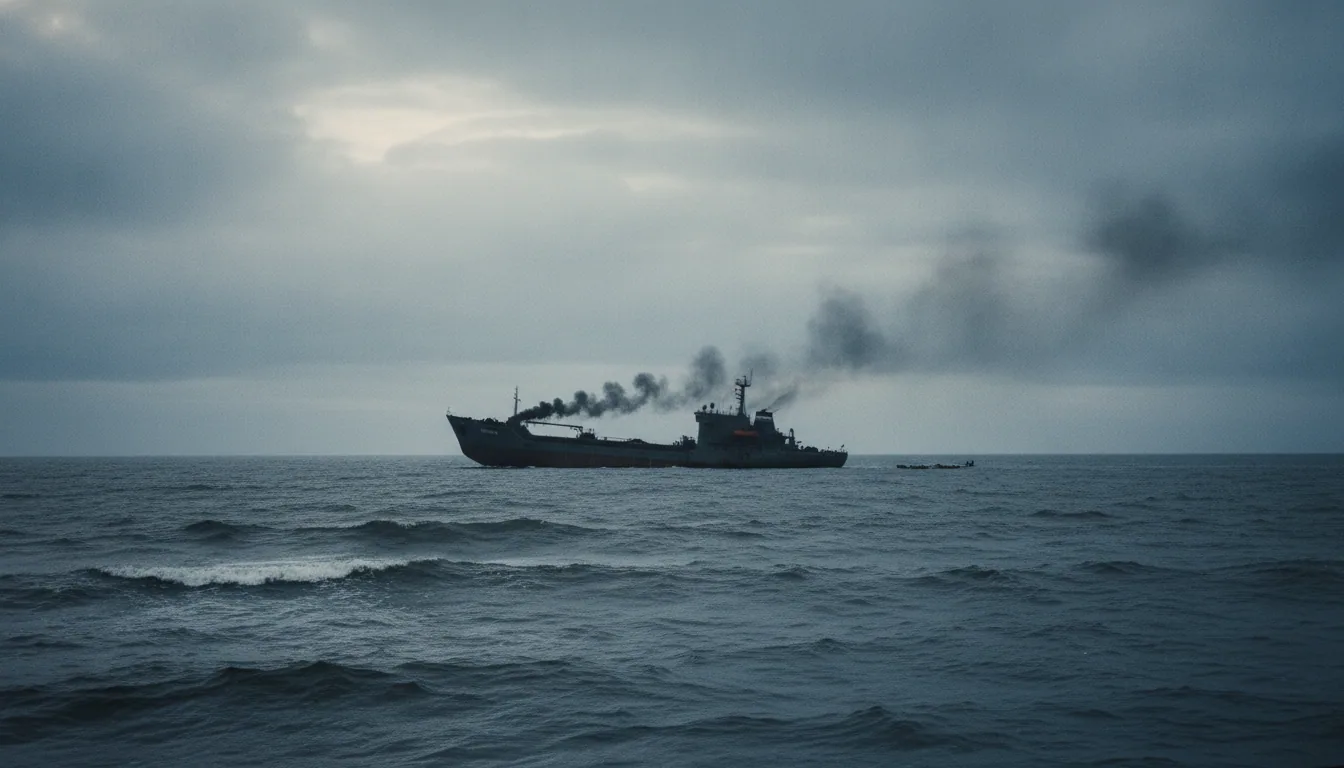
On November 21, 2026, the Russian cargo vessel Sparta II was struck by two drones in international waters, 11 nautical miles north of Vaindloo Island. The vessel, which subsequently drifted from the Estonian economic zone into Finnish territorial waters, represents the first confirmed kinetic strike on a merchant ship in this corridor. The incident effectively converts the maritime passage between St. Petersburg and Kaliningrad into a contested logistics zone.
The Silence of Vaindloo and the New Geography
On November 11, 2026, the Russian corvette Naro-Fominsk smoked in the cold air of the Gulf of Finland. In St. Petersburg, officials preferred the term "technical failure," but the sea maintains a more accurate record. On Saturday, the theoretical threat became a kinetic fact. In the neutral waters of the gulf, the final illusions regarding the security of these shipping lanes were dismantled.
This event overturns the long-standing assumption that commercial routes in this narrow strait remained inviolable. Vaindloo, the northernmost point of Estonia, has become the primary witness to a revised military geography. If the strike on the corvette earlier in the month was an attack on a symbol of naval power, the hit on the Sparta II is an attack on the empire’s logistical circulatory system.
There is no longer any reason to believe the corridor between St. Petersburg and Kaliningrad retains its former immunity. The report from the governor of the Leningrad Region regarding the downing of 80 drones suggests a saturation operation in which the Sparta II proved to be the weakest link. War is no longer a distant bulletin; it is a visible column of smoke rising a few miles from the silence of Vaindloo.
While maritime rescue operations have transitioned to the Finnish Border Guard, the strategic weight of the incident rests on the regional coastline. The drift of the Sparta II across maritime boundaries is a technicality on a map that has begun to burn. Imperial arms shipments have become targets, leaving the small nations of the borderland to manage the resulting debris and environmental risks.
The Anatomy of the Strike: 09:35
The Estonian Police and Border Guard Board recorded the first report of explosions aboard the Sparta II at 09:35 on Saturday morning. This was not an isolated incident on the Baltic, but the conclusion of a sequence that began hours earlier on the coast. In this context, a lone vessel in open water is never a random casualty.
Russian agencies confirmed the vessel was hit by two drones while in international waters. Its trajectory was the umbilical cord between St. Petersburg and Kaliningrad—a route that is strategically essential for Russia but structurally vulnerable. The Sparta II is not a standard merchant vessel; it has occupied a place on the US Treasury’s sanctions list since the early months of the conflict.
Reports from Ukrainian military intelligence indicate the ship was transporting weaponry and unspecified military technical equipment intended for the garrison in the Kaliningrad exclave. Following the strikes, the crew was evacuated immediately to avoid casualties amidst the burning cargo. By 10:00, the smoldering hull had drifted out of the Estonian economic zone and into Finnish territorial waters.
This strike marks the first confirmed drone hit on a merchant vessel in the open waters of the Gulf of Finland. It alters the fundamental dynamics of the regional security architecture and transforms a standard maritime rescue into a diplomatic minefield. The attack serves as a demonstration that military logistics operating under a civilian flag have been reclassified as legitimate targets.
The Invisible Line: From Economic Zone to Territorial Waters
At ten o'clock in the morning, the Sparta II crossed an invisible threshold. The incident began in the Estonian economic zone, but the uncontrolled drift of the vessel did not wait for jurisdictional permission. The Finnish Border Guard, or Raja, assumed command of the operation immediately—a physical demonstration of sovereignty in a crowded sea.
The Finnish Defense Forces established temporary air and maritime exclusion zones in the area. These act as necessary buffers, keeping unauthorized parties away from a potentially explosive object. Such measures serve as a reminder of how fragile the free use of the Baltic Sea has become as the war extends its reach into the water.
At present, no maritime pollution has been detected in either Estonian or Finnish waters. This remains the only stable metric in a crisis where the ship’s exact technical condition is unknown. When a vessel drifts without engines and without a crew, it ceases to be a ship and becomes a hazard on the navigation charts of others.
The Sparta II: Sanctions and Strategic Targets
The silhouette of the Sparta II is well-known in the grey light of the Baltic. Its owner is directly linked to the Russian Ministry of Defense's logistics network. Ukrainian intelligence has previously identified the vessel as a strategic arms carrier, noting its history of transporting heavy equipment between the Syrian front and Russian ports.
This was not a blind strike, but a calculated hit on a specific military supply chain. The civilian labeling of military logistics no longer provides political protection. The reaction from Finnish Prime Minister Petteri Orpo marks a significant diplomatic shift. Orpo stated publicly that Ukraine has the full right to combat the aggressor beyond the immediate front lines. This position confirms that the Nordic nations no longer intend to accommodate Russia's hybrid logic.
The Kaliningrad Corridor and the Small-Nation Floor
Kaliningrad is the empire’s reaching finger, perpetually dependent on the supply chain from St. Petersburg. Governor Alexei Besprozvannykh has asserted that the incident does not threaten the exclave’s security of supply. This expected reassurance masks a deep strategic anxiety regarding the safety of these sea lanes.
The operational cooperation between Estonia and Finland is the load-bearing wall of this crisis. If that cooperation should fracture, the coastal states lose control over their own economic zones. The drift of the Sparta II proves that the strategic depth of the Baltic has shrunk to a few critical miles, where any error can lead to escalation.
Russian claims of 80 intercepted drones point toward a new reality. Watch the composition of future transits: specifically, whether Russia begins to form armed naval convoys to protect its merchant shipping. If the first caravan appears with an armed escort, the era of maritime peace in the Gulf of Finland has officially concluded.