The Day Light Became a Yardstick
At 10:16:07 UTC on Wednesday, November 18, 2026, Voyager 1 crossed one light-day from Earth — something that has never happened before in the four-billion-year history of this planet. Not one light-year, not one light-hour. One light-day. The difference matters, and so does the precision of that timestamp.
A light-day is the distance light covers in 24 hours of travel through vacuum, where nothing moves faster. That works out to roughly 25.9 billion kilometers. Writing the number helps very little, so try it this way: if you shrank the Sun-to-Earth distance down to the length of a football field, one light-day would still stretch nearly two full fields beyond it. Even that analogy buckles a little under the weight of the real scale, which is part of the point.
Astronomers already use a more compact unit for solar system distances: the astronomical unit, or AU, defined as the mean distance between Earth and the Sun, approximately 150 million kilometers. Voyager 1 is currently 173.14 AU away. To someone raised on that unit, 173 feels almost manageable. Then you remember that one AU is already eight light-minutes of travel, and the manageability dissolves.
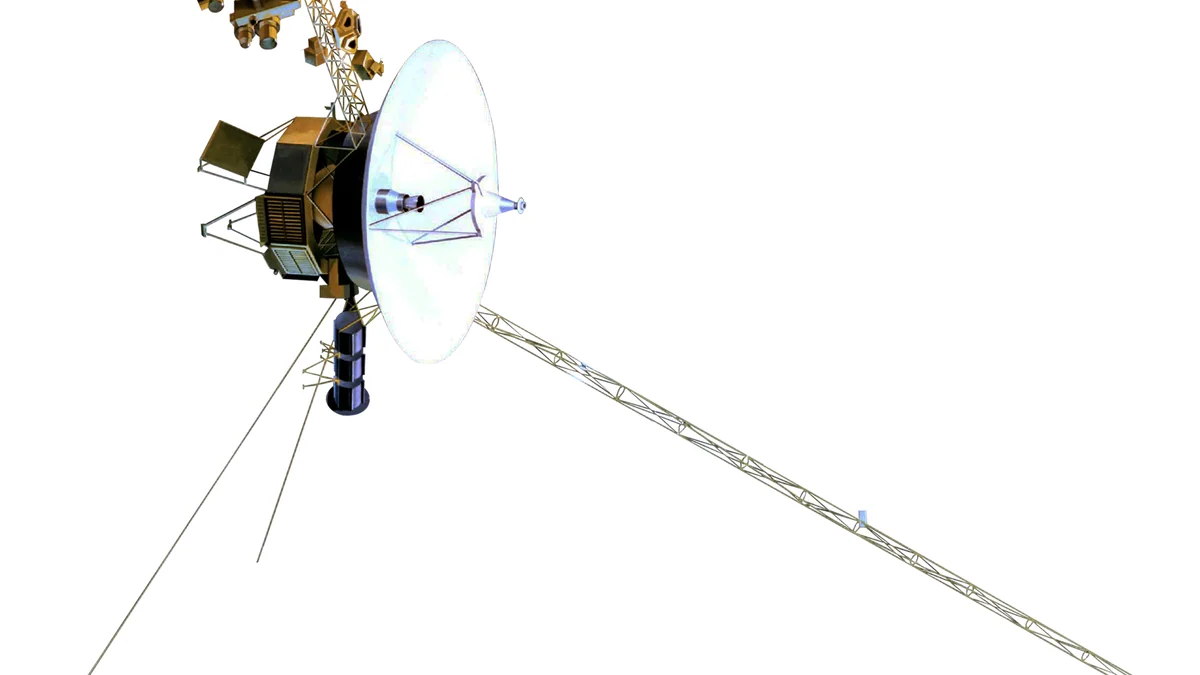
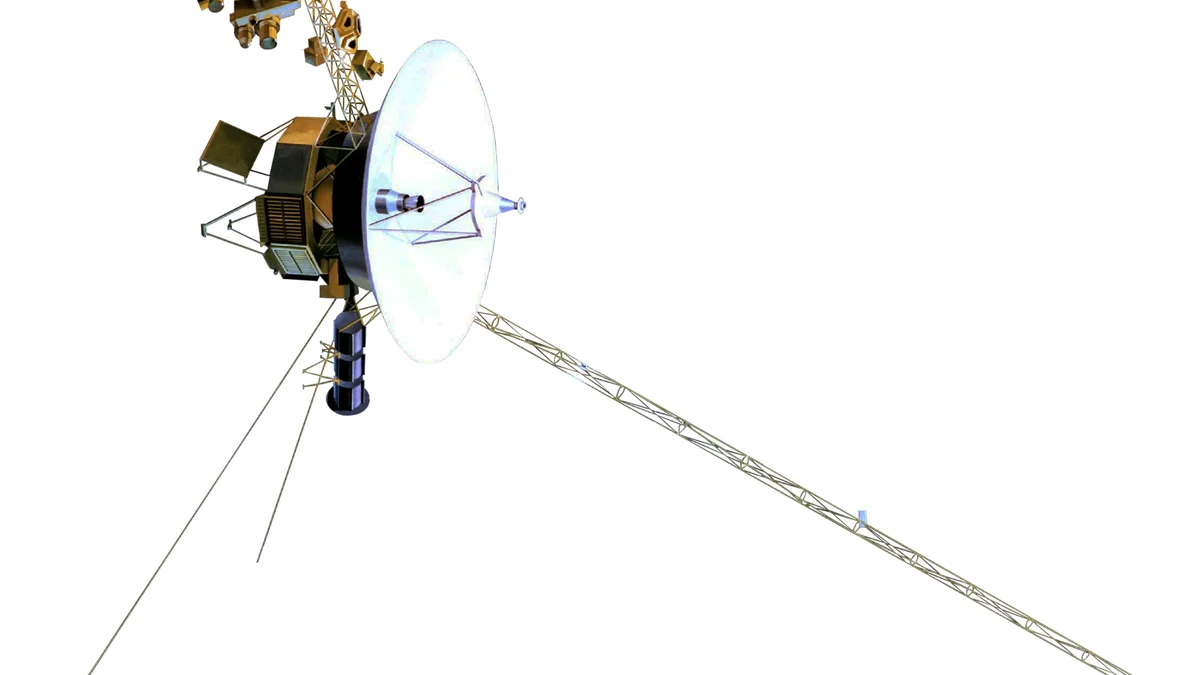
Here is the strange part. The spacecraft covering that distance is not some sleek modern probe. It is a 722-kilogram machine assembled in the 1970s, launched on September 5, 1977, and originally designed for a five-year tour of Jupiter and Saturn. It is now, without any close competition, the most distant human-made object ever built. No other thing we have ever launched, thrown, or aimed outward has gone as far. The number on the clock read 10:16:07, and a new kind of distance entered the story of human exploration.
No other thing we have ever launched, thrown, or aimed outward has gone as far.
A Five-Year Mission, Forty-Nine Years Ago
Voyager 1 launched on September 5, 1977, with a tightly bounded job: swing past Jupiter, swing past Saturn, collect data, done. The planned mission life was five years. Engineers would have considered that a full success.
It has now been 49 years, 2 months, and 13 days.
That longevity is not an accident of luck - it is Cold War engineering built with margins that nobody expected to actually need. The spacecraft is traveling at roughly 61,000 kilometers per hour, which sounds abstract until you translate it. That is fast enough to cross the entire continental United States in about three minutes. Fast enough that if you aimed it at the Moon, it would arrive in roughly six and a half hours. And it has been running at that speed, uninterrupted, for nearly half a century.
What makes the present position genuinely different from every earlier milestone is not the distance alone but the medium through which Voyager 1 moves. In 2012, the spacecraft crossed the heliopause - the boundary where the Sun's outward-flowing solar wind finally runs out of pressure against the interstellar medium and stops. Voyager 1 did not just get far from home. It left the Sun's physical domain entirely. It now moves through the interstellar medium, the thin, cold, ancient gas and dust that fills the space between stars - a regime no human-made object had ever sampled before.
The original five-year mission planners had no particular reason to design for this. The probe was aimed at planets, not the spaces between civilizations. That it survived to reach interstellar space is, by any honest accounting, a magnificent accident of ambition.
Twenty-Four Hours Across a Light-Day
Send a radio signal to Voyager 1 today and it will arrive tomorrow. Not metaphorically, not approximately - exactly one full rotation of the Earth from the moment you transmit. The speed of light is the fastest thing physics allows, and even light needs a full day to cover the distance now separating us from the probe. A simple command-and-response cycle - the kind your laptop completes in milliseconds - now takes 48 hours to complete.
The instrument threading this conversation across 25.9 billion kilometers is NASA's Deep Space Network: a trio of giant dish antenna complexes stationed in California, Spain, and Australia, spaced around the globe so that as Earth rotates, at least one dish always faces the right patch of sky. They are listening for a signal weaker than a watch battery's output, arriving from a 1970s transmitter that has been running for 49 years without a service call.
In October 2026, that thread went quiet. Engineers at JPL worked to restore contact after a brief communication outage, and they succeeded. The details of exactly what caused the interruption remain unclear, which is worth sitting with for a moment. At 25 billion kilometers, a "brief" silence is not a glitch you notice in real time. By the time you know something is wrong, hours have already passed. By the time a fix arrives, a full day is gone. Distance does not just make communication slow - it makes the whole conversation feel like exchanging letters across a very cold ocean, with no guarantee the ship makes it through.
Running on Borrowed Watts
There is a small pellet of plutonium-238 at the heart of Voyager 1, and it has been quietly doing the same thing for forty-nine years: falling apart. That is not a malfunction. It is the plan. As plutonium-238 decays, it releases heat, and that heat runs through a thermoelectric generator, nudging electrons into motion. The result is electricity, steady and self-contained, requiring no sunlight and no refueling stop.
Every year, Voyager's three RTGs produce roughly four fewer watts than the year before. Four watts sounds trivial - it is about the draw of a single LED desk lamp - but when you are running a spacecraft on a total budget measured in tens of watts, four watts is a surgery, not a rounding error. Engineers at JPL have spent decades performing that surgery with remarkable calm: heaters switched off one by one, non-essential systems quietly retired, instruments shut down when their power cost could no longer be justified.
The result of all that triage is a spacecraft stripped to its essentials. By late 2026, only two scientific instruments remain operational, still tasting the interstellar medium, still sending data home on a signal barely stronger than a refrigerator light. The engineers who made those shutdown decisions are, in many cases, not the engineers who built the systems they were switching off. That detail matters. This is a relay race, and the current team carries forward something the original builders could not have fully imagined: a machine still alive, still listening, running on borrowed watts and borrowed time.
A Light Left On for Voyager
On the evening of November 17, the night before Voyager 1 crossed its threshold, people around the world stepped outside and pointed lights skyward. The "Shine Bright for Voyager's Light-Day" campaign was not science. It was something older than science: the human need to mark a moment, to say we were here when this happened. No photon from a backyard flashlight was ever going to reach interstellar space. The gesture was entirely for us.
Two days later, on November 19, JPL's von Kármán Auditorium hosted a commemorative public discussion - the kind of gathering where engineers and enthusiasts sit together and try to put words to something almost wordless. Voyager mission manager Kareem Badaruddin reached for the image of a relay race: a 49-year handoff between teams, each one carrying forward what the last could not finish, none of them ever holding the baton alone. It is a better frame than "mission." Missions end. Relay races ask the question of who comes next.
The answer, for now, is Voyager 2. Its twin is on a slightly different trajectory and moving somewhat slower. By November 2035, it will reach the same 25.9-billion-kilometer mark that Voyager 1 just crossed. That is nine years away - time enough for another generation of engineers to inherit the console. Where Voyager 1 is the pioneer, Voyager 2 arrives as confirmation: humanity did not send one message into the dark. It sent two.
The Long Silence That Hasn't Happened Yet
Nobody can tell you the exact date Voyager 1 will transmit its last signal. That is not an admission of failure; it is an honest accounting. The RTGs lose roughly four watts of output per year, and the two remaining instruments draw from an ever-shrinking reserve. Engineers can model the curve, but the precise moment the threshold drops below what any science instrument needs sits beyond calculation. The Deep Space Network's own ability to pull meaning from a 20-watt whisper across 26 billion kilometers faces its own creeping limits, and no one has published a confident deadline for that either.
What we do know is this: when the last transmission finally goes quiet, the spacecraft does not stop. It keeps moving at 61,000 kilometers per hour, indifferent to the silence. Voyager 1 will drift through the interstellar medium for billions of years, carrying a golden record addressed to no one in particular and everyone at once.
On November 18, 2026, at 10:16 UTC, a machine humanity built crossed one light-day from Earth. Forty-nine years of engineering, mathematics, and stubborn human attention stretched across a distance that makes our entire solar neighborhood look like a lamp left on in a very dark room. That is as far as human reach has ever gone. And somewhere beyond the reach of every antenna we have ever pointed at the sky, the distance keeps growing.