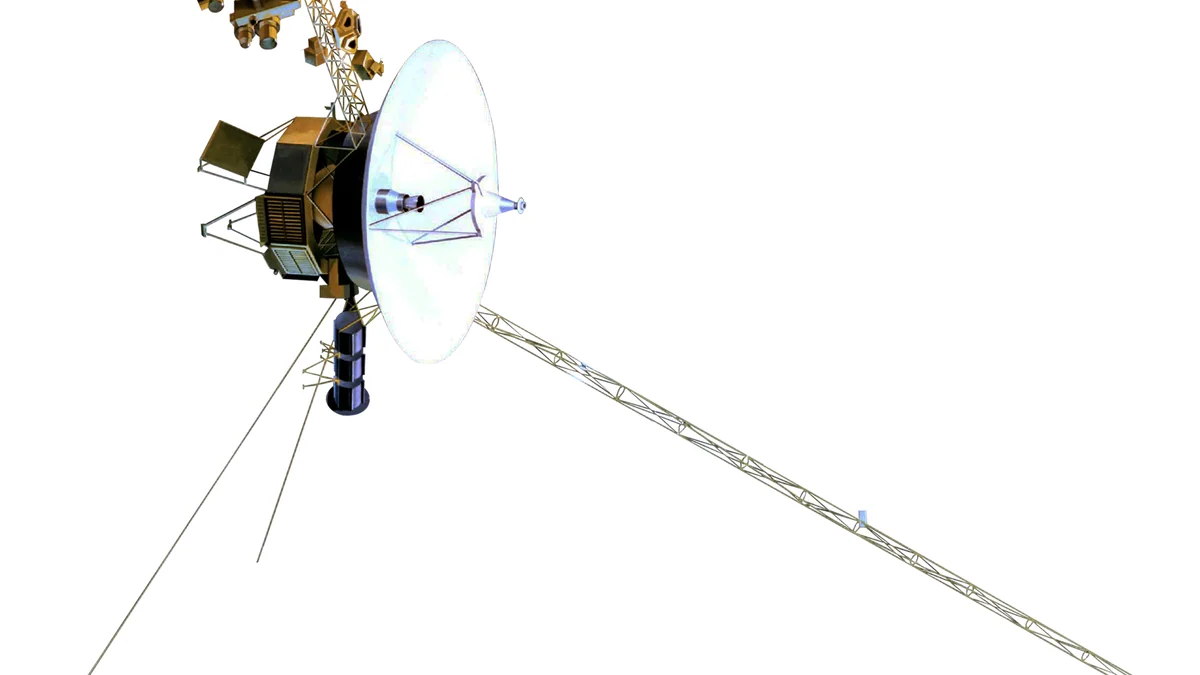
Twenty-Four Hours to Say Hello
At 5:16:07 a.m. EST on November 18, 2026, Voyager 1 reaches the one-light-day milestone — the point where a radio signal leaving Earth takes exactly one full day to arrive. Not approximately. Not roughly. One day, to the second.
Sit with that for a moment, because the precision is almost the strangest part. We can pinpoint the milestone to a single second, yet the number behind it, 16,094,799,096 miles, is so large it refuses to lodge in the brain. The timestamp feels knowable. The distance does not. That gap between what we can measure and what we can feel is exactly where this story lives.
Here is what the milestone actually means in practice. A command sent from mission control today will not arrive until tomorrow. The reply will not return until the day after. Every conversation between Earth and Voyager 1 now stretches across a 48-hour round-trip, longer than most weekends.
The light-day is not a physical boundary, like a fence or a shoreline. There is no marker in space where things look different on either side. The milestone is defined entirely by time-of-travel, which makes it stranger, not less significant. We chose to measure distance in time because time is what the delay punishes you with.
What Voyager 1 crossed into is not a new region. It is a new kind of relationship — the relationship between a machine and the people who built it, stretched now to the point where real-time control is simply gone.
The Number That Stops Making Sense — So Let's Try It Another Way
16,094,799,096 miles. Read that number and something happens: it passes through the brain without leaving a mark. Sixteen billion miles is simply too large to land anywhere useful. It needs translation.
Start with something smaller. One astronomical unit — AU for short — is the average distance from Earth to the Sun, about 93 million miles. That is already a drive no highway will ever host, but it is at least a number with a shape to it. Now stack 173 of those. One light-day, the distance Voyager 1 crosses on November 18, equals 173.14 AU. The Sun, already unimaginably far, would need to be placed 173 times farther away to mark where the spacecraft sits. That image is uncomfortable in exactly the right way.
Here is another ladder rung. A commercial jet cruises at roughly 575 miles per hour. Fly one, nonstop, toward Voyager 1 at that speed, and you arrive in approximately two million years. The dinosaurs that watched a mass extinction would have needed to board that flight sixty-five mass extinctions ago. The number has stopped being a number; it has become time.
Now hold that thought, and add a companion. Voyager 2 — launched sixteen days before its twin in 1977 but sent on a slower, curving route to visit Uranus and Neptune — will not reach this same one-light-day threshold until November 2035. Nine years behind. That gap is itself a measure of the scale involved: two spacecraft, both traveling faster than any bullet ever fired, both running since before the first home computers existed, and the frontier between them is nine years of flight. The edge of our reach moves slowly. It moves, but it is slow.
Forty-Nine Years at Full Speed
Voyager 1 left Earth on September 5, 1977, the same year audiences first watched a farm boy blow up a space station. Its actual mission was considerably less dramatic: fly past Jupiter, then Saturn, photograph them both, and report back. It did exactly that, finishing its primary work by 1980. Nobody told it to stop.
What happened next was a gift from physics. Each planetary flyby was engineered as a gravity assist, using a planet's gravitational field like a sling. The craft swings in, borrows a slice of the planet's orbital momentum, and swings out faster than it arrived. No fuel burned. The speed is simply kept, permanently. Jupiter gave, then Saturn gave again, and Voyager 1 found itself on a trajectory aimed out of the solar system entirely, at roughly 37,800 miles per hour relative to the Sun. That is fast enough to cross the continental United States in about four minutes. It is nowhere near fast enough to reach the nearest star in any timeframe a human would recognize as a lifetime.
Records fell quietly along the way. In February 1998, Voyager 1 passed Pioneer 10, the previous most distant human-made object, and has held that title for 28 years without any competition in sight. Then came August 2012, the genuinely strange moment: the probe crossed the heliopause — the boundary where the Sun's outward-streaming solar wind finally gives out against the pressure of interstellar gas — becoming the first spacecraft ever to enter interstellar space. Voyager 1 was not built for interstellar space. It went there anyway, still transmitting, still listening for instructions that now take a full day just to arrive.
Running on Empty, Still Running
Somewhere in JPL's mission control, a small box on a monitoring screen shows a number creeping downward: the available wattage from Voyager 1's power supply. The spacecraft runs on three radioisotope thermoelectric generators — RTGs — which work on a principle almost beautifully simple. Plutonium decays, releasing heat. That heat flows across a temperature gradient and becomes electricity. No sunlight required, no moving parts, just the patient arithmetic of radioactive physics doing its work 16 billion miles from the nearest socket.
The engineers who installed those RTGs in 1977 built wisely. But physics is physics, and the generators lose roughly 4 watts of output every year. That does not sound like much until you understand what it means in practice: every few years, something aboard Voyager 1 must be permanently switched off. The science instruments are mostly already gone. What remains operational are two: the Magnetometer, which measures the magnetic field threading through interstellar space, and the Plasma Wave Subsystem, which listens for the electric hum of charged particles. Everything else is dark.
In September 2026, engineers at JPL executed what they called, with quiet drama, the "Big Bang" maneuver. Three onboard devices were switched from their original systems to lower-power alternatives, buying the mission a little more time. It was a one-way door. Each new data point Voyager 1 sends home now carries a hidden price: another small piece of the spacecraft, extinguished forever to pay for it. The probe is not dying slowly. It is spending itself, deliberately, on the science it was always meant to do.
The probe is not dying slowly. It is spending itself, deliberately, on the science it was always meant to do.
The Interstellar Probe That Has to Think for Itself
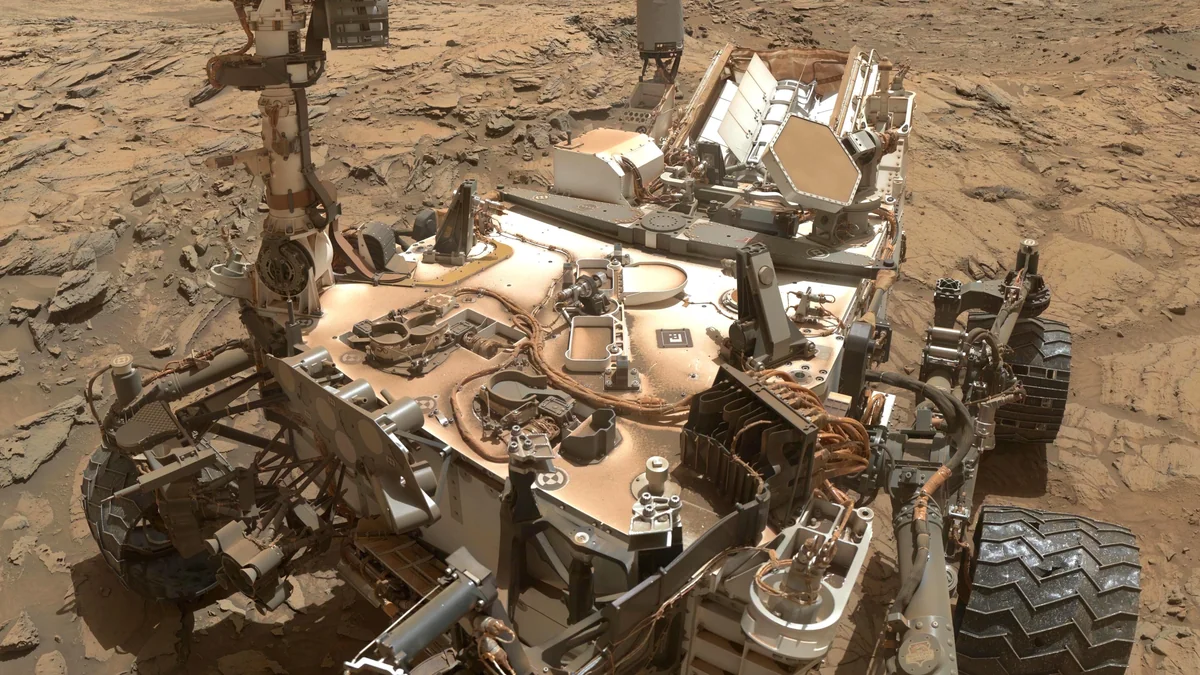
Compare Voyager to any other machine we have ever sent into the void and one difference stands apart: everything else we fly, we fly in something close to real time. A Mars rover is twelve to twenty minutes away by radio on a bad day. A rough drive, a stuck wheel, a software hiccup, and engineers at JPL can respond within the hour. Voyager 1 is now a full 24 hours away, one direction. Send a command today; it arrives tomorrow. If it replies immediately, you read that reply the day after. No human reflex, however practiced, operates across two calendar days.
That is not a design philosophy. It is a physics fact, and it means the spacecraft must behave less like a probe and more like a patient, careful surgeon who happens to be alone in the room. If a system misbehaves, Voyager diagnoses it, decides, and acts — all before anyone on Earth even knows something happened.
October 2026 made that vivid. For 48 hours, Voyager 1 went silent. The Deep Space Network, whose 70-meter antennas are sensitive enough to hear a 20-watt transmitter — the power of a refrigerator bulb — whispering across 16 billion miles, heard nothing. Then the signal returned. No command had been sent to fix it. The cause remains, officially, unknown.
That silence is a small landmark in its own right. Somewhere between launch and now, Voyager crossed a threshold we never formally declared: from a spacecraft humans operate to a machine that simply continues, on its own terms, into territory where we cannot follow in real time.
A Golden Record and a Flicker of Light
The evening before Voyager reached one light-day, NASA asked something remarkable: go outside, find the constellation Ophiuchus, and flash a light toward it. Three letters, Morse code: dot-dash-dash, dash-dash-dot, dot-dash-dot. V-G-R. Tens of thousands of people apparently did exactly that, blinking pocket torches and phone screens at a point in the sky where a 722-kilogram machine was coasting silently through interstellar dark, 16 billion miles out.
Their light, of course, never arrived. It dissipated within seconds, absorbed by atmosphere and distance. But the act was not really about communication. It was about acknowledgment.
Onboard Voyager is the Golden Record, a 12-inch gold-plated copper disk that carries sounds, images, and greetings from 55 languages. Among its encoded content is the Latin phrase "Ad astra per aspera" — to the stars through hardship — written in Morse code. Carl Sagan's committee designed it for a hypothetical alien finder. After 49 years, it has quietly become something else: a letter from the humans of 1977 to whatever intelligence, human or otherwise, eventually holds it.
Whether the record has survived intact is genuinely unknown. Five decades of cosmic ray bombardment is not a gentle archive condition, and we have no way to check. The spacecraft itself may not reach its 50th anniversary in September 2027, with engineers uncertain how long the RTGs can sustain even a single instrument.
So here is where the data runs out, and the question begins. At one light-day from Earth — 16 billion miles and still moving — Voyager 1 carries a golden disk encoded with the sound of rain and a child laughing and a pulsar's heartbeat. We do not know if it still plays. We do not know if anything will ever listen. We just know we threw it, as far and as hard as we possibly could.