Russia's 155 billionaires held a combined $695.5 billion in late 2026, more than before the invasion. Life after Putin has quietly become a private calculation at the highest levels of Russian business — second passports, cryptocurrency reserves, and Dubai property are the instruments of a parallel financial existence.
From 'Boss' to 'Grandpa': What a Single Word Tells the Analyst
Courts have vocabularies. When the vocabulary shifts, the analyst pays attention — not to the gossip, but to the structure it reveals. In the late Soviet years, the word nachalnik carried genuine weight; it named not just a superior but the source of all material fate.
That the word now circulating privately among Russia's business elite is Ded — Grandpa, and rarely affectionately — is not a footnote. It is a seismic reading.
Alexandra Prokopenko, former Central Bank official and now exiled analyst, identified the shift. Her framing is precise: the fear governing elite behavior remains, in her words, "of an entirely Stalinist kind."
Yet Stalinist fear, fully intact, does not produce contemptuous nicknames. It produces only silence and performance.
The fact that Ded circulates at all — even in whispers, even with a phone placed face-down under a thigh to defeat the microphone — tells the analyst that something in the load-bearing structure has begun to move.
The physical counter-surveillance detail is worth holding for a moment. Sitting on a mobile phone is not a casual habit. It is practiced tradecraft, borrowed from an older era of paranoia, re-adopted by men with private jets and nine-figure balance sheets.
That the richest people in Russia feel compelled to physically muffle their conversations about their own president tells you more about the internal atmosphere than any public statement. The public register of a court is always theater. The private register — the word chosen when the phones are silenced — is the evidence.
The Mathematics of Loyalty: Rubles, Confiscations, and the February Lesson
The arithmetic is not subtle. Russian corporations paid 471 billion rubles in "voluntary" donations to the state war budget in 2026. The quotation marks around "voluntary" are doing considerable work.
No ballot was held, no board voted freely, and no refusal was recorded in any public filing — because refusal is not a category the system recognizes.
Suleiman Kerimov's case makes the individual exposure precise. One hundred billion rubles extracted from a single fortune. The figure is not a tax in any legal sense; it carries no schedule, no published rate, no right of appeal.
It is a demonstration, addressed less to Kerimov than to the 154 billionaires watching the ledger update.
Asset confiscations against Dmitry Kamenshchik and Konstantin Strukov in 2026 completed the lesson. Kamenshchik controlled Domodedovo, one of Russia's principal air gateways. Strukov ran a mining empire.
Neither man was accused of disloyalty in any formal proceeding — the Kremlin rarely bothers with the decorative molding of due process when it wants the load-bearing asset.
The foundational precedent was set earlier, and more cleanly. In February 2022, thirty-six of Russia's most powerful business figures were summoned to the Kremlin. None dissented publicly.
Bill Browder described what had happened to those self-confident men: they became, in his account, completely submissive, almost desperate schoolboys. That is not a character observation. It is a structural description of what happens when accumulated wealth confers no protection, only exposure.
The fortune, it turns out, is the hostage — not the shield.
155 Billionaires, $695 Billion, and the Paradox of Wartime Wealth
Forbes counted 155 Russian billionaires in late 2026. Their combined net worth reached $695.5 billion — exceeding the pre-invasion 2021 figure of $663 billion. The number requires a moment of held attention, because it is not what a sanctions regime is supposed to produce.
The explanation is mechanical, not mysterious. War-adjusted commodity prices lifted the revenue lines of energy and fertilizer exporters. Ruble depreciation, which looks like a loss in dollar terms on a balance sheet, actually inflated the ruble-denominated asset valuations that underpin Forbes rankings.
Sanctions that cut access to Western capital markets simultaneously eliminated Western competition from the domestic market. The system rewarded proximity to the state, which is precisely what the state intended.
The paradox sharpens when you look at the distribution. Dmitry Nekrasov, a former adviser with a clear view of the structure, is direct: "They are rich because they have some relationship with Putin, not the other way round." That dependency is not incidental.
It is the load-bearing wall.
Those holding government contracts sit at the top of the wealth table and, by the same logic, face the highest succession risk — their fortunes are not portable across a regime change, because the contracts that generated them were political instruments, not commercial ones.
Eight individuals were removed from the Forbes list in 2026 specifically because of citizenship changes. That is a small number. It is also a signal about which way the remaining 155 are reading the balance sheet.
Plan B in Practice: Passports, Crypto, and the Road to Dubai
The exit moves are not new. They are simply no longer hidden.
Arkadi Volozh, the founder of Yandex, renounced his Russian citizenship after the invasion. Oleg Tinkov, the entrepreneur who called the war criminal in public, did the same. By late 2026, eight individuals had been quietly removed from the Forbes billionaire list specifically because of citizenship changes — not losses in business, not sanctions, but the deliberate act of becoming someone else's national.
The capital moved faster than the passports. Outflows ran into the tens of billions, routed through channels that leave the thinnest paper trail: cryptocurrency, gold, and residential property in the United Arab Emirates. The architecture is not accidental.
These three instruments share one structural quality — they sit outside the SWIFT network, outside Western regulatory sight, and largely outside the Kremlin's reach. Somewhere a spreadsheet was quietly updated, and the column heading was not denominated in rubles.
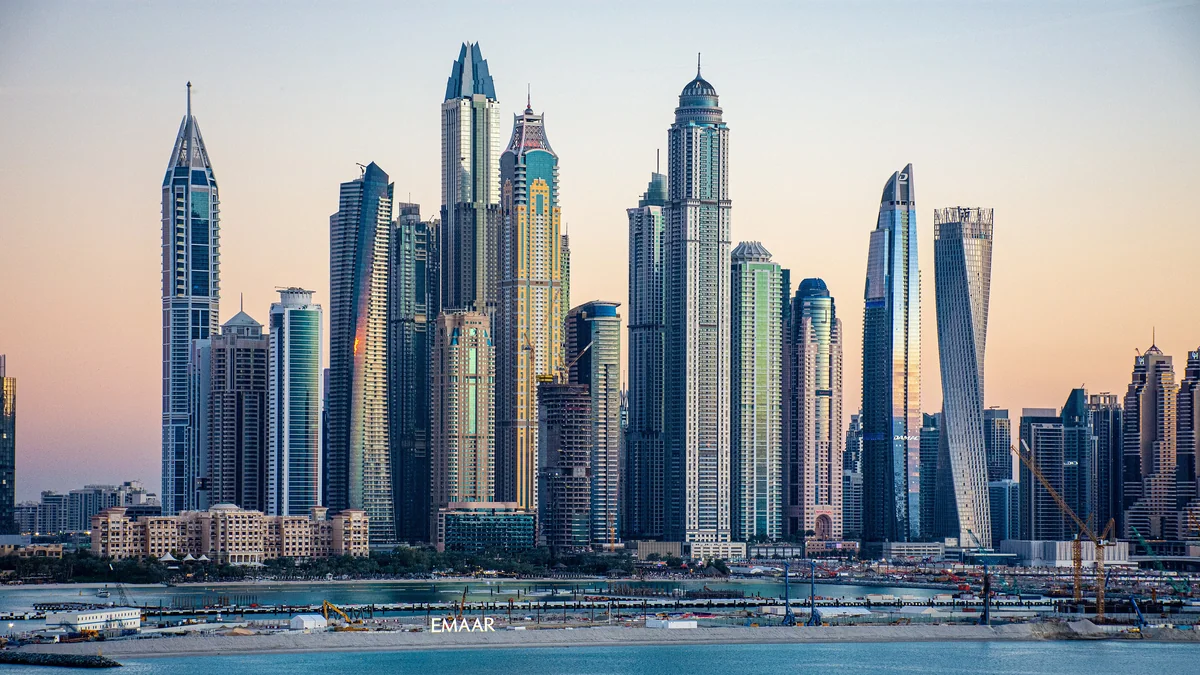
Dubai is not chosen for its climate. The UAE does not sanction Russia, its legal framework for property ownership is opaque by design, and a flight from Moscow lands there in four hours.
It offers the specific combination a Russian billionaire with a second passport requires: distance from the Kremlin, distance from Brussels, and proximity to both if the weather changes. The destination is structural, not sentimental.
What the elite are constructing, asset by asset, jurisdiction by jurisdiction, is a parallel financial existence — one that survives a regime, in either direction. Whether the new passport becomes a shield or merely a suitcase handle will depend entirely on who controls Moscow the morning after.
The fortune, it turns out, is the hostage — not the shield.
After the Tsar: Three Scenarios for Post-Putin Russia
Andrey Melnichenko is the eighth-richest Russian. When a man at that altitude speaks on the record to The Economist and says Russia must end one-man rule and reopen to the world, the significance is not the opinion — opinions are cheap. The significance is the calculation that saying it out loud now costs less than staying silent.
The analysts and the BBC's sourcing converge on three post-Putin scenarios: a weak authoritarian successor who inherits the architecture but not the authority; an oligarchic power-sharing arrangement modeled loosely on the 1990s, before Khodorkovsky taught everyone what happens when business imagines it owns the state; or regime collapse, the scenario that frightens the oligarchs most, because collapsed regimes do not honor existing property titles.
Each scenario carries a radically different price for the 155 billionaires.
The weak successor is manageable — familiar even. Power-sharing is what they want. Collapse is what they fear.
Aleksei Dyumin is the name that circulates most often as the "second-generation" transition candidate. A former bodyguard to Putin, then a regional governor, he is a silovik by formation — which is precisely the signal old-money oligarchs should read carefully.
Security-apparatus men do not arrive at power sharing as a first instinct. Whether Dyumin would honor existing property rights or use a transition to redraw the ownership map is the question the back-channel conversations are quietly circling.
Some elites are already building relationships with specific ministers and security-agency figures — not a conspiracy, but an insurance policy placed in several pockets at once.
China is running its own calculation in parallel. Beijing's preferred outcome — a stable, dependent, manageable Russia — diverges sharply from the oligarchs' preferred outcome, which is a Russia open enough to let them back into Western capital markets. Watch which foreign leader Dyumin's first phone call reaches, if the moment ever comes.
The Borderland Question: What a Russian Transition Means Beyond Russia
The question that matters least inside the Garden Ring is the one that matters most everywhere adjacent to it: who is not in the room when Moscow's internal settlement is negotiated. The 1990s answer was instructive.
When the Soviet state dissolved and Russia's first oligarchic order took shape through privatization, the former Soviet republics did not gain sovereignty by default. They gained exposure. The business-led governance of that decade delivered neither rule of law inside Russia nor anything resembling respect for borders outside it.
Mikhail Khodorkovsky's arrest in 2003 established one durable rule: wealth without political immunity is just a larger target. The oligarchs who survived learned subordination, not liberalism.
There is no reason to expect that 155 billionaires who collectively held $695.5 billion in 2026 by tolerating asset confiscation and war levies have developed, in the interim, a commitment to Estonian sovereignty or Georgian territorial integrity.
An oligarchic restoration is not a liberal restoration. The 1990s model is the proof of that, not the template.
China is already running its own contingency analysis on what comes next. Estonia and its neighbors are not.
Watch one appointment: whether Aleksei Dyumin acquires a formal coordinating role in the security apparatus before any visible succession signal. If he does, the borderland states will know precisely what kind of order is being assembled, and they will know it before Washington does. Life after Putin — whatever form it takes — will be announced not in public speeches but in security appointments and the quiet redrawing of an ownership map that was never publicly filed.