September 2024: When Nepal's Floods Broke the Record
Nepal's 2024 floods did not arrive as an escalation of the known monsoon rhythm — they arrived as a verdict on it. The 1970 event — still cited by the Department of Hydrology and Meteorology as the previous benchmark for severity — at least had the decency to announce itself within the understood range of catastrophe. What arrived between September 26 and 28, 2024 did not.
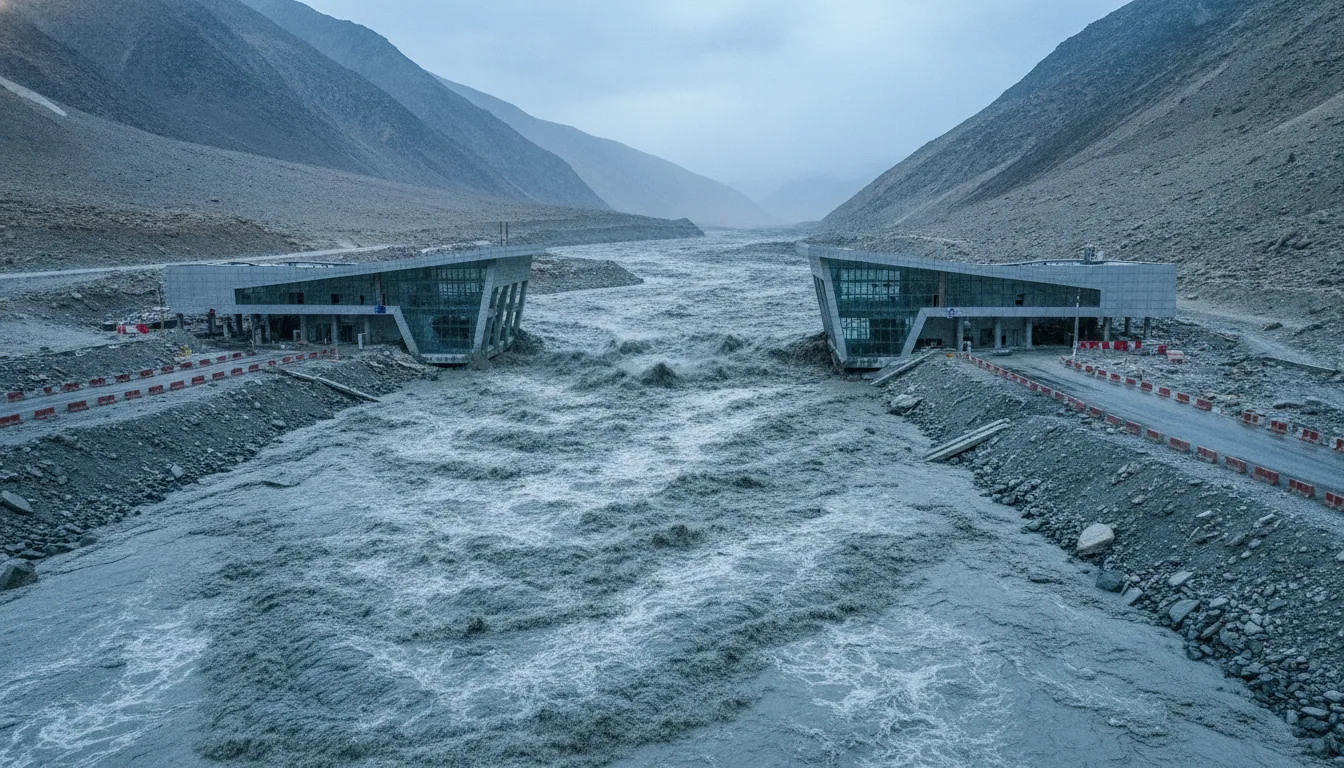
In a single 24-hour period, Kathmandu recorded 323.5 mm of rainfall — a figure that exceeds half a century of precedent. A late-monsoon low-pressure system over the Bay of Bengal drove the deluge, and the Bagmati and its tributaries responded accordingly, breaching banks that urban planners had spent decades pretending were adequate containment.
The National Disaster Risk Reduction and Management Authority confirmed at least 244 deaths and 19 people still missing by October. Seventy-one municipalities across 20 districts were formally declared crisis zones — not a rhetorical designation but an administrative one, triggering emergency powers and resource reallocation.
Over 30,000 security personnel were deployed to reach approximately 17,000 people trapped by floodwater and severed roads. Somewhere a spreadsheet was quietly updated.
The scale resists the usual softening. Nepal has survived severe Himalayan flooding before, and each time the language of "unprecedented" gets attached, then shelved when the next event comes. This time the hydrometeorological record is specific: worst since 1970, by a measurable margin.
The comparison to 1970 holds only up to a point — that earlier disaster predated the valley's current population density and the infrastructure built directly onto floodplains. The physical magnitude may be similar. The exposure was not.
What the Attribution Science Says — and Where It Stops
The World Weather Attribution consortium ran its rapid analysis after the September rains subsided. Their finding is precise and carries weight: human-induced climate change made this rainfall event 70% more likely to occur and 10% more intense than it would have been in a pre-industrial climate.
That is not a rhetorical flourish. It is a quantified shift in probability distributions, derived from ensemble modelling against the observed 323.5 mm that fell on Kathmandu in a single day.
The science establishes cause. It does not assign the bill.
Agricultural damage exceeded 45 million USD, concentrated in rice crops that were not insured, grown by households without reserves. The number is not large by the standards of donor-country disaster accounting. By the standards of a subsistence farm in a flood-zone district, it is a season gone, possibly a household gone.
The distinction rarely survives the summary paragraph of an aid appeal.
Then there is the recovery figure that circulated in early reporting: 4,700 billion dollars. Read that again. Nepal's entire GDP in 2024 was roughly 43 billion dollars.
A recovery bill one hundred times larger than the national economy would be a different kind of story entirely, and it is not that story. The figure almost certainly represents a Nepali rupee total that passed through a conversion step without the division. NDRRMA has not confirmed any dollar figure near that scale.
In a crisis, a misplaced decimal travels faster than the correction — and the correction rarely catches the headline.
What the attribution science gives policymakers is a mechanism, not a mandate. The gap between those two things is where negotiation lives, and where small nations historically lose.
The Hydropower Wager and Its Price
Eleven hydropower plants were damaged in the September floods. The number is precise, the consequence measurable: 625 MW of generating capacity knocked offline — enough to darken a significant portion of the grid that Nepal had spent a decade building as its primary export commodity.
India and Bangladesh were the intended buyers. The infrastructure lay in the river valleys for the same reason the floodwater came: geography is not negotiable.
Nepal's economic strategy is not complicated to state. The country has almost no oil, limited arable flat land, and a diaspora remittance base that covers a substantial share of GDP. Hydropower was the one structural bet — the load-bearing wall, not the moulding.
The floods struck it directly. When the BBC summarised the damage, the observation required no elaboration: Nepal had wagered nearly everything on water, and water collected the debt first.
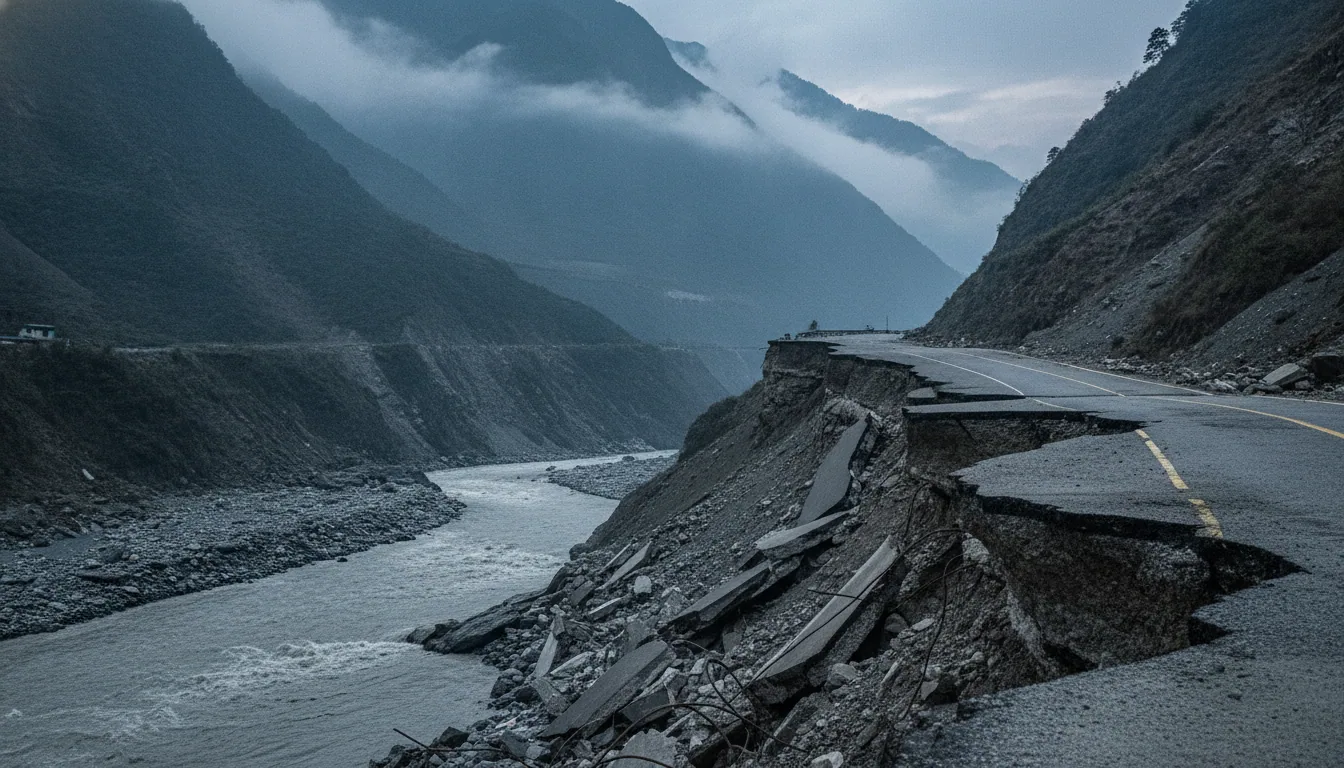
The BP Highway tells a parallel story in concrete and mud. A 26-km stretch between Bhakundebesi and Nepalthok failed in total — not damaged in sections, not requiring repair at points, but gone continuously across that entire run, severing the mountain supply lines that connect Kathmandu's hinterland to the capital. The Ministry of Physical Infrastructure and Transport oversees that road. Its restoration timeline remains, as of this writing, unconfirmed.
The solution is being consumed by the problem it was built to solve.
The green-energy paradox is not subtle once stated plainly. The infrastructure Nepal constructed to help decarbonise the region — to provide renewable power to its larger neighbours and reduce the subcontinent's coal dependency — was destroyed by the intensified rainfall that climate scientists attribute, at 70% increased likelihood, to the carbon already in the atmosphere. The solution is being consumed by the problem it was built to solve. There is no irony here, only a mechanism.
The Border, the Floodplain, and the Urban Error
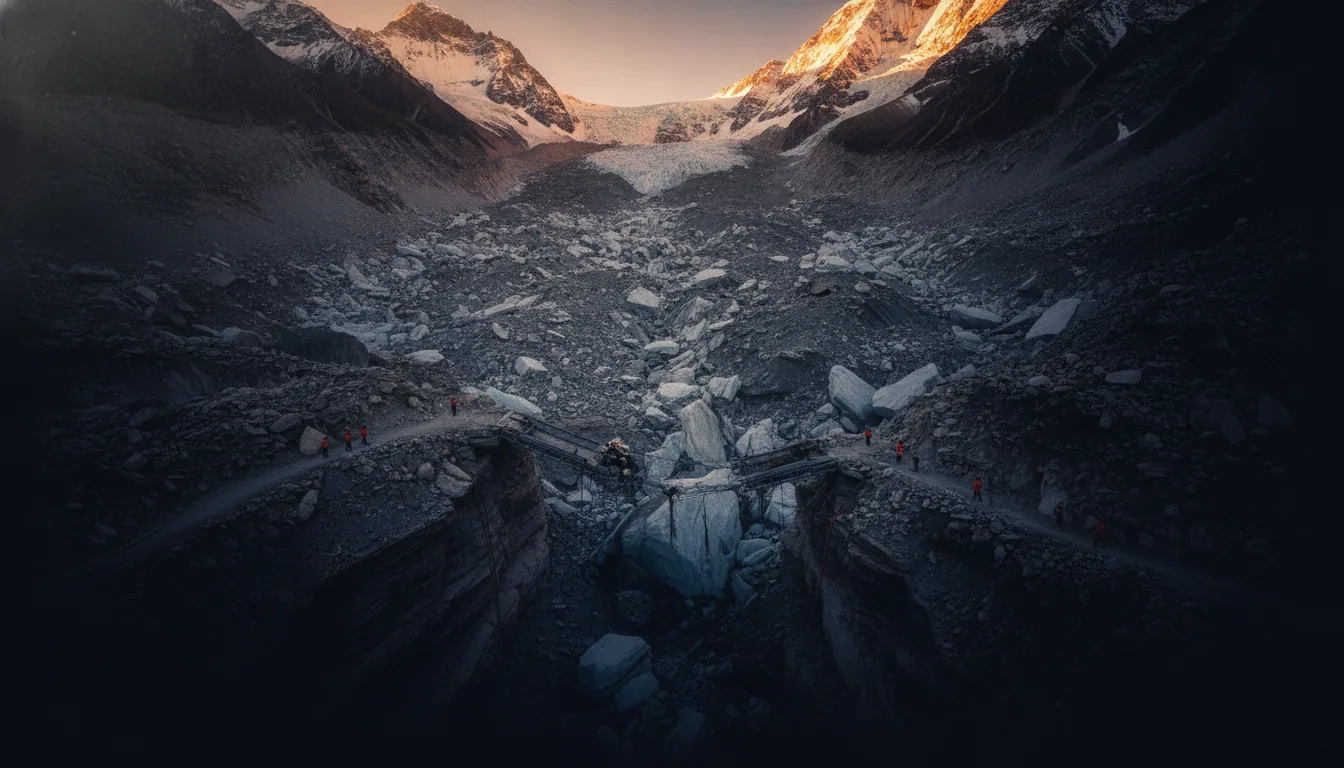
The floods did not wait for the rain to stop. On the China-Nepal border, an ice-rock avalanche broke loose from the high terrain and drove water downslope with a force the meteorological record alone cannot explain.
The cryosphere here is not backdrop. It is an agent, increasingly unmoored from the seasonal calendar that Himalayan communities have read for generations.
The Tatopani crossing, which threads through that border terrain, became a hard administrative fact in the days after: 114 Nepali citizens were stranded in Tibet, cut off by debris and broken roads, and had to be repatriated through that single passage. A border crossing designed for trade in ordinary times bore the weight of an emergency it was never configured to handle. The degree to which permafrost melt on the Chinese side contributed to the initial avalanche remains unresolved — that is not a hedge, it is a gap in the record that matters.
Kathmandu itself delivered a different kind of testimony. The International Centre for Integrated Mountain Development found that unplanned urban expansion onto the Bagmati and other river floodplains directly amplified the damage. This is ICIMOD's finding, not conjecture, and the distinction carries weight.
The city grew toward the water because the land was flat and cheap and no planning authority held the line.
The pattern is structural. Standard urban planning assumptions — drainage coefficients, flood-return intervals, buildable setbacks — were calibrated for lowland cities with lower precipitation and flatter gradient. Imported wholesale into a high-altitude, high-rainfall basin, they do not fail at the margins — they fail completely.
What was built on the floodplain went under. The floodplain remembered what the permit office had forgotten.
Kathmandu at the Podium — and the Labour Exodus That Will Not Wait
Nepal brought the September floods to the United Nations General Assembly not as a humanitarian appeal but as a prosecutorial argument. A small Himalayan state, responsible for a negligible fraction of global emissions, named the mechanism plainly: the wealthy emitters have externalised the cost, and Nepal is absorbing it in dead hectares of rice and broken turbine halls. The $49.6 million UN emergency aid appeal followed as the formal invoice.
The comparison the Nepali delegation did not make, but the record invites, is with the Pacific island states who have occupied this position for two decades. The rhetoric is the same; the funding record is not encouraging.
What shifts Nepal's position slightly is the hydropower argument — the donors who talk green energy need Nepal's rivers, which gives Kathmandu a lever the Maldives never held. Whether that lever is pulled is a different question.
The 1% GDP loss does not distribute evenly. The hydropower investor carries it differently from the subsistence rice farmer whose crop the Bagmati river took in September. The investor has a recovery curve; the farmer has a labour broker's phone number.
Economic insecurity following Nepal's flooding has historically accelerated labour migration, and Khabarhub's reporting on departures to Malaysia and the Gulf after September 2024 follows a pattern the country knows by heart. When institutions fail to absorb a shock, people absorb it themselves, by leaving.
The marker to watch is the UN emergency appeal, and the word to watch is whether the donor communiqués say shall or should. Full funding before the 2025 monsoon season would mean something. Partial pledges dressed in the language of commitment would mean something else, and the farmers displaced by Nepal's floods who have already bought their flight to Kuala Lumpur will not wait around to read the fine print.