The Number, and What It Actually Means
Last year, Brazil's Amazon deforestation fell to a record low of 3,335 square kilometers cleared. That sounds like a lot. Set it against the Amazon's total area of roughly 7 million square kilometers and you are looking at 0.05 percent — less than one twentieth of one percent of the whole.
More importantly, 3,335 is the lowest figure recorded since INPE, Brazil's National Institute for Space Research, began tracking deforestation by satellite in 1988. That baseline matters: 1988 is when the numbers became reliable, which means this is the best result in the entire modern record.
The drop from the previous cycle is 41.8 percent — the steepest single-cycle decline ever logged. One monitoring period earlier, the 2023-2024 figure stood at 6,288 square kilometers. Before that, during the Bolsonaro years from 2019 to 2022, annual clearing regularly exceeded 10,000 square kilometers. The trajectory is not ambiguous.
The measurement itself is worth understanding before drawing conclusions. INPE runs two satellite systems: PRODES, which delivers the official annual deforestation count used here, and DETER, which fires real-time alerts so enforcement agents can intercept illegal clearing while it is still happening. PRODES counts completed clearings — land where the forest canopy has been removed entirely — over a 12-month cycle running to July. It does not count degraded forest, drought damage, or fire scarring.
That distinction will matter later. What the 3,335 figure tells us, precisely and only, is how much primary forest was completely cleared between August 2025 and July 2026. On that specific, measurable question, the answer is the best humanity has seen since the satellite era began.
The Baseline Behind Amazon Deforestation's Record Low
To understand what 3,335 square kilometers means, you need to know what normal looked like before. During the Bolsonaro administration, from 2019 to 2022, annual deforestation in the Brazilian Amazon regularly exceeded 10,000 square kilometers. That was not an anomaly. It was policy.
The administration change in January 2023 was the structural break in the data series. Lula's government reactivated enforcement agencies, reinstated PPCDAm, and brought Marina Silva back to the environment ministry. The results appeared in the numbers almost immediately. The 2023-2024 monitoring cycle recorded 6,288 square kilometers cleared, a 30.6% fall from the Bolsonaro peak. The 2025-2026 figure of 3,335 square kilometers is a 41.8% drop on top of that.
That is not a lucky year. It is a trajectory. Two consecutive record lows, each built on the last, each tied to deliberate enforcement choices rather than rainfall patterns or commodity price dips.
The comparison that gives the current headline its real weight is not last year versus the year before. It is 2025-2026 versus 2019-2022: roughly 3,300 square kilometers against a baseline of more than 10,000. That is a reduction of more than two-thirds in forest clearing rates across one policy cycle.
The satellite record goes back to 1988. In that entire span, the Amazon has never been cleared this slowly. The baseline is the story. The win is real precisely because the hole it was dug out of was so deep.
The Enforcement Machine: How They Actually Stopped the Chainsaws
The headline number did not happen by accident. Behind the 41.8% drop is a policy architecture called PPCDAm — the Action Plan for Prevention and Control of Deforestation in the Legal Amazon — rebuilt by Environment Minister Marina Silva after years of dismantlement. The plan coordinates satellites, prosecutors, and field agents. It does not ask nicely.
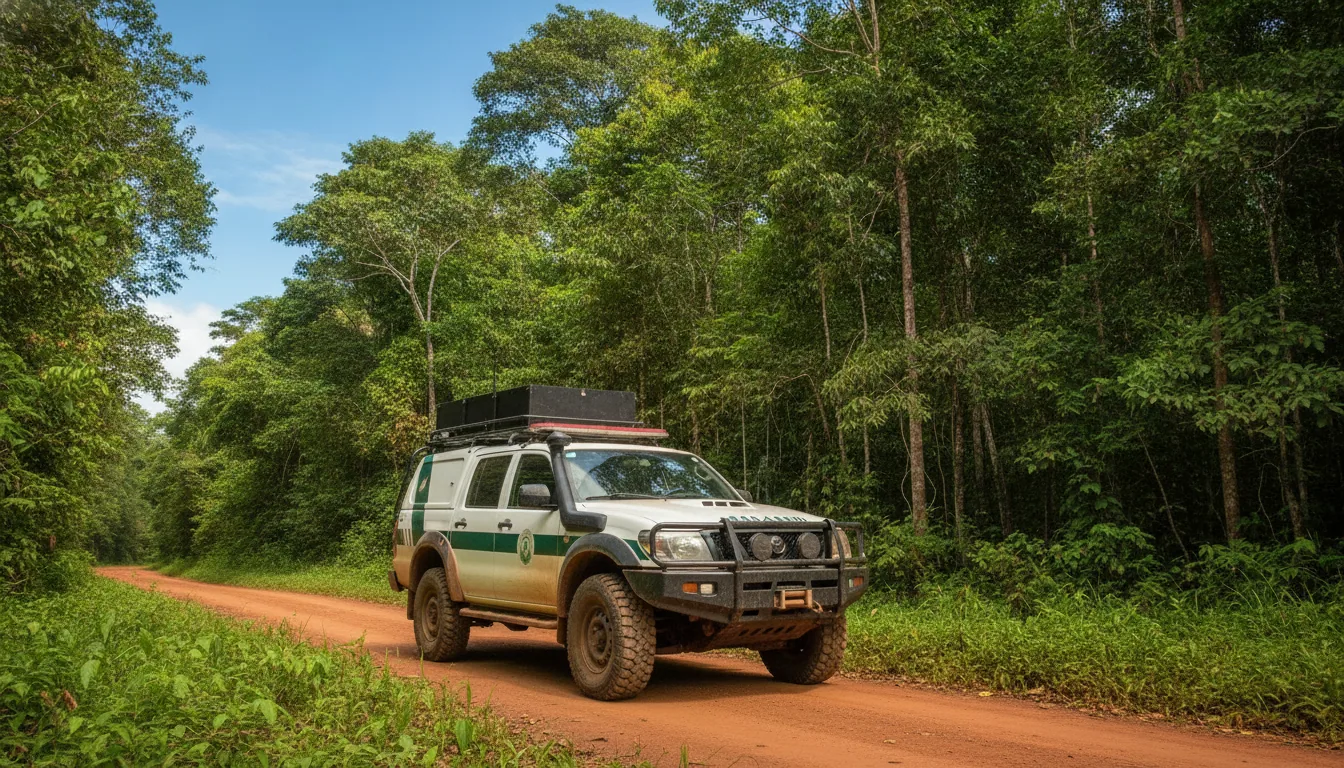
The operational nerve of the system is DETER, INPE's real-time satellite alert platform. When DETER flags a clearing, Ibama agents can be on the ground within days, not the years it used to take under a paper-based regime. Speed matters because illegal loggers move fast. A deforestation alert that takes eighteen months to process is not enforcement. It is a receipt.
The financial pressure runs parallel. Under the current administration, environmental fines in the Amazon region increased by 98%. That is not a signal of intent. That is a lever — a fine with teeth, a consequence that changes the cost calculation for a land grabber.
Remove any one of them and the deforestation numbers from 2019 to 2022 tell you exactly what happens next.
The Amazon Fund, dormant under Bolsonaro, was reactivated with Norway and Germany as its primary backers. Their money finances the on-the-ground operation: the rangers, the monitoring infrastructure, the prosecution capacity that turns a satellite image into a court case. International funding channeled into domestic enforcement is what closes the gap between a government commitment and a forest that is actually still standing.
The honest read is this: the system works when all three components — monitoring, enforcement, and financing — run together. Remove any one of them and the deforestation numbers from 2019 to 2022 tell you exactly what happens next.
The Catch: Fire Is Winning Where the Chainsaw Lost
In the dry season of 2024, smoke columns rose above stretches of Amazonas state where no logger had set foot. The trees were still standing — or had been, until the drought came. Then the understory dried to tinder, a spark caught, and the canopy that no enforcement agent had flagged on DETER simply burned.
This is the part of the story the headline number does not tell.
Forest degradation — damage from drought and wildfire that thins the canopy and dries out the interior without fully clearing it — surged 497% in 2024, according to tracking by Imazon. That figure did not show up in the deforestation totals, because technically the trees were not removed. But a thinned, scorched, fragmented forest stores less carbon and recycles less moisture than an intact one.
The distinction between "deforestation" and "degradation" matters to satellite systems. It matters much less to the carbon cycle.
By 2026, fire counts in Amazonas state had risen 253%. Ibama agents can intercept a chainsaw. They cannot intercept a drought.
This is where the enforcement story hits its ceiling. The tools that worked against land grabbers — satellite alerts, rapid response teams, fines that doubled under the current administration — were built for human actors making rational economic decisions under the threat of consequences.
Climate-driven fire is neither rational nor deterrable. It arrives from a warming atmosphere that Brazilian law has no jurisdiction over.
A degraded forest can sometimes recover, but the timeline is decades, not years. The 2030 zero-deforestation target addresses one threat with considerable success. The other threat is currently winning ground in a different column of the ledger — quieter, slower, and entirely outside the reach of the enforcement machine that earned this year's record.
Beyond Brazil's Border: The Leakage No Headline Mentions
Brazil's 41.8% drop is real. But the Amazon does not stop at the Brazilian border, and the celebration should not either.
In 2024, Bolivia accounted for 27.3% of all Amazon forest loss. That is not a footnote — it is roughly one in four trees cleared across the entire basin, happening in a country with far weaker satellite enforcement networks and considerably less international scrutiny. When agricultural pressure faces a tightened frontier in Brazil, it does not vanish — it migrates. Economists call this policy leakage; forest scientists call it displacement. The result is the same: the chainsaw moves, not the incentive that drives it.
The picture inside Brazil is also more complicated than official figures suggest. Imazon, the independent research institute that runs its own SAD monitoring system, recorded only a 7% reduction in deforestation in 2024. The official PRODES number from INPE was substantially more optimistic. Both groups use satellite data; they measure slightly different things and apply different methodologies.
A 7% fall and a 41.8% fall are not the same story, and a reader who only sees the headline misses the gap.
This is not an argument for pessimism. It is an argument for the right unit of analysis. The Amazon is a single hydrological and ecological system covering roughly 7 million square kilometers.
Moisture recycled in Bolivian cloud forest eventually falls as rain on Brazilian soy fields and vice versa. Protecting one country's share of a shared system is progress. It is not a solution.
The 2030 zero-deforestation target Brazil has set is meaningful. A regional target, agreed by all nine Amazon nations, would be a lever.
The Honest Scorecard: 2030, an Election, and What Comes Next
Brazil's formal pledge is zero deforestation by 2030. From 3,335 square kilometers, that target is closer than it has ever looked — but it requires holding the same enforcement budget, political will, and international funding through at least two more annual cycles. None of those three are guaranteed.
The record-low announcement lands as a key election approaches. That timing is not a reason to dismiss the numbers; INPE's satellite data is independent of campaign calendars. It is, however, a reason to separate the policy achievement from the political framing and ask which institutions survive a change in government.
The honest scorecard: the chainsaw is retreating, the climate-driven fire is not, and Bolivia's 27.3% share of regional loss shows the problem does not respect a border. Brazil's record-low Amazon deforestation rate is the strongest result in the satellite era — and the lever worth pulling now is sustained Amazon Fund financing, because Norway and Germany's continued investment is what keeps Ibama in the field when the next administration takes office.