Three White Vans and Twelve Bombers
The price of the RAF Fairford sabotage plot was £300. That is the verifiable ledger line at the centre of this story: three white vans, drums of petrol, and a Gloucestershire airfield that hosts some of the heaviest strategic bombers the United States Air Force flies. The asymmetry is not incidental. It is the thesis.
In the early hours of September 27, 2026, those vans moved through the lanes around Whelford village toward RAF Fairford. By the time bomb disposal teams had been called, some 85 households had been evacuated from the surrounding area. The figure is worth holding: 85 families turned out of their homes in the Cotswold dark, for £300 of fuel in borrowed vans.
The disposal teams found no explosive devices. What they found was petrol — chemical accelerant, nothing more sophisticated. One suspect, it has since emerged, rang 999 during the incident and told the operator that a handler had said a bomb was inside the vehicle. Whether that call was conscience or calculation remains, for now, an open question.
The United States Air Force did not wait for the lawyers to finish. Twelve B-1 bombers were withdrawn from RAF Fairford following the security threat. The B-1 is not a defensive aircraft. Its withdrawal is an institutional statement about the seriousness of the assessed risk, issued in the language that air forces use when words feel insufficient. Somewhere a spreadsheet was quietly updated, and twelve of the most capable heavy bombers in the Western inventory moved off the board. The vans contained £300 of petrol. The response involved twelve strategic aircraft. That gap is where the real story begins.
Cover Story: Pool Supplies, Petrol Drums, and a Video Call
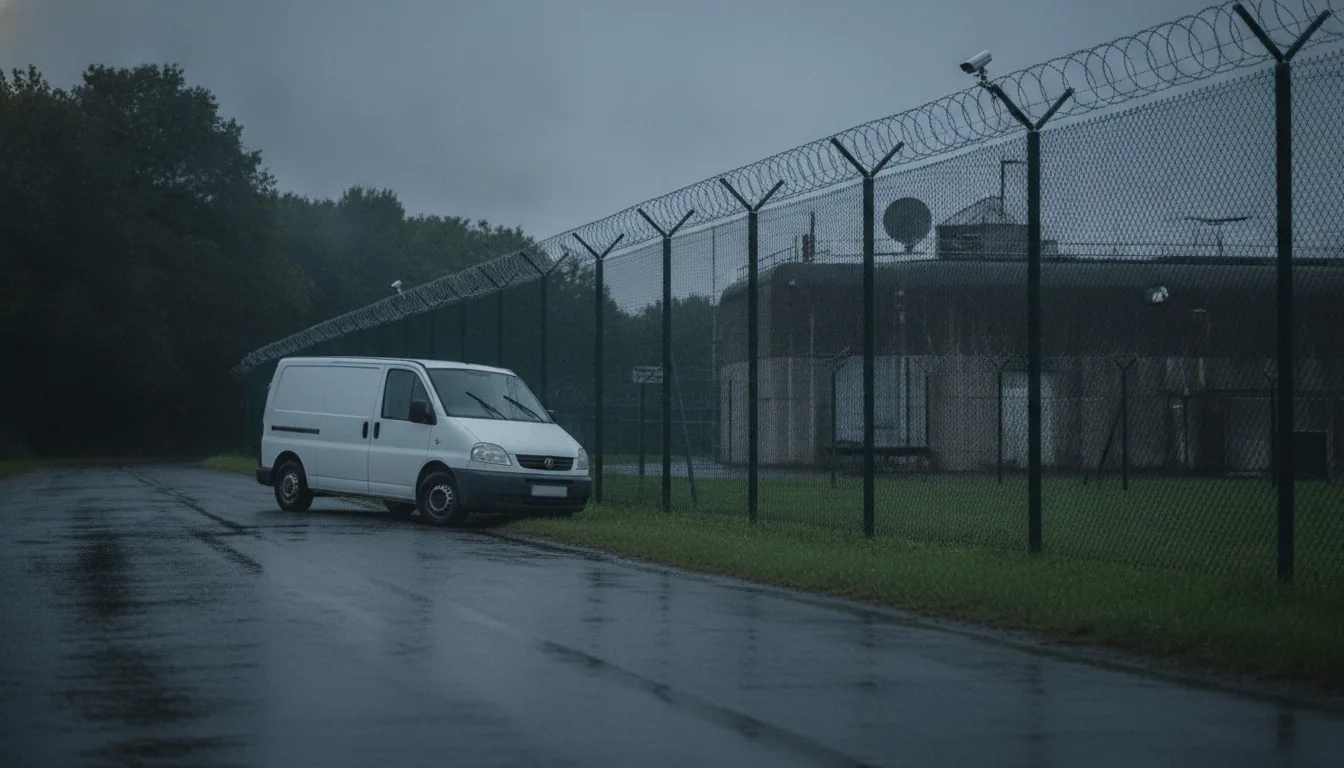
The cover story was professional enough. Custom business decals applied to the vans, transforming them into the kind of unremarkable commercial vehicles — fuel delivery, pool supply — that move through any English county road without a second glance. The operational logic is old: the best disguise is boredom.
Six weeks before the vans rolled, Nouman Essghir was at RAF Fairford with a phone. On August 22 he filmed the base perimeter during a live video call with a handler — reconnaissance conducted in real time, the footage transmitted as it was gathered. That detail matters for what it implies about the network's confidence: a 24-year-old with a camera on a public road, the handler watching from somewhere else, the base sitting there in the frame.
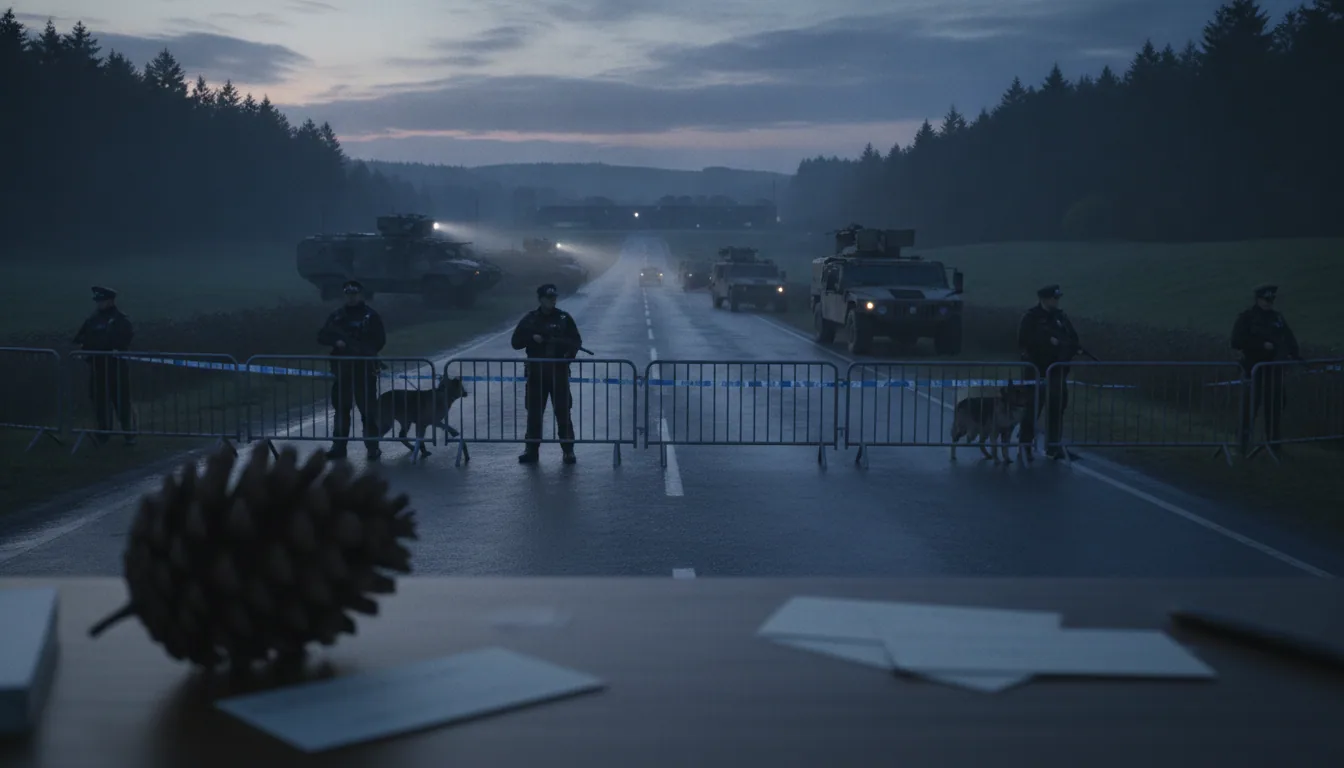
The vans moved on the night of September 26. Two of the three encountered security checkpoints and could not proceed on their intended route. The third made it far enough to trigger the evacuation of 85 households in Whelford before bomb disposal teams confirmed what the police already suspected: petrol drums, no detonator, no explosive device.
Then one of the suspects called 999. His account, as recorded, was that a handler had told him there was a bomb inside the vehicle. Whether that call was a crisis of conscience or a calculated move to end an operation already failing is not established by the public record. What it did was hand investigators a live suspect describing the chain of command in real time. The plot's operational design was competent up to the point it encountered the first checkpoint. After that, the architecture collapsed faster than the cover story it was built on.
Command at a Distance: Al-Saadi and the Prison Telephone
Mohammad Baqer Saad Dawood Al-Saadi was sitting in a New York federal detention facility when the September plot was taking shape in Gloucestershire. He is an Iraqi national. He is also, according to the US Department of Justice indictment, the man who ran it.
The mechanism was the prison telephone. Al-Saadi allegedly passed coded instructions through family members, who relayed money and messages to the co-conspirators preparing the vans. One recorded exchange, cited in the indictment, has him directing a relative to "give him money so we can do it." His sister, in a separate call, reportedly confirmed that "the work isn't cancelled." A prison telephone is not supposed to be an operational command line. The question the indictment forces is structural: what, precisely, does a high-security facility secure?
The scale of the question is not incidental. Prosecutors allege Al-Saadi's involvement in approximately 20 prior attacks across Europe and Canada — a record suggesting that the Fairford plot was not an improvisation but a continuation. The transoceanic geometry here is specific: a handler network inside Iran, a director inside a US jail, recruiters moving through the UK. Each node sits in a different jurisdiction, which is partly the point. Coordination across borders fragments legal accountability the same way it fragments operational exposure.
What the phone calls establish, if the indictment holds, is not merely that one man ran a plot from custody. It is that the plot's architecture was designed to route around every obvious chokepoint — borders, identities, surveillance — except, it turns out, the one that records every call.
The vans contained £300 of petrol. The response involved twelve strategic aircraft. That gap is where the real story begins.
Two Jurisdictions, Three Indictments, One New Statute
In November 2026, the U.S. Department of Justice unsealed federal indictments against Al-Saadi, Mohsen Mohajeri, and Mohammad Ali al-Hassani. The charge sheet named a New York jail cell as a command post and prison telephony as the operational channel. Todd Blanche, announcing the indictments, put it plainly: "anyone who plans a terrorist plot on a military base housing American servicemembers will be prosecuted by the United States government."
Across the Atlantic, British prosecutors moved on a separate track, using a newer instrument. Mohmed Ahmad Abdulkarim, 24, was charged under the National Security Act 2023 — the law passed partly in response to exactly this kind of Iranian-directed interference — with assisting a foreign intelligence service. It was the first time many British readers encountered the statute outside a parliamentary debate. The Act had been moulding for three years; Abdulkarim was now load-bearing evidence for it.
Nouman Essghir, also 24 and a dual British-Iranian national, faced a narrower charge: entering a prohibited place for purposes prejudicial to the United Kingdom. The specific act named in the charge was the August 22 reconnaissance, Essghir filming the perimeter of RAF Fairford on a video call with a handler. Both men were scheduled to appear at the Old Bailey on November 20, 2026 — the first public checkpoint at which the British legal architecture would be tested before a court. The indictments on two continents described the same plot, but they were built from different statutory materials, and the gap between them will tell us something about how closely the two governments are sharing more than intelligence.
The Intelligence That Arrived from Jerusalem
Benjamin Netanyahu confirmed publicly that Israeli intelligence reached London before the September 27 incident. The fact of that warning tells a great deal about the surveillance architecture surrounding IRGC-linked networks — and about who, in this geometry, is doing the watching. No country invests the resources required to monitor those networks unless it expects to need the product.
The comparison worth making is not 2024 but 1988, when Western services relied on Israeli signals to intercept Iranian-directed operations in Europe after the Lockerbie era's intelligence blind spots. The architecture then was episodic, shared under duress, and slow. What arrived in London this September was evidently precise enough to matter — which suggests something more continuous.
Andy Burnham chose his words with the care of a man who has read a legal brief. "Strong indications" of Iranian involvement is not an accusation; it is a hedge load-bearing enough to support diplomatic restraint while the courts do their work. Tehran's denial was formulaic. London's phrasing was not accidental.
Here is the small-nation floor question the geometry forces: the plot ran from Tehran through a New York cell to Gloucestershire, and the intelligence that disrupted it ran from Jerusalem to London. The base targeted was American. The suspects charged are Iraqi, Iranian, and British. Britain, in this map, is the borderland — the terrain on which others' contests are being settled, whether London wishes it or not.
What the Old Bailey Hearing Will Reveal About the Fairford Airbase Attack
On November 20, Abdulkarim and Essghir are scheduled to appear at the Old Bailey. Watch what the prosecution leads with. If the charge of assisting a foreign intelligence service under the National Security Act 2023 survives intact, the state has evidence it is prepared to test in open court. If it narrows, or if the foreign-intelligence count is quietly traded for something lesser, the geometry of what can be proved — and what must remain classified — will announce itself in the reduction.
The unresolved architecture is considerable. The handler known only as "Ali" has no public name. Mohsen Mohajeri and Mohammad Ali al-Hassani remain unlocated. The 999 call, in which a suspect claimed a bomb was inside the vehicle, is still uncharacterised: operational abort, genuine panic, or calculated disruption. Al-Saadi is linked by federal prosecutors to roughly twenty alleged attacks across Europe and Canada. Whether the RAF Fairford sabotage plot was an outlier or one node in a documented campaign is the structural question the November indictment opens but does not close.
Read one word in any future extradition request: directed versus facilitated. The first is state sponsorship on the record. The second is deniable asset, and everyone can keep lying, and this will be back on your screen before the year is out.